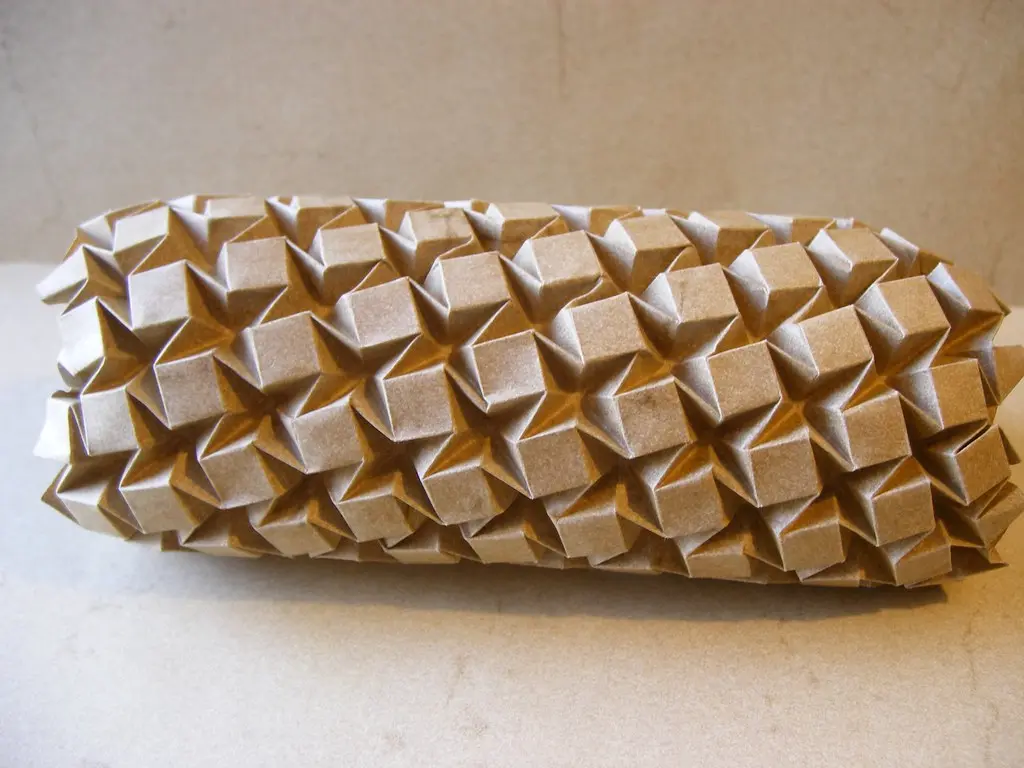
I still remember the first time I tried to explain to a friend why my flat, geometric paper pattern and my locked-together modular star were both technically "origami," and watching her face go completely blank. Tessellation vs modular origami is one of those comparisons that trips up even folders who've been at this a while, since both techniques push past simple single-fold models but head in almost opposite directions once you look closely.
This tutorial is Part of Common Origami Questions & Comparisons, and it covers how these two techniques differ, whether either one needs multiple sheets, which assembly methods modular designs rely on, and how their difficulty levels actually compare.
What Is the Difference Between Tessellation Origami and Modular Origami?
The core difference comes down to structure and sheet count. Tessellation origami folds a single sheet of paper into a repeating geometric pattern, using precise, evenly spaced creases to create shapes like twists, pleats, or interlocking polygons across the whole surface.
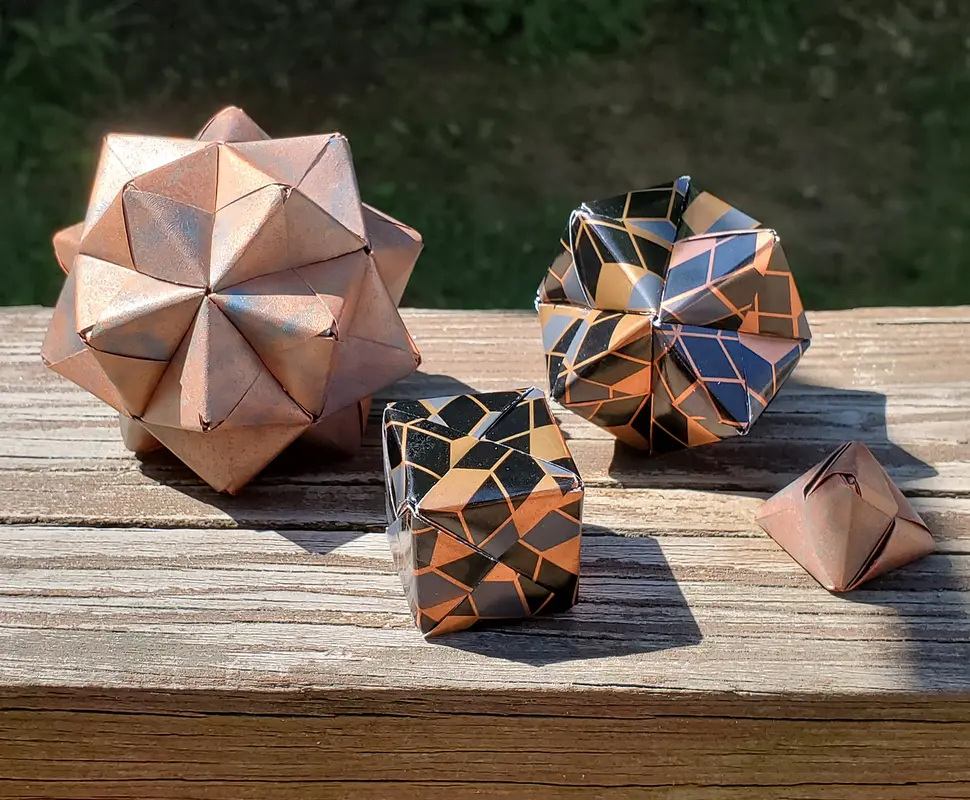
Modular origami takes the opposite approach, folding several identical units from separate sheets, then locking those units together through tucked flaps and pockets to build one larger three-dimensional shape. I've found that this distinction, one sheet versus many, is really the fastest way to tell the two techniques apart at a glance, even before you consider how each one actually looks once finished.
Tessellation compared to modular origami really comes down to whether you're working with pattern and repetition on a flat plane, or with individual pieces combining into a dimensional whole. Both techniques demand precision, but the type of precision required is genuinely different.
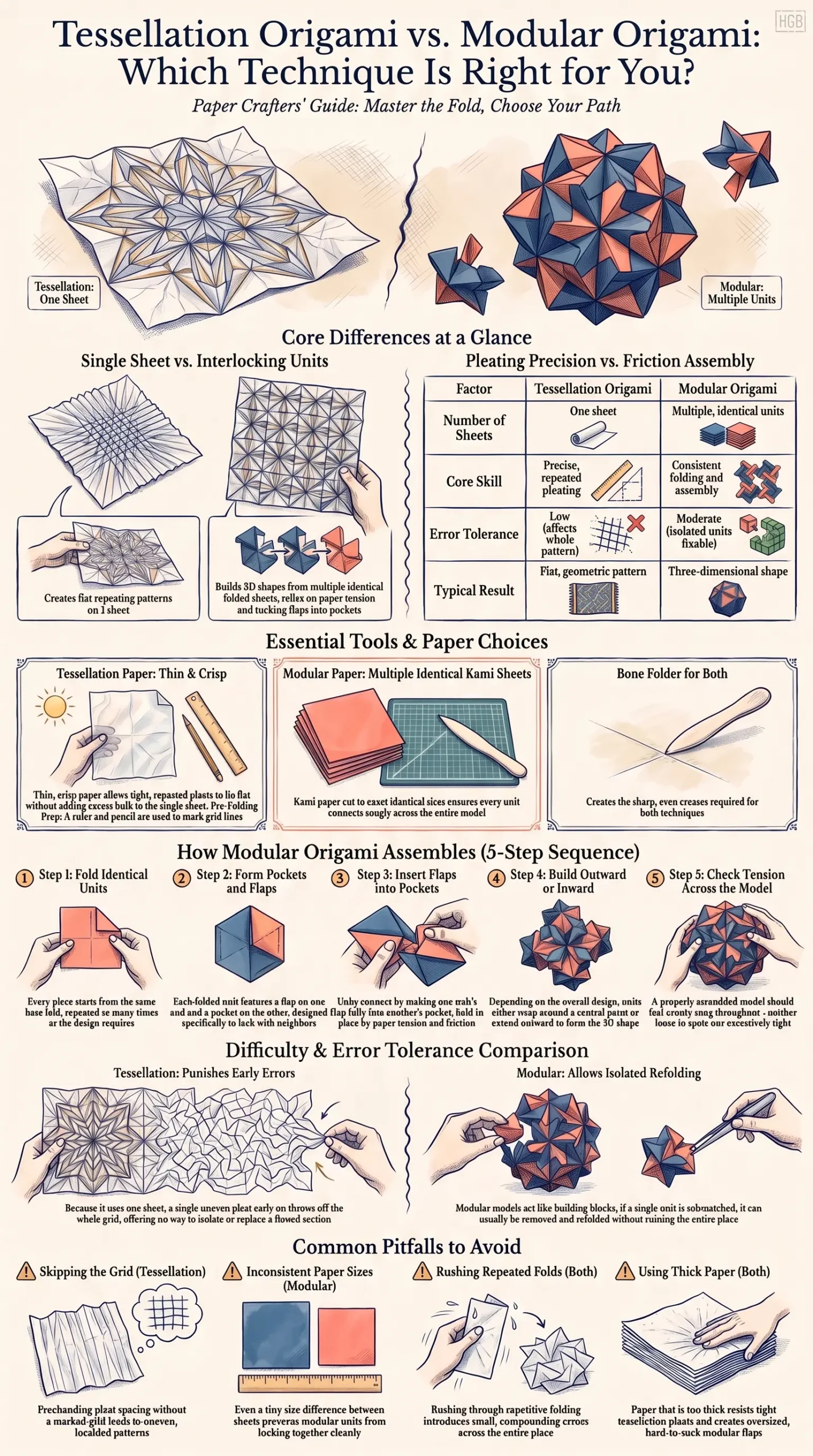
Photo Credit: Hobby Guidebook Editorial
Materials Needed for Both Techniques
A short list of supplies covers what's needed to explore either style, though the paper choice differs slightly between them.
|
Item |
Purpose |
|
Thin, crisp paper (tessellation) |
Allows tight, repeated pleats to lie flat without excess bulk |
|
Kami paper, multiple identical sheets (modular) |
Provides consistent units for assembly across a modular model |
|
Bone folder |
Creates sharp, even creases, especially important for repeated tessellation folds |
|
Ruler and pencil (tessellation) |
Helps mark grid lines for evenly spaced pleats before folding begins |
Does Tessellation Origami Use Multiple Sheets of Paper?
No, tessellation origami is built entirely from a single sheet, which is actually one of its defining features. The repeating pattern you see across a finished tessellation comes from folding that one sheet along a carefully planned grid, not from combining separate pieces.
This single-sheet approach means the entire pattern has to be planned out before the first fold, since there's no room to add or adjust pieces partway through like you might with a modular project. A missed or uneven pleat early in a tessellation tends to throw off the entire grid by the time you reach the far edge of the paper.
If you want to see exactly how this single-sheet planning and folding process works in practice, it's worth exploring further. Tessellation Origami: How It Works walks through the grid-based folding process that makes these repeating patterns possible from just one piece of paper.
Are Tessellations Folded From One Sheet?
Yes, and this bears repeating since it's such a common point of confusion for folders newer to the technique. Every fold, pleat, and twist in a finished tessellation comes from that same original sheet, manipulated entirely through creasing rather than any cutting or piecing together.
This is actually part of what makes tessellations so impressive once finished, since a pattern that might look like dozens of separate pieces locked together is really just one sheet folded with remarkable precision. The complexity comes from the folding sequence itself, not from combining materials.
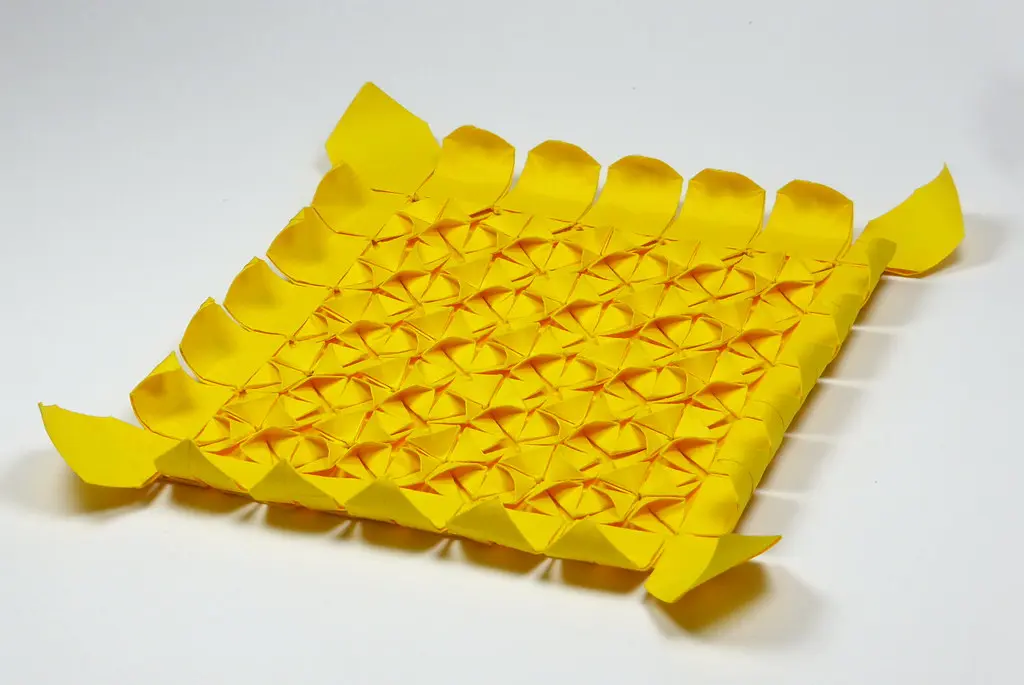
Photo Credit: Internet
Which Techniques Are Used to Assemble Modular Origami?
Modular origami relies on a small set of assembly techniques that repeat across most designs, regardless of how many units a particular model uses.
- Fold identical units. Every piece in a modular model starts from the same base fold, repeated as many times as the design requires.
- Form pockets and flaps. Each unit typically has a flap on one end and a pocket on the other, built specifically to interlock with neighboring units.
- Insert flaps into pockets. Units connect by tucking one unit's flap fully into another's pocket, relying on friction and paper tension to hold the connection.
- Build outward or inward. Depending on the design, units either wrap around a central point or extend outward to form the model's overall shape.
- Check tension across the whole model. A properly assembled modular piece should feel evenly snug throughout, not loose in some spots and tight in others.
If a modular model you're building refuses to come together cleanly, it's worth troubleshooting the specific connection points rather than assuming the whole design is flawed. Why Won't My Modular Origami Units Fit Together? covers the most common causes behind loose or mismatched units, which tends to be the real issue far more often than the pattern itself.
A folder I once corresponded with described modular origami as building with paper instead of blocks, since each unit behaves like a single brick that only makes sense once it's locked against its neighbors. That comparison stuck with me, since it explains why a single poorly folded unit can throw off an entire model in a way that a single bad fold on a tessellation usually can't, since a tessellation has no separate pieces to isolate and fix.
How Does the Difficulty of Tessellations Compare With Modular Models?
Difficulty between these two techniques is honestly hard to rank directly, since each demands a different kind of skill rather than one simply being harder than the other. Tessellations require exceptional precision and planning, since a single sheet has to be folded consistently across dozens of repeated pleats without any room for a piece-by-piece correction.
Modular models demand consistency across multiple units, along with patience through repetitive folding and careful assembly. I'd say tessellations tend to punish small errors more severely, since one uneven pleat affects the whole finished pattern, while modular models are often more forgiving, since a single mismatched unit can usually be isolated and refolded without unraveling the entire piece.
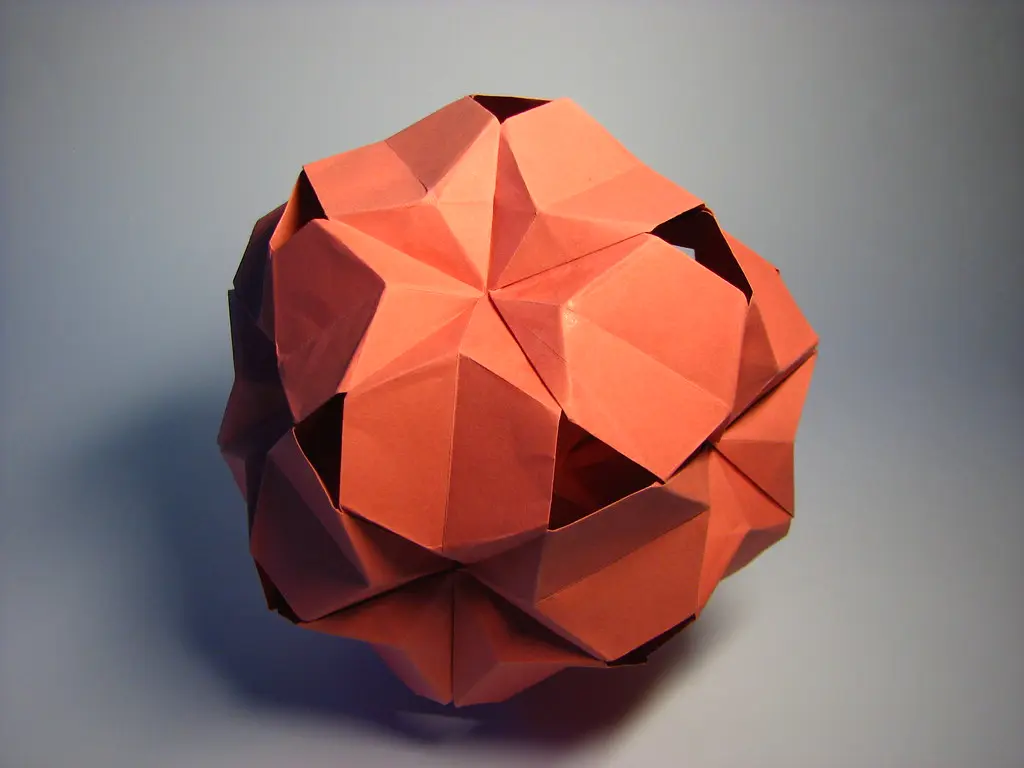
Photo Credit: Internet
Common Mistakes With Both Techniques
A few habits tend to trip up folders exploring either style for the first time.
- Skipping the grid layout on a tessellation. Freehanding pleat spacing without a marked grid almost always leads to an uneven, lopsided pattern.
- Using inconsistent paper across modular units. Even a slight size difference between sheets prevents units from locking together cleanly.
- Rushing repeated folds. Both techniques rely on repetition, and rushing through it tends to introduce small errors that compound across the whole piece.
- Choosing paper that's too thick. Bulky paper resists tight tessellation pleats and creates oversized, hard-to-tuck modular flaps alike.
Comparing Tessellation and Modular Origami
|
Factor |
Tessellation Origami |
Modular Origami |
|
Number of sheets |
One |
Multiple, identical units |
|
Core skill |
Precise, repeated pleating |
Consistent folding and assembly |
|
Error tolerance |
Low, affects whole pattern |
Moderate, isolated units fixable |
|
Typical result |
Flat, geometric pattern |
Three-dimensional shape |
Frequently Asked Questions
What is the difference between tessellation origami and modular origami? Tessellation origami folds one sheet into a repeating flat pattern, while modular origami combines multiple identical folded units into a larger three-dimensional shape.
Does tessellation origami use multiple sheets of paper? No, tessellations are folded entirely from a single sheet, using repeated creases rather than combining separate pieces.
Are tessellations folded from one sheet? Yes, every pleat and twist in a tessellation comes from one original sheet manipulated purely through folding.
Which techniques are used to assemble modular origami? Modular assembly relies on folding identical units, then locking them together by inserting flaps fully into matching pockets on neighboring units.
How does the difficulty of tessellations compare with modular models? Both are challenging in different ways, with tessellations demanding precise, error-sensitive pleating while modular models require consistency across multiple units and assembly patience.
Final Thoughts
Tessellation and modular origami both push beyond basic folding, just in very different directions, one through a single sheet's precise pattern and the other through many units locking into a larger form. Try both once you've got the basics down, and you'll likely find yourself drawn to one style's particular kind of challenge more than the other.
If you're ready to explore the rest of what this hobby has to offer, Read the full origami guide for everything from paper choices to techniques across every skill level.



Leave a Reply