I still remember staring at a tutorial that casually mentioned "score the GSM 250 chipboard with a bone folder," and having absolutely no idea what any of that meant. This paper crafts glossary a-z exists so nobody else has to pause a video and google three words in one sentence just to keep up.
Paper crafting has its own language, and once the terms click, everything from tutorials to product listings makes a lot more sense. This article is Part of Paper Crafts Glossary & Reference, so bookmark it and come back whenever a new term trips you up.
Why a Paper Craft Terms List Actually Helps Beginners
A paper craft dictionary saves you from guessing what a tutorial means, or worse, buying the wrong supply because a term sounded close enough to something else. I've watched beginners buy paper when a project actually called for cardstock, simply because nobody explained the difference clearly.
Knowing the right words also helps when shopping online, since product listings rarely explain themselves. A quick glossary check beats returning a package that wasn't what you expected.
Common Terms: A Through F
These early alphabet terms cover tools and materials you'll run into almost immediately.
- Bone folder: A smooth, flat tool used to press sharp creases into paper, giving cleaner folds than fingernails alone.
- Cardstock: A thick, sturdy paper weight, heavier than regular printer paper, used for cards, layered projects, and anything needing structure.
- Chipboard: A dense, rigid paper based material, thicker than cardstock, often used as a base layer for scrapbook pages or sturdy card fronts.
- Die cut: A shape cut from paper using a metal die and a cutting machine, producing identical, precise shapes every time.
- Embellishment: Any decorative add-on to a project, like buttons, ribbon, stickers, or small paper accents, added for visual interest.
- Fussy cutting: Carefully cutting around a printed image's exact outline, rather than cutting a simple square or rectangle around it.
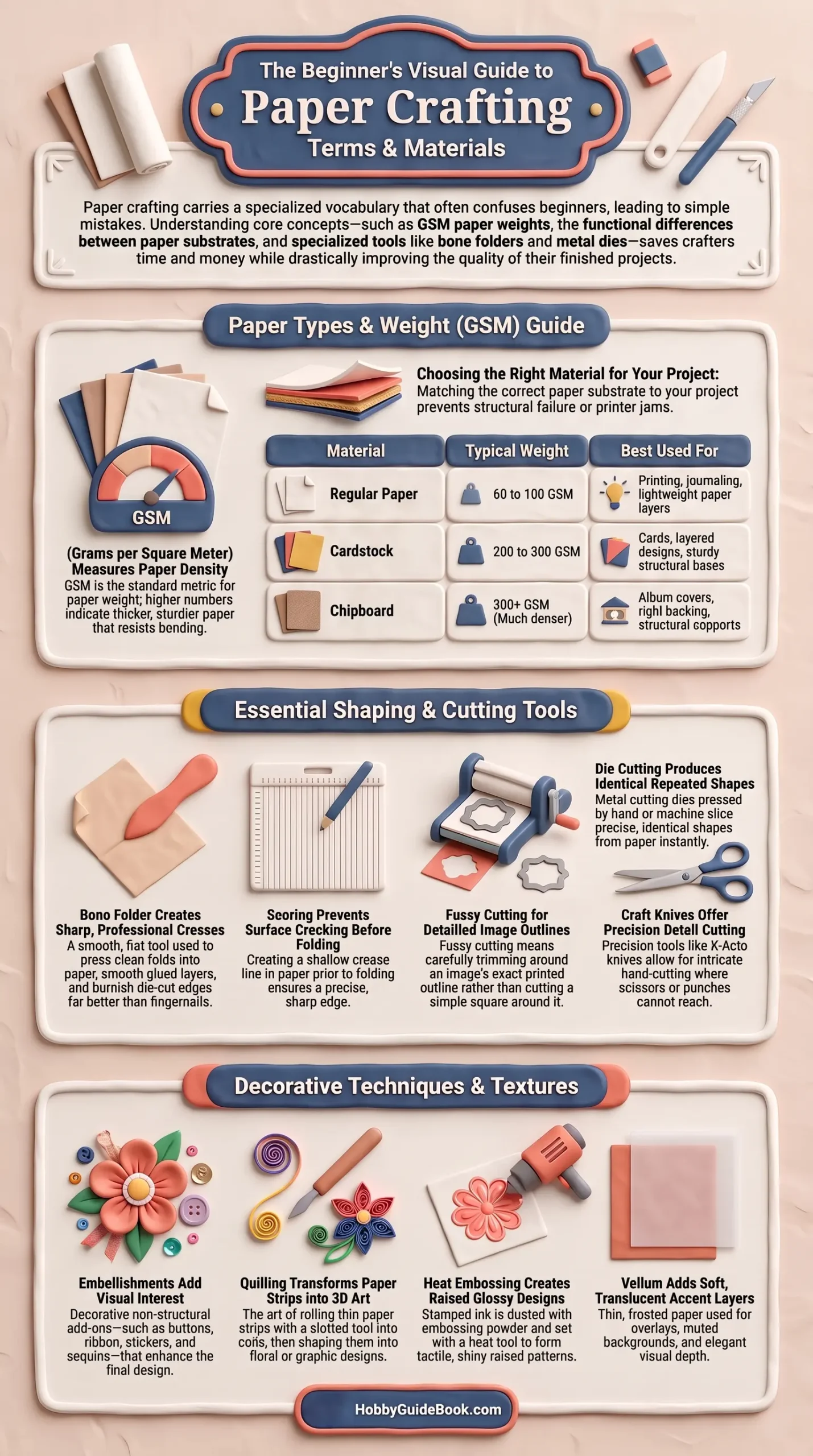
Photo Credit: Hobby Guidebook Editorial
Common Terms: G Through M
The middle stretch of the alphabet covers a mix of tools, materials, and techniques.
- GSM: Grams per square meter, the standard measurement for paper weight, with higher numbers meaning thicker, sturdier paper.
- Heat embossing: A technique using embossing powder and a heat tool to create raised, glossy designs on paper.
- Ink pad: A flat pad loaded with ink, used with rubber stamps to transfer designs onto paper.
- Journaling: Writing notes or memories directly onto a scrapbook page, often alongside photos and embellishments.
- Layering: Stacking multiple paper pieces to add depth and dimension to a card or page design.
- Mat board: A thick, often colored board used as a backing layer, similar in purpose to chipboard but usually smoother.
For a deeper look at how these terms connect to actual techniques, Paper Crafts Terminology expands on many of these with visual examples and side by side comparisons.
Common Terms: N Through S
This range covers scoring, punches, and a few technique specific words worth knowing.
- Negative space: The empty area left behind after cutting a shape out of paper, often used intentionally in paper cutting designs.
- Offset: Slightly shifting one layer of a design from another, rather than stacking pieces perfectly centered.
- Punch: A handheld tool that cuts a specific repeated shape, like a circle, star, or flower, out of paper.
- Quilling: Rolling thin paper strips into coils, then shaping them into decorative designs like flowers or borders.
- Scoring: Creating a shallow crease line in paper before folding, resulting in a sharper, cleaner fold.
- Slotted tool: A small handheld tool with a slot at the tip, used to grip and roll paper strips during quilling.
Photo Credit: Marek Ruczaj
Common Terms: T Through Z
The final stretch rounds out tools and finishing techniques common in more advanced projects.
- Template: A pre-cut or printed guide used to trace or cut consistent shapes repeatedly.
- Underlayer: A hidden layer of paper placed beneath a design, often adding color or support without being fully visible.
- Vellum: A thin, translucent paper, often used for overlays or soft, frosted looking accents.
- Washi tape: A decorative, easily torn paper tape, popular for adding color and pattern without heavy adhesive.
- X-Acto knife: A common brand name craft knife, frequently used as a general term for any sharp precision cutting blade.
- Zig-zag scissors: Decorative edge scissors that cut a wavy or zig-zag pattern, often used for photo trimming or card edges.
Knowing this full range of terms genuinely changes how confident you feel picking up a new project. I still reference lists like this one myself whenever a technique uses a word I haven't touched in a while.
What Does Die Cut Mean
A die cut is any shape cut from paper using a metal cutting die, either by hand pressing or through an electronic cutting machine. Dies come in countless shapes, from simple circles to detailed floral designs, and they produce the exact same shape every single time.
Die cutting saves huge amounts of time compared to hand cutting repeated shapes, especially for cards or scrapbook pages needing several identical pieces.
What Does GSM Mean in Paper Crafting
GSM stands for grams per square meter, and it measures how thick and heavy a sheet of paper is. Regular printer paper sits around 80 GSM, while cardstock typically ranges from 200 to 300 GSM, and chipboard runs even heavier still.
Understanding GSM helps you choose the right weight for a project, since flimsy paper won't hold a fold well, and overly thick paper won't run through most home printers.
Photo Credit: kaboompics
What Is an Embellishment
An embellishment is any small decorative piece added to a project purely for visual appeal, rather than structural purpose. Buttons, ribbon, sequins, stickers, and small die cut shapes all count as embellishments.
A good embellishment supports a design instead of overwhelming it. The best paper crafts usually know when to stop adding, not just when to start.
What Is a Bone Folder Used For
A bone folder presses a sharp, clean crease into paper before or during a fold, resulting in flatter, more professional looking results than folding by hand alone. It's also useful for smoothing down glued layers and burnishing die cut edges.
I consider this one of the cheapest tools that makes the biggest visible difference in finished work. A five dollar bone folder has outperformed nearly every expensive tool sitting on my desk.
Cardstock vs Paper vs Chipboard
These three materials get confused constantly, mostly because they all start as, well, paper.
|
Material |
Typical Weight |
Best Used For |
|
Regular paper |
60 to 100 GSM |
Printing, journaling, lightweight layers |
|
Cardstock |
200 to 300 GSM |
Cards, layered designs, sturdy bases |
|
Chipboard |
300+ GSM (much denser) |
Album covers, rigid backing, structural supports |
Regular paper folds easily but won't stand up well on its own. Cardstock holds a shape and a fold without much trouble, and chipboard adds real rigidity when a project needs to stay flat or stand upright.
For an even more detailed breakdown of weights within cardstock itself, Cardstock Weight Chart covers the full GSM range and where each weight works best.
FAQ
What are the most common paper crafting terms? Cardstock, die cut, embellishment, bone folder, scoring, and GSM come up constantly across tutorials, product listings, and beginner guides.
What does die cut mean? A die cut is a shape cut from paper using a metal die, producing identical, precise shapes every time it's used.
What does GSM mean in paper crafting? GSM stands for grams per square meter, a measurement showing how thick and heavy a sheet of paper is.
What is an embellishment? An embellishment is any small decorative add-on, like ribbon, buttons, or stickers, added to a project purely for visual appeal.
What is a bone folder used for? A bone folder presses sharp, clean creases into paper for cleaner folds, and it also smooths glued layers and burnished edges.
What is the difference between cardstock, paper, and chipboard? Regular paper is thin and flexible, cardstock is thicker and holds folds well, and chipboard is the densest, offering real structural rigidity.
Final Thoughts
This glossary covers the words you'll run into most often, but paper crafting keeps adding new terms as techniques evolve. Keep this page handy, and the next confusing tutorial term will take a lot less time to figure out.
Read the full paper crafts guide for more beginner friendly tips across every paper craft technique.




Leave a Reply