Every crane, every frog, every modular star you've ever admired started from the exact same handful of folding patterns, just aimed in different directions. Learning these origami base folds is the single fastest way to stop feeling lost every time a new diagram lands in front of you, and this reference breaks down exactly what each base is, how it works, and which models grow out of it.
This guide is Part of Origami Glossary & Reference, and it covers the core bases every folder eventually learns, how to fold them step by step, and why recognizing a base inside a new model saves you from feeling stuck at fold six wondering what went wrong.
What Is an Origami Base?
A base is a starting shape you fold before a model branches off into its final form. Think of it like a skeleton. The same preliminary base, for example, can become a crane, a flapping bird, a flower, or a box depending on which folds come after it.
I've found that most beginners don't realize how much repetition exists across models until someone points it out. Once you recognize that the crane and the flapping bird share almost the exact same opening sequence, diagrams stop feeling like isolated puzzles and start feeling like variations on a theme you already know.
Bases exist because folding from scratch every single time would be slow and inconsistent. Instead, origami designers over generations settled on a handful of reliable starting shapes, and nearly every traditional model builds from one of them.
Why Base Folds Help You Learn Origami Models Faster
Learning bases first, rather than jumping straight into finished models, builds a mental shortcut your hands remember even when your eyes forget the next step. This is genuinely one of the biggest differences between a folder who plateaus early and one who keeps progressing.
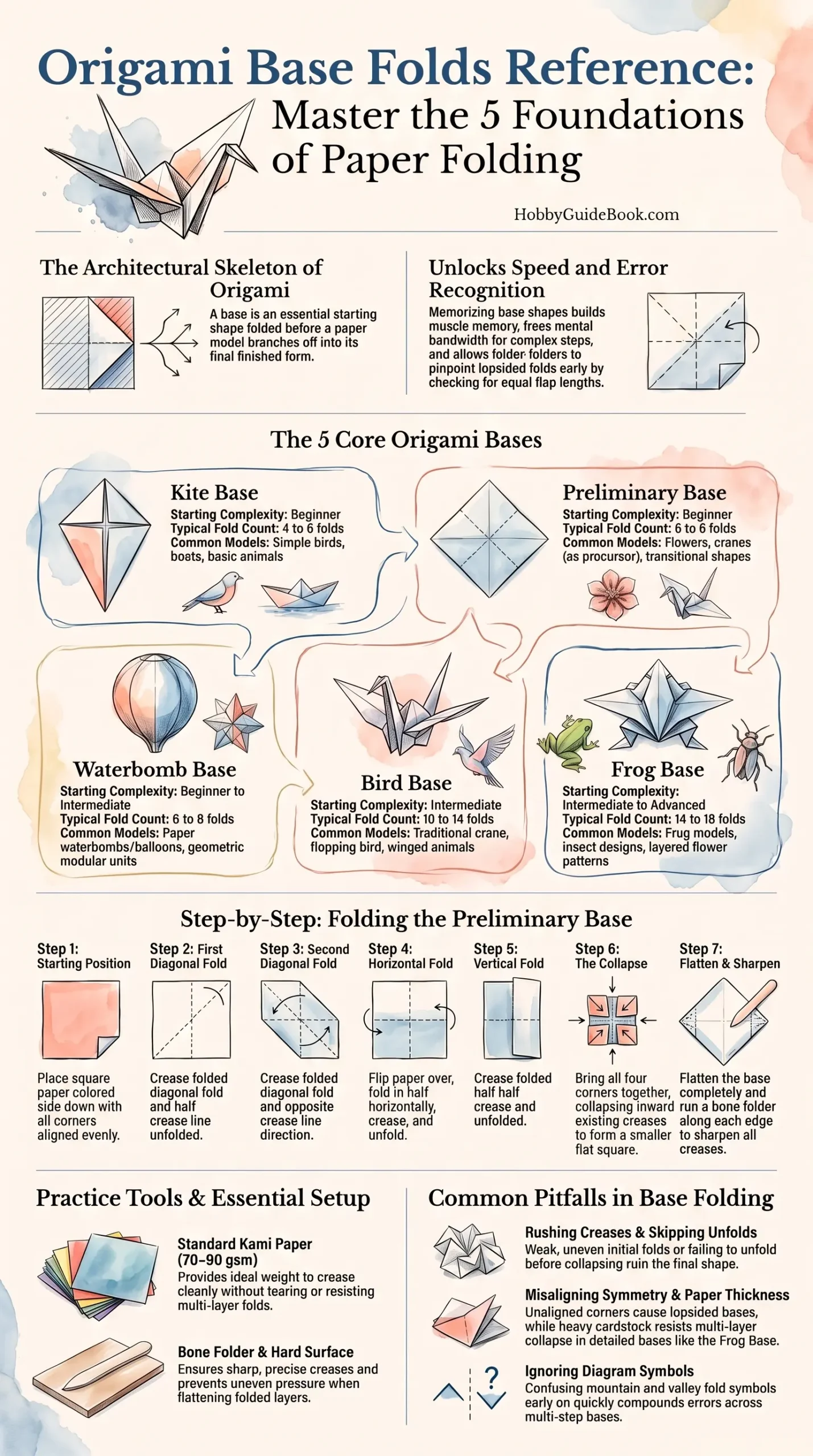
Photo Credit: Hobby Guidebook Editorial
Once your hands know a base without needing to check a diagram, you can focus your attention on the parts of a new model that actually are unfamiliar. That mental space matters more than people expect, since it's usually the mid-fold moment, not the opening sequence, where paper stops cooperating and mistakes sneak in.
Recognizing a base inside a new diagram also helps you catch your own errors faster. If you know a bird base should leave four flaps of equal length and yours look uneven, you know exactly where to backtrack instead of restarting the entire model from scratch.
Tools and Materials for Practicing Base Folds
You don't need much to practice base folds, but a few specific items make the process noticeably smoother.
|
Item |
Purpose |
|
Square origami paper (kami, 70-90 gsm) |
Standard weight that creases cleanly without tearing |
|
Bone folder |
Creates sharp, precise creases along fold lines |
|
Flat, hard surface |
Prevents uneven pressure when pressing creases |
|
Reference diagrams or a base chart |
Helps confirm fold direction and sequence accuracy |
|
Extra practice sheets |
Lets you repeat a base multiple times without hesitation |
The Most Common Origami Bases
A small set of bases accounts for the vast majority of traditional models you'll come across. Learning these five gives you a working foundation for a huge range of paper folding projects.
Preliminary Base
The preliminary base is often the very first base beginners learn, and it forms the starting point for the bird base, the frog base, and several flower designs. It's built from a square sheet folded diagonally both ways, then folded in half both ways, and collapsed inward so four flaps meet at a central point.
Waterbomb Base
The waterbomb base looks similar to the preliminary base but folds in the opposite direction, with the creases reversed. It's the starting shape behind the classic paper waterbomb, several balloon-style models, and modular units used in geometric star designs.
Bird Base
The bird base builds directly from the preliminary base by folding the flaps inward using a technique called a petal fold. This base leads directly into the traditional crane, along with a wide range of flapping bird and winged animal models.

Photo Credit: https://kaboompics.com/
Frog Base
The frog base also starts from the preliminary base but uses a slightly more complex sequence involving multiple petal folds on each side. It's the foundation behind frog models, some insect designs, and a handful of layered flower patterns.
Kite Base
The kite base is simpler than the others, folded by bringing two adjacent edges of a square toward a center diagonal line. It's often one of the earliest bases beginners practice, and it leads into simple bird shapes, boats, and several basic animal models.
How to Fold the Preliminary Base Step by Step
Since the preliminary base leads into so many other models, it's worth practicing until it feels automatic.
- Start with your paper colored side down, square shape, all corners aligned evenly.
- Fold the paper in half diagonally, corner to corner, crease firmly, then unfold.
- Fold diagonally the other direction, corner to corner again, crease firmly, then unfold.
- Flip the paper over, then fold it in half horizontally, crease, and unfold.
- Fold in half vertically, crease, and unfold again.
- Bring all four corners together, collapsing the paper inward along the creases you just made, so it folds flat into a smaller square shape.
- Flatten the base completely, running a bone folder along each edge to sharpen the creases.
A folding instructor I once learned from during a beginner workshop described the collapse step as the moment where trust matters more than technique, since the paper genuinely wants to fold itself into shape if the earlier creases were made accurately. That description still holds up, since a clean collapse almost always traces back to firm, accurate creases made several steps earlier.
Common Mistakes When Learning Base Folds
A few habits slow down base-fold practice more than people expect, and knowing them ahead of time saves frustration.
- Rushing the initial creases. Weak or uneven diagonal folds throw off the entire collapse step later on.
- Skipping the unfold step. Creases need to be made and then unfolded before the collapse, not folded and left closed.
- Ignoring symmetry. A base that looks slightly lopsided usually traces back to one corner not aligning exactly during an earlier fold.
- Using paper that's too thick. Heavier cardstock resists the multiple layers involved in a collapse, making bases like the frog base frustrating to flatten cleanly.
- Not referencing fold direction symbols. Confusing a valley fold with a mountain fold early on compounds quickly across a multi-step base.
For a full breakdown of what those fold direction symbols actually look like on a diagram, Origami Symbols & Diagram Legend explains the standard markings used across nearly all origami instructions, which makes reading any base diagram considerably easier.
Comparing the Core Origami Bases
|
Base Name |
Starting Complexity |
Common Models |
Typical Fold Count |
|
Kite base |
Beginner |
Simple birds, boats |
4 to 6 folds |
|
Preliminary base |
Beginner |
Flowers, transitional shapes |
6 to 8 folds |
|
Waterbomb base |
Beginner to intermediate |
Balloons, modular units |
6 to 8 folds |
|
Bird base |
Intermediate |
Crane, flapping bird |
10 to 14 folds |
|
Frog base |
Intermediate to advanced |
Frog, insect models |
14 to 18 folds |
Once these five feel familiar, moving on to broader beginner technique practice becomes much easier. Basic Origami Folds Every Beginner Should Know covers the individual fold types, like valley folds, mountain folds, and petal folds, that combine to build every base on this list.
Photo Credit: Internet
Frequently Asked Questions
What is an origami base? A base is a starting fold sequence that multiple different models grow out of, similar to a foundation shape that branches into different finished designs.
What are the most common origami bases? The kite base, preliminary base, waterbomb base, bird base, and frog base cover the majority of traditional origami models.
What is a preliminary base? It's a foundational shape folded from diagonal and horizontal creases collapsed into a smaller square, forming the starting point for cranes, flowers, and several other models.
What is a bird base? The bird base builds from the preliminary base using petal folds, and it forms the foundation for the traditional crane and other winged models.
What is a frog base? The frog base also starts from the preliminary base but uses additional petal folds on each side, leading into frog, insect, and layered flower designs.
How do base folds help you learn origami models faster? Recognizing a familiar base inside a new diagram lets you skip ahead mentally, focusing your attention only on the unfamiliar steps that follow it.
Final Thoughts
Learning these five bases genuinely changes how approachable new origami diagrams feel, since so much of what looks complicated is really just a familiar base pointed in a new direction. Practice each one a few times until your hands remember it without the diagram.
If you're ready to explore the rest of what this hobby has to offer, Read the full origami guide for everything from paper choices to techniques across every skill level.






Leave a Reply