
You're halfway through folding a crane when the diagram throws you a curveball. A dotted line. Two small arrows curling in opposite directions. No explanation in sight. Is that a mountain fold? A squash fold? Something else entirely?
I've folded paper for years, and I still remember flipping through my first origami book with zero idea what half the terms meant. This origami glossary exists so you never have to guess again. Below, you'll find plain-language origami definitions for the words, symbols, and phrases that show up again and again in books, patterns, and video tutorials.
This page works best as a reference you return to while you fold, not a starting point. If you're brand new to the craft, Back to the complete origami guide first, then come back here whenever a term stops you mid-fold.
Why Origami Terms Aren't Always Consistent
Origami has grown across different countries, communities, and decades. Because of that, some terms shift depending on who's teaching you.
A move one book calls a "rabbit ear fold" might get called something else in a different guide. This origami terms glossary sticks to the names you'll see most often, so you can follow almost any diagram with confidence.
How to Use This Glossary While You Fold
You don't need to memorize every word before you start folding. Instead, treat this page like a dictionary you keep nearby.
- Skim the term list once so you know roughly what's here.
- Bookmark this page or keep it open in another tab while you work through a project.
- Search for the exact word your diagram uses whenever you hit a confusing step.
That's it. Most folders pick up terminology naturally after a few projects, not by studying it in advance.
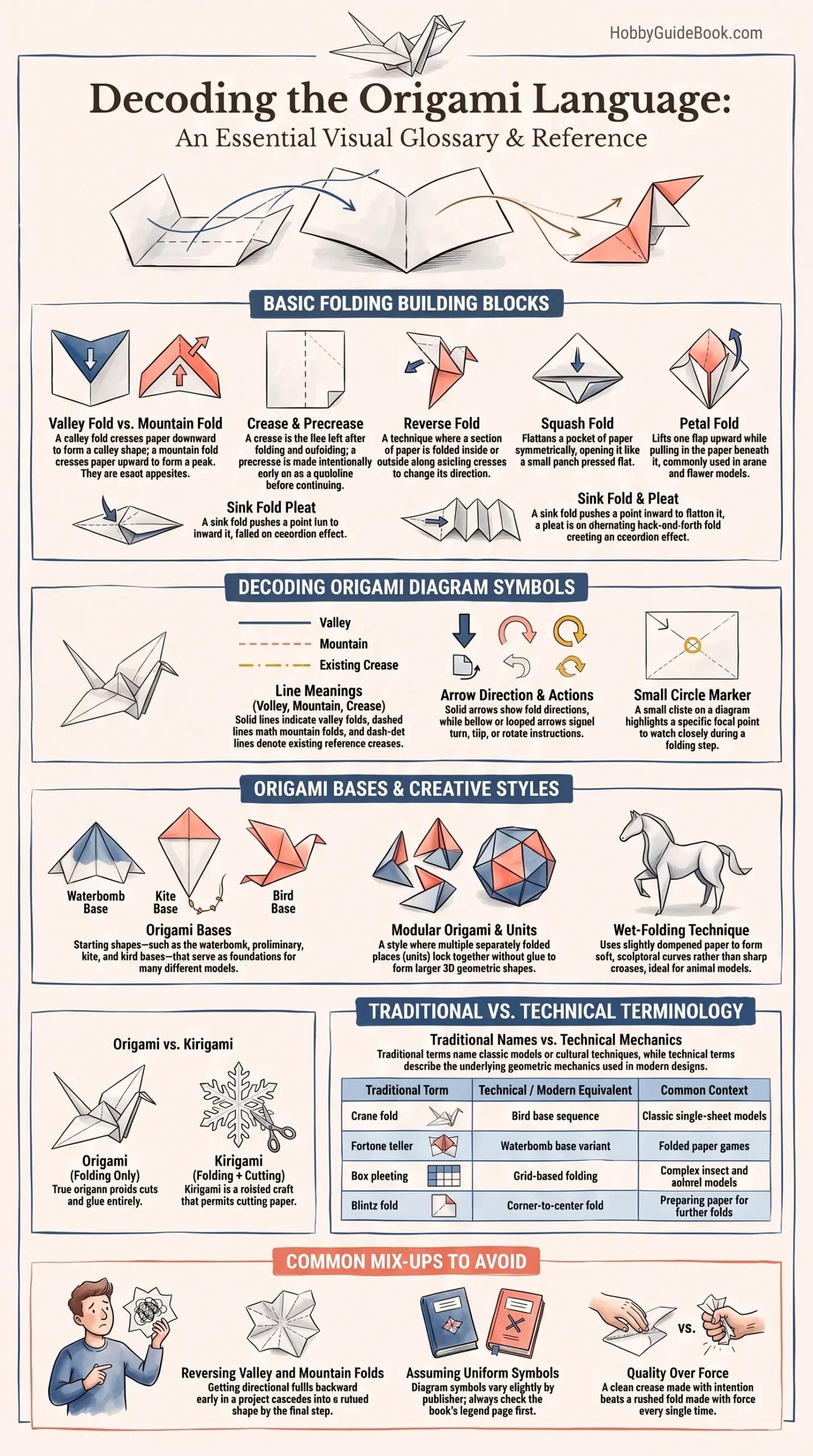
Photo Credit: Hobby Guidebook Editorial
Basic Folding Terms Every Folder Should Know
These are the building blocks of almost every origami instruction you'll ever read. Learn these first, and most other terms will make sense on their own.
- Valley fold: A fold where the paper creases downward, forming a shape like a valley when viewed from the side. This is the most common fold in origami.
- Mountain fold: The opposite of a valley fold. The crease points upward, like a small mountain peak.
- Crease: The line left behind after a fold has been made and unfolded. Creases act as guides for later steps.
- Crease pattern: A map showing every fold line needed to complete a model, usually shown flat before any folding happens. Advanced folders sometimes work backward from a crease pattern instead of following numbered steps.
- Precrease: A fold made early on purely to create a guideline, then unfolded before continuing.
- Reverse fold: A technique where a section of paper is folded inside or outside along existing creases, changing its direction.
- Squash fold: A fold that flattens a pocket of paper symmetrically, opening it like a small pouch pressed flat.
- Petal fold: A fold that lifts one flap upward while pulling in the paper beneath it, often used in traditional crane and flower models.
- Sink fold: A fold where a point is pushed inward and flattened, often used in more advanced models.
- Pleat: A repeated back-and-forth fold, alternating valley and mountain, that creates an accordion-like section.
These basic terms cover most of what you'll hit in beginner and intermediate patterns. Once valley and mountain folds feel automatic, reverse folds and squash folds usually click within a project or two.
Understanding Origami Diagram Symbols
Diagrams use a visual language, and once you know it, almost any pattern becomes readable, even in a language you don't speak.
- Solid line: Usually marks a valley fold.
- Dashed line: Usually marks a mountain fold.
- Dash-dot line: Often marks an existing crease, meaning don't fold it now, just reference it.
- Solid arrow: Shows the direction to fold the paper.
- Hollow or looped arrow: Often signals a turn, flip, or rotate instruction rather than a fold.
- Small circle: Sometimes highlights a specific point to watch closely during a step.
Symbols can vary slightly between publishers, which trips up a lot of beginners. For a full breakdown with visuals, our Origami Symbols & Diagram Legend covers every common mark you'll run into.
Origami Bases Explained
An origami base is a starting shape used as the foundation for many different models. Instead of folding every model from scratch, folders often begin with a familiar base, then branch off into a specific design.
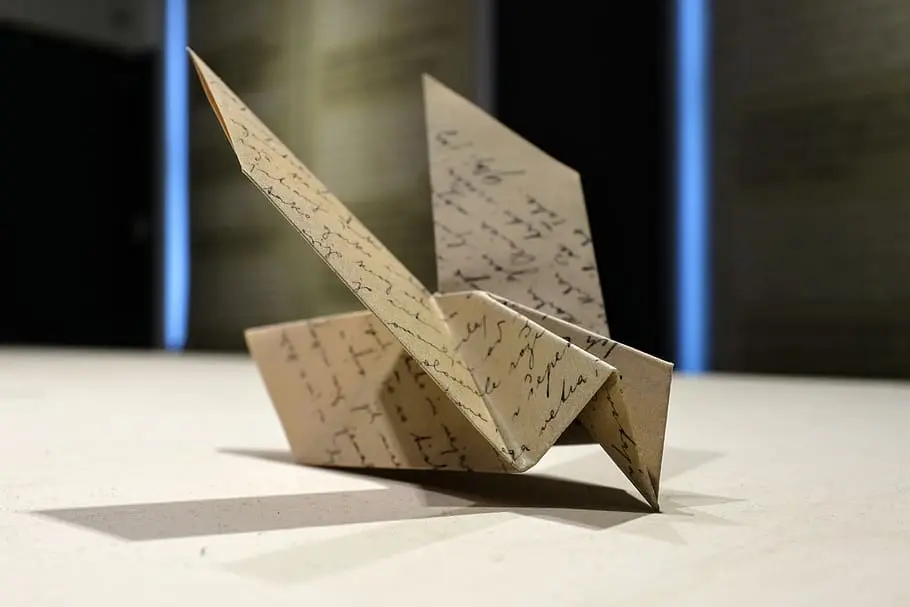
Photo Credit: Internet
Some of the most common bases include the waterbomb base, the preliminary base, the kite base, and the bird base. Each one sets up a different arrangement of flaps and points that later steps build on.
Learning bases early saves time. Once you recognize a base partway through a diagram, you already know several steps ahead without reading each one closely.
Our Origami Base Folds Reference walks through each base step by step if you want to practice them individually before jumping into a full project.
Modular Origami and Other Style Terms
Not every origami term describes a single fold. Some describe an entire style or approach to the craft.
- Modular origami: A style where multiple identical units, each folded separately, lock together without glue to form one larger shape, like a star or geometric ball.
- Unit: A single folded piece used in modular origami before it's assembled with others.
- Tessellation: A pattern of repeated folds, often twists and pleats, that creates a woven or textile-like surface across a flat sheet.
- Wet-folding: A technique using slightly dampened paper to create soft, sculptural curves instead of sharp creases. It's common in more advanced animal and figure models.
- Action origami: Any model built to move, flap, or change shape after folding is complete.
- Kirigami: A related but separate craft that allows cutting in addition to folding. True origami, by most definitions, avoids cuts and glue entirely.
Modular projects can take a full evening once you're assembling ten, twenty, or more units. I've had stars fall apart three units from the finish line simply because one earlier unit wasn't folded tightly enough, so precision early on really does pay off later.
Traditional vs Technical Origami Terms
Origami terminology roughly splits into two camps: traditional names passed down through classic folding culture, and technical terms used more often in modern, complex designs.
|
Traditional Term |
Technical/Modern Equivalent |
Common Context |
|
Crane fold |
Bird base sequence |
Classic single-sheet models |
|
Fortune teller |
Waterbomb base variant |
Folded paper games |
|
Box pleating |
Grid-based folding |
Complex insect and animal models |
|
Blintz fold |
Corner-to-center fold |
Preparing paper for further folds |
Traditional terms tend to describe the finished model or a well-known technique by name. Technical terms tend to describe the underlying mechanics, which matters more once models get complex enough to need a crease pattern instead of a numbered diagram.
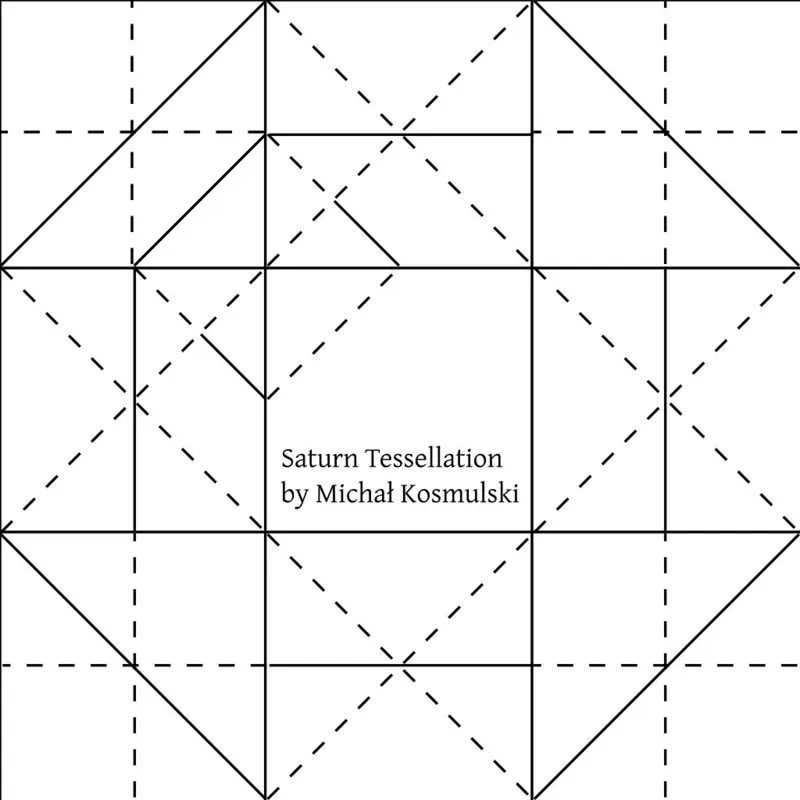
Photo Credit: Internet
Common Terminology Mix-Ups to Avoid
- Confusing origami with kirigami: If a pattern tells you to cut anything, it's technically not traditional origami.
- Mixing up valley and mountain folds: These directions are opposite, and getting them backward early in a model usually cascades into a wrecked shape by the final step.
- Assuming all diagrams use the same symbols: Always check a book's legend page before starting, especially with older or translated publications.
- Skipping the crease pattern on complex models: For advanced folds, the crease pattern often explains why a step works, not just what to do next.
As many longtime folders put it, a clean crease made with intention beats a rushed fold made with force, every single time.
Frequently Asked Questions
What do the most common origami terms mean? The most common terms describe basic folds and shapes, like valley fold, mountain fold, crease, base, and pleat. These cover the majority of instructions in beginner and intermediate patterns.
What do arrows and lines mean in origami diagrams? Solid lines usually mean valley folds, dashed lines usually mean mountain folds, and arrows show which direction to move the paper. Exact symbols can vary slightly by publisher, so checking the diagram's legend helps avoid confusion.
What is an origami base? An origami base is a starting shape, like the bird base or waterbomb base, used as the foundation for many different models instead of folding each design entirely from scratch.
What is a crease pattern? A crease pattern is a flat diagram showing every fold line in a finished model at once, rather than showing steps one at a time. It's most common in advanced or technical designs.
What are valley and mountain folds? A valley fold creases the paper downward, while a mountain fold creases it upward. They're opposite directions and form the basis of almost every other fold in origami.
What is a modular unit? A modular unit is one individually folded piece of paper that gets combined with other identical units, without glue, to build a larger modular origami shape.
What is the difference between traditional and technical origami terminology? Traditional terms often name a technique or model by its classic identity, like a crane fold. Technical terms describe the underlying mechanics, which becomes more useful once a design is complex enough to require a crease pattern.
Final Thoughts
Origami terminology isn't something you need to master overnight. Most of it sinks in naturally, one project at a time, as you start recognizing the same words and symbols again and again.
Keep this origami glossary handy while you fold, and don't be afraid to look up a term mid-project. Every experienced folder has done exactly that more times than they can count.
Ready to put these terms into practice? Read the full origami guide for beginner projects, techniques, and everything else you need to start folding with confidence.





Leave a Reply