Grab the wrong needle and you'll either fight to pull it through the fabric or watch it slip out of your fingers mid-stitch, both equally frustrating. This embroidery needle size chart breaks down exactly which size to reach for, based on your fabric and thread.
This article is part of our Embroidery & Cross-Stitch Glossary & Reference, and it works as a quick needle size guide you can check before starting any new project.
How Do Embroidery Needle Sizes Work?
Needle sizes work backward from what you'd expect, a lower number means a thicker, longer needle, while a higher number means a thinner, shorter one. This confuses almost every beginner at first, myself included.
I've unpicked more knotted thread than I'd like to admit over the years, and more often than not, the wrong needle size was quietly making tension worse the whole time. A needle that's too thin forces excess friction, while one that's too thick leaves oversized holes behind.
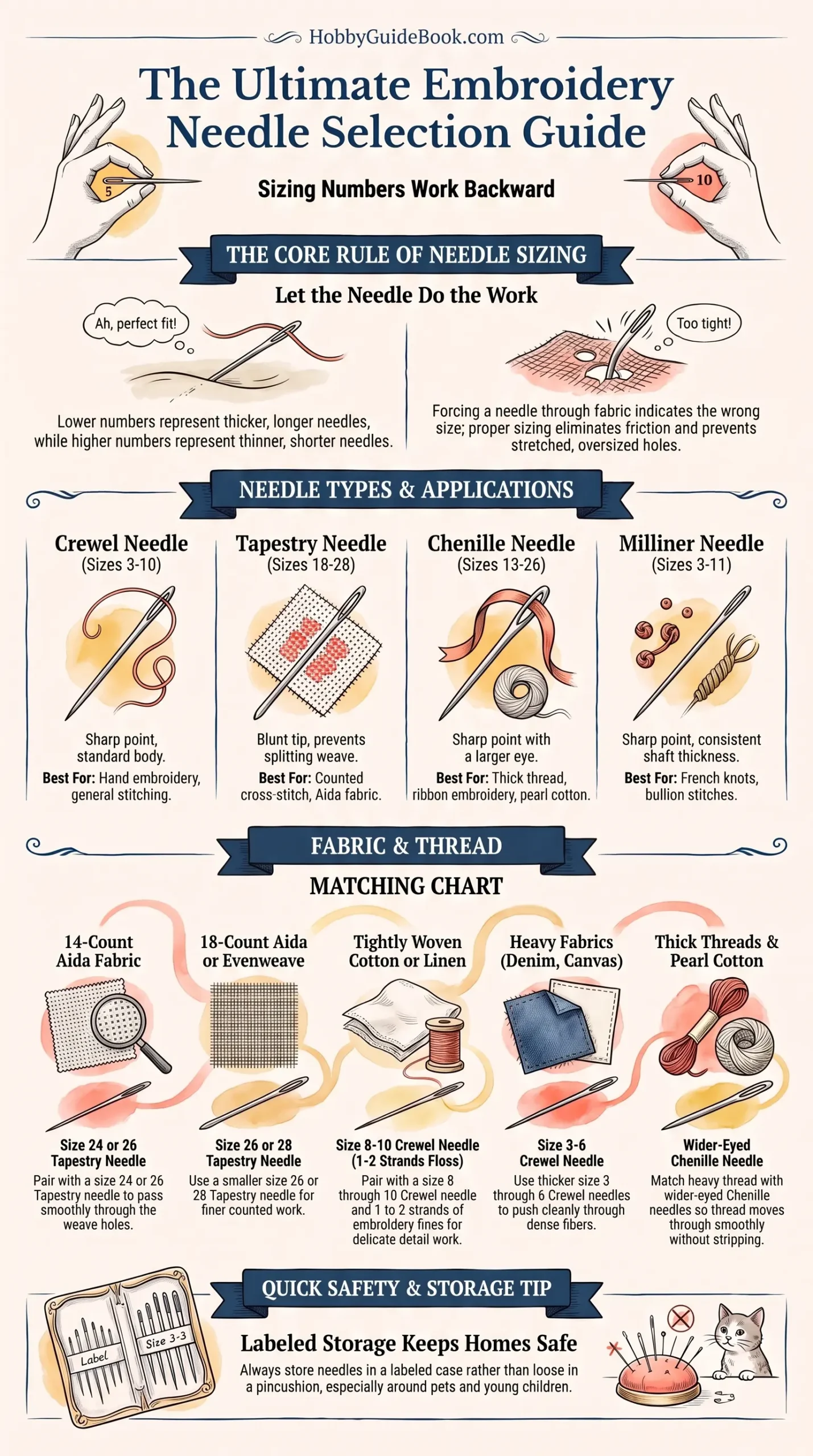
Photo Credit: Hobby Guidebook Editorial
Embroidery Needle Size Chart
|
Needle Type |
Common Sizes |
Best For |
|
Crewel |
3 to 10 |
Hand embroidery, general stitching |
|
Tapestry |
18 to 28 |
Counted cross-stitch, Aida fabric |
|
Chenille |
13 to 26 |
Thick thread, ribbon embroidery |
|
Milliner |
3 to 11 |
French knots, bullion stitches |
Our embroidery needles explained guide goes deeper into how each needle type is shaped and why that shape matters for specific stitches.
What Needle Size Is Best for Fine Embroidery?
For fine embroidery, smaller crewel needles, sizes 9 or 10, work best, since their thin bodies pass cleanly through tightly woven fabric without leaving visible holes. These sizes pair naturally with just one or two strands of floss.
Larger crewel sizes, like 3 or 4, suit heavier fabric and thicker thread, but they're overkill for delicate detail work.
How Does Fabric Type Affect Needle Size?
Fabric weight and hole size largely decide which needle fits best. Follow this quick guide when matching needle to fabric.
- For 14 count Aida, use a size 24 or 26 tapestry needle.
- For 18 count Aida or evenweave, drop down to a size 26 or 28 tapestry needle.
- For tightly woven cotton or linen, use a crewel needle sized 8 through 10.
- For heavier fabric like denim or canvas, size 3 through 6 crewel needles handle the thickness better.
Matching needle to fabric prevents both snagging and stretched, distorted holes.
Photo Credit: https://kaboompics.com/
How Does Thread Thickness Affect Needle Choice?
Thread thickness and needle eye size need to work together, since the needle has to carry the thread through cleanly. Thicker thread, like pearl cotton, needs a wider eye, which points you toward chenille needles.
Thin thread, like a single strand of floss, works better with a narrower eye, found on higher-numbered crewel or tapestry needles.
"Let the needle do the work, not your fingers." That advice holds up well, since forcing a needle through fabric almost always signals the wrong size, not weak technique.
How Do Crewel, Chenille, and Tapestry Needle Sizes Compare?
Crewel needles have sharp points for woven fabric, chenille needles share that sharp point but with a larger eye for thick thread, and tapestry needles have blunt tips built specifically for counted work like Aida. Our cross-stitch needles and tools guide compares these side by side if you're stocking a full needle case.

Photo Credit: Nic Wood
A quick safety note, store needles in a labeled case rather than loose in a pincushion, especially in households with young kids or pets nearby.
Frequently Asked Questions
How do embroidery needle sizes work? Lower numbers mean thicker needles, higher numbers mean thinner ones.
What needle size is best for fine embroidery? Crewel sizes 9 or 10 work well for delicate, detailed stitching.
How does fabric type affect needle size? Tighter, finer fabric needs thinner needles, while heavier fabric needs thicker ones.
How does thread thickness affect needle choice? Thicker thread needs a wider eye, thinner thread needs a narrower one.
How do crewel, chenille, and tapestry needle sizes compare? Crewel and chenille are sharp, tapestry is blunt, and each suits different fabric and thread combinations.
Final Thoughts
Once you match needle size to your fabric and thread, stitching gets noticeably smoother almost right away. Keep this chart handy, and you'll skip one of the most common beginner headaches entirely.
For more, check out the full embroidery & cross-stitch guide.





Leave a Reply