I get some version of this question in my inbox almost every month, usually from someone standing in a craft store holding two pattern books and not sure which one to buy. So can beginners learn Hardanger or redwork first, and does it actually matter which one you pick? Short answer: it matters more than you'd think, and this guide breaks down exactly why.
This is part of our broader Common Embroidery & Cross-Stitch Questions & Comparisons guide, which covers other beginner decision points worth reading.
What Are the Most Common Questions About Starting With Hardanger or Redwork?
Most beginners want to know which technique forgives mistakes better, and which one requires fewer specialty tools to get started. Both are fair questions, since the two techniques really do differ in what they demand from a first timer.
Redwork uses a single simple stitch worked in one thread color, while Hardanger involves cutting fabric threads and building geometric patterns around that open space. That difference alone shapes almost everything else about the beginner experience.
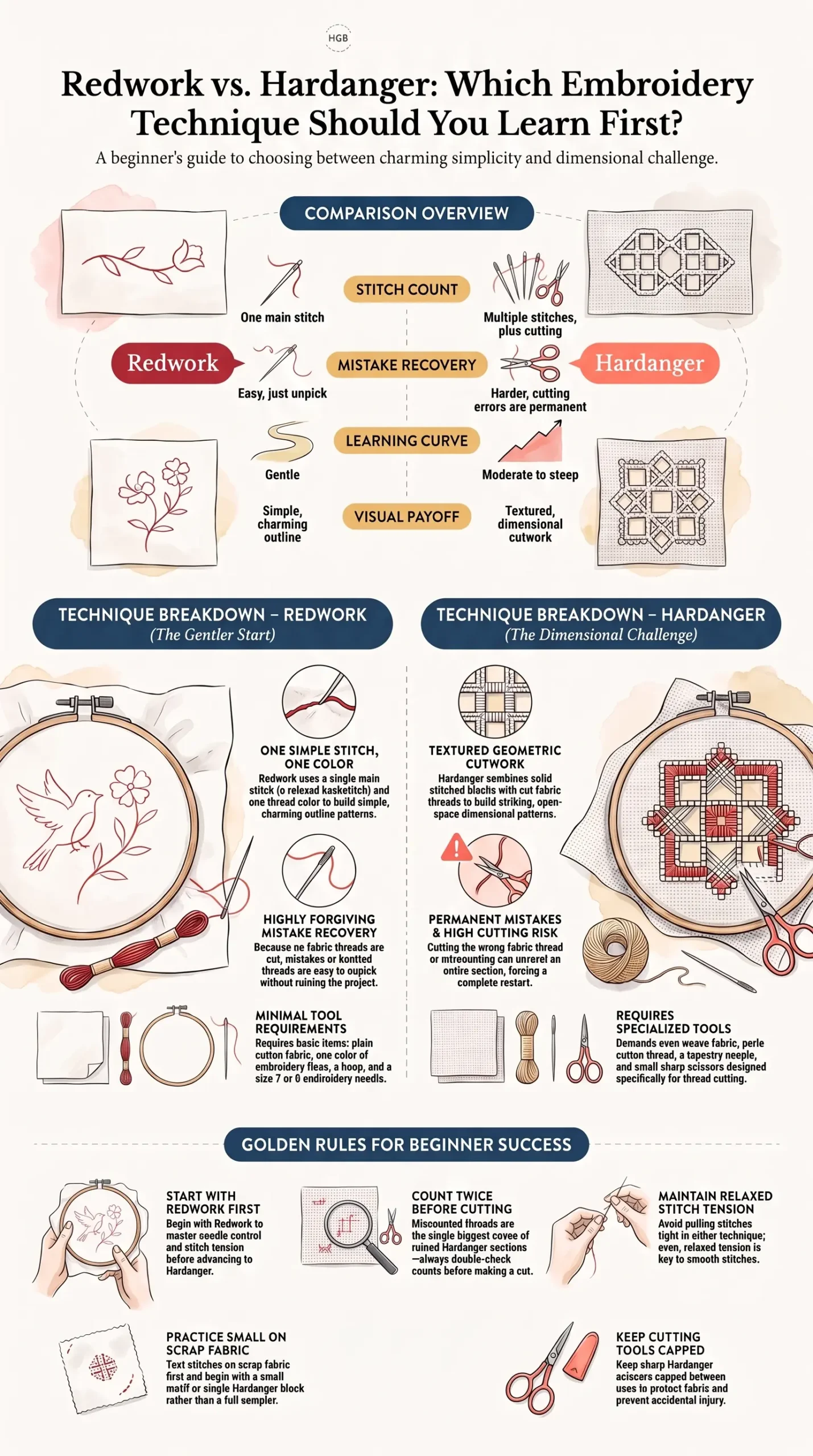
Photo Credit: Hobby Guidebook Editorial
What Are the Main Benefits and Limitations of Each?
Redwork's biggest benefit is simplicity. One stitch, one thread color, and mistakes are easy to unpick since nothing gets cut. Its main limitation is that it stays fairly flat and simple, without much room for texture or dimension.
Hardanger's benefit is the finished look, a genuinely striking mix of open cutwork and solid stitched blocks that redwork can't replicate. Its limitation is real though, since cutting the wrong thread can unravel a whole section and force a restart.
Is This Difficult for Beginners?
Hardanger vs redwork difficulty really comes down to one factor: does the technique involve cutting fabric. Redwork doesn't, which makes it dramatically more forgiving for a first project.
I've unpicked more knotted thread than I'd like to admit, and I've learned that most beginner frustration traces back to tension, not skill. That's especially true in redwork, where a relaxed, even backstitch matters far more than any fancy technique.

Photo Credit: Анар Гумбатов
"Even tension makes even stitches." That principle holds in both techniques, but Hardanger raises the stakes since uneven counting before cutting can undo an entire section of work.
|
Factor |
Redwork |
Hardanger |
|
Stitch count |
One main stitch |
Multiple stitches, plus cutting |
|
Mistake recovery |
Easy, just unpick |
Harder, cutting errors are permanent |
|
Learning curve |
Gentle |
Moderate to steep |
|
Visual payoff |
Simple, charming outline |
Textured, dimensional cutwork |
What Materials and Tools Are Needed?
- Redwork needs plain cotton fabric, one color of embroidery floss, a hoop, and a standard embroidery needle, size 7 or 8.
- Hardanger needs even weave fabric, perle cotton thread, a tapestry needle, and small sharp scissors specifically for cutting threads cleanly.
That extra tool requirement is worth pausing on. Handling sharp scissors near tightly woven fabric takes a steady hand, and it's genuinely a bigger ask for a first ever embroidery project.
Our Redwork Embroidery guide covers the full technique if you decide it's the gentler place to start.
How Can Beginners Avoid Common Mistakes?
The easiest specialty embroidery for beginners is almost always redwork, simply because it removes the cutting risk entirely. Still, a few habits help with either technique:
- Count twice before cutting, if attempting Hardanger, since miscounted threads are the single biggest cause of ruined sections.
- Keep tension relaxed, avoiding the urge to pull stitches tight in either technique.
- Practice on scrap fabric first, especially before making any cuts in a real Hardanger project.
- Start small, a single motif or one small Hardanger block, rather than a full sampler right away.
Photo Credit: Suzy Hazelwood
A quick safety note, keep Hardanger scissors capped between uses, since the small, sharp blade needed for clean cuts carries more risk than standard embroidery scissors.
Frequently Asked Questions
What are the most common questions about starting with Hardanger or redwork? Beginners mostly want to know which technique forgives mistakes better and needs fewer specialty tools, and redwork wins on both counts.
What are the main benefits and limitations of each? Redwork is simple and forgiving but stays flat, while Hardanger creates striking texture but risks permanent cutting mistakes.
Is this difficult for beginners? Redwork is genuinely beginner friendly, while Hardanger has a steeper learning curve due to the cutting step.
What materials and tools are needed? Redwork needs basic fabric, floss, and a needle, while Hardanger adds even weave fabric and small sharp cutting scissors.
How can beginners avoid common mistakes? Count carefully before cutting, keep tension relaxed, and start with a small practice piece before attempting a full project.
Final Thoughts
If you're choosing between the two, start with redwork, then move to Hardanger once you're comfortable with a needle and a relaxed hand. Both are worth learning eventually, just not necessarily on the same afternoon.
For more, check out the full embroidery & cross-stitch guide.






Leave a Reply