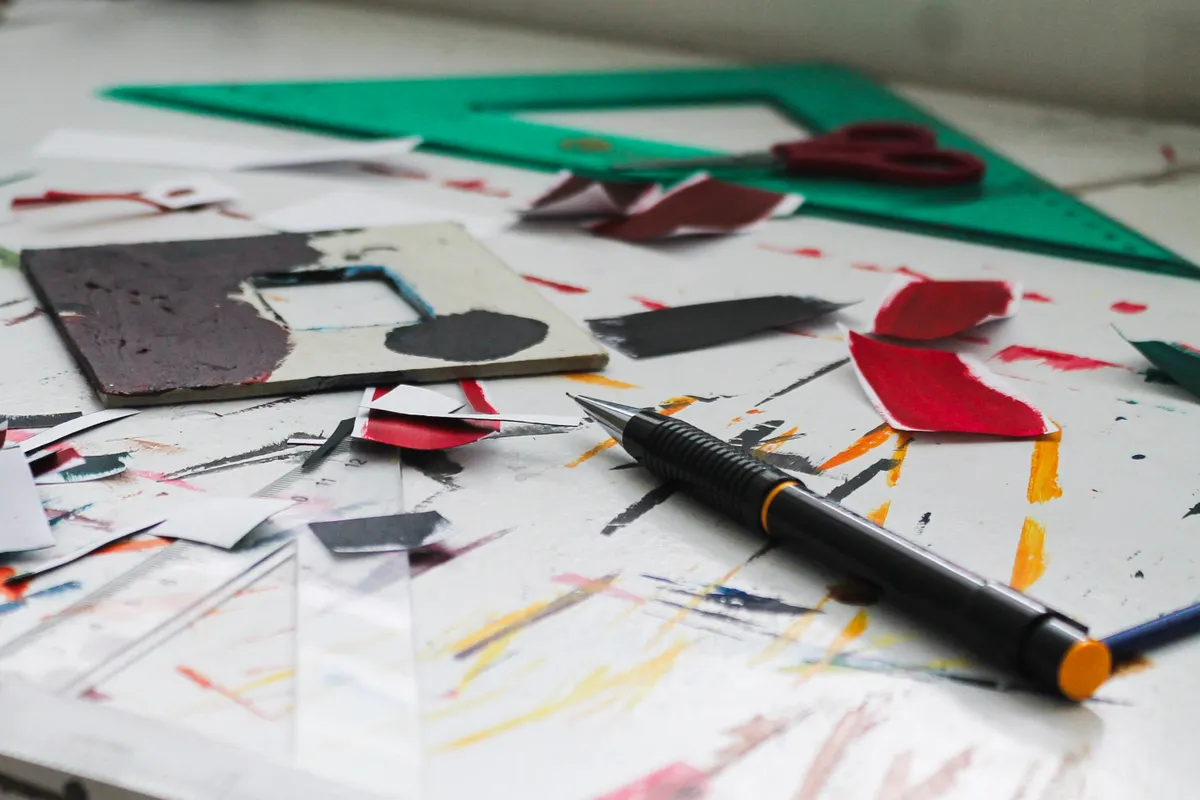
I sliced clean through a nearly finished snowflake pattern once, one wrong angle with a dull blade, and watched an hour of careful folding and cutting fall apart in a single second. That's the real lesson behind good kirigami cutting tools, the right blade at the right moment matters just as much as the folding itself.
This piece is Part of Origami Materials & Tools Guide, and it covers exactly which cutting tools kirigami actually needs, when to reach for scissors versus a precision knife, and how to keep both your paper and your fingers safe while working.
What Is Kirigami, and Why Does Cutting Matter?
Kirigami is a paper craft closely related to origami, but unlike traditional origami's strict hand folds only rule, kirigami allows cutting alongside folding to create more intricate patterns, symmetrical designs, and pop-up style structures. The cuts and folds work together, and precision in both matters equally to the finished result.
Because cutting is built into the technique itself, the tools you choose genuinely shape what you're able to create. A clean, controlled cut opens up delicate patterns that folding alone could never produce, while a sloppy cut can undo careful work in an instant.
If you want a deeper look at how kirigami differs from standard origami and where cutting fits into the broader craft, Kirigami covers the full picture, from basic snowflake patterns through more advanced layered designs.
What Cutting Tools Are Needed for Kirigami?
Most kirigami projects only need a small handful of tools, and you likely already own several of them. The core setup usually includes a pair of sharp scissors, a craft knife with replaceable blades, and a self-healing cutting mat to protect your work surface underneath.
Beyond that basic trio, a few smaller additions make detailed work noticeably easier. Fine-tip scissors handle tight curves better than standard household ones, and a metal ruler helps guide straight cuts cleanly when you're working with a craft knife rather than freehand.
I've found that most kirigami frustration traces back to using the wrong tool for a specific cut rather than any real lack of skill. Straight lines, tight curves, and tiny interior details each genuinely call for a different approach, and fighting a curve with a straight blade almost always ends in a ragged edge.
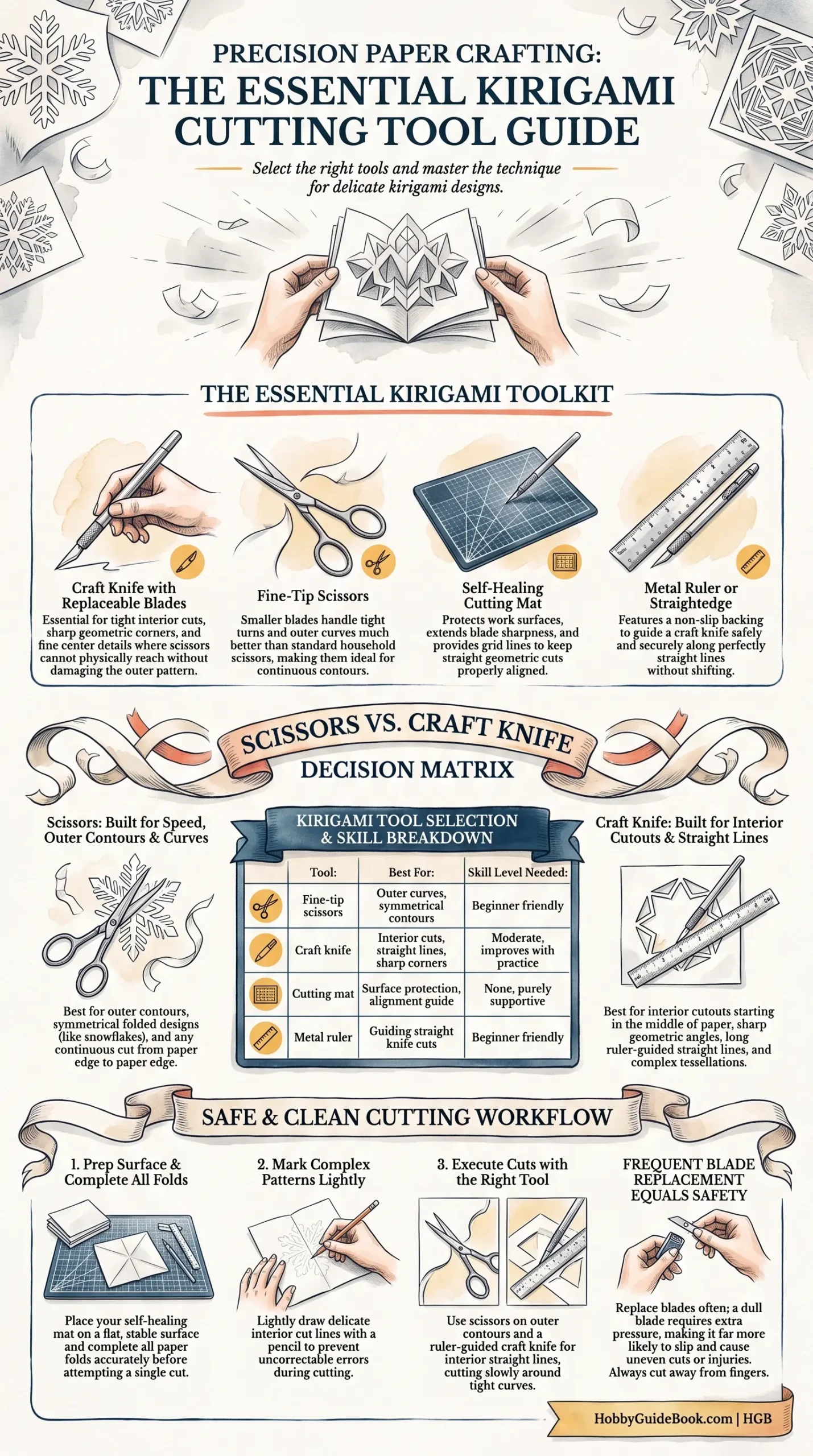
Photo Credit: Hobby Guidebook Editorial
Materials and Tools for Kirigami Cutting
Here's a full rundown of what a well-equipped kirigami setup typically includes.
|
Item |
Purpose |
Notes |
|
Craft knife, replaceable blades |
Precision cuts, tight interior details |
Swap blades often for clean results |
|
Fine-tip scissors |
Curved lines, general shaping |
Smaller blades handle tight turns better |
|
Self-healing cutting mat |
Protects surface, guides straight cuts |
Grid lines help with alignment |
|
Metal ruler or straightedge |
Guides the knife along straight lines |
Non-slip backing prevents shifting |
|
Craft paper, medium weight |
Base material for cutting and folding |
Slightly heavier stock holds detail better |
Should You Use Scissors or a Craft Knife for Kirigami?
This is probably the most common question beginners ask, and the honest answer is that most kirigami projects genuinely need both, just for different parts of the pattern. Scissors are faster and generally safer for beginners, handling curves and larger outer shapes with reasonable control.
A craft knife takes over where scissors struggle, particularly on tight interior cuts that don't reach an outer edge, like a small window or geometric shape cut out from the middle of a folded design. Scissors simply can't reach those interior spots without an entry cut that damages the surrounding pattern.
Scissors for origami and kirigami work best on outer contours, symmetrical folded patterns like snowflakes, and any cut where you can follow a continuous line from one edge to another. A craft knife takes over for interior details, sharp geometric corners, and any spot where scissors simply can't maneuver into position.
When Is a Precision Knife Better Than Scissors?
A craft knife kirigami setup earns its place specifically on interior cuts, sharp corners, and fine geometric detail that scissors physically cannot execute cleanly. Anytime a cut needs to start in the middle of the paper rather than from an edge, a knife is really your only clean option.
Precision knives also outperform scissors on long, perfectly straight lines, especially when paired with a metal ruler as a guide. Scissors tend to introduce small waviness on long straight cuts since the blade naturally wants to curve slightly with each snip, while a knife guided along a straightedge holds a perfectly consistent line.
A paper artist I once watched demonstrate layered kirigami at a craft fair described the knife as the tool for patience and the scissors as the tool for confidence. That distinction stuck with me, since it captures exactly how differently the two tools feel in your hand once you've used both enough to notice.
Complex tessellation-style kirigami, where the design uses repeated interior shapes across the whole sheet, almost always leans heavily on a craft knife for this reason. Scissors simply don't offer the control needed for that level of repeated precision.
Step-by-Step: Setting Up for a Safe, Clean Kirigami Cut
Getting your setup right before you start cutting prevents most of the common mistakes beginners run into.
- Lay your cutting mat on a flat, stable surface before placing your paper down, since a wobbly surface throws off even a steady hand.
- Fold your paper according to the pattern first, confirming all fold lines are sharp and accurate before making a single cut.
- Mark your cut lines lightly in pencil if the pattern is complex, especially for interior details where a small error is hard to correct afterward.
- Choose scissors for outer contours and curves, working slowly around tight turns rather than forcing the blade through quickly.
- Switch to a craft knife for interior cuts, using a metal ruler as a guide wherever the line is straight.
- Replace a dull blade before it forces you to press harder. A blade that requires extra pressure is far more likely to slip and cause an uneven cut, or a cut to your fingers.
- Unfold carefully once every cut is complete, checking the pattern gently before fully opening to catch any spot that needs a small touch-up cut.
Do You Need a Cutting Mat for Kirigami?
Yes, and this is one of those tools that feels optional right up until you skip it and immediately regret it. A self-healing cutting mat protects your work surface from blade marks, but it also does something more important for the cut itself, giving the blade a slightly forgiving surface underneath that produces cleaner results than cutting directly on a hard table.
Cutting on a bare table also dulls blades faster, since a hard surface like wood or glass resists the blade in a way a proper mat doesn't. If you're doing kirigami regularly, a cutting mat pays for itself quickly just in blade longevity alone.
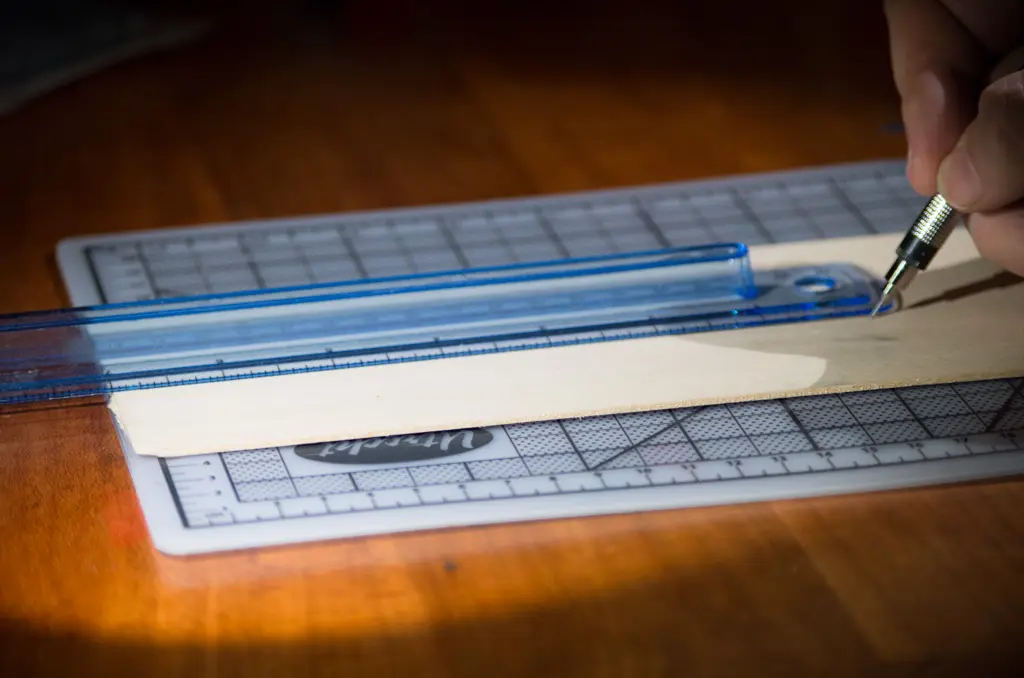
Photo Credit: Internet
Grid lines printed on most cutting mats are also genuinely useful for keeping straight cuts aligned, especially on geometric kirigami patterns where even a slightly off angle throws off the whole design once unfolded.
How Do You Choose a Blade for Detailed Paper Cuts?
Blade choice matters more than most beginners expect, and it's an easy detail to overlook when you're focused entirely on the pattern itself. A standard craft knife blade works fine for most kirigami, but sharpness matters far more than blade shape for the vast majority of cuts.
For extremely fine interior detail, some kirigami artists prefer a smaller, narrower blade that offers tighter control in cramped spaces, though this comes with a steeper learning curve for beginners. A standard blade, replaced regularly, handles the overwhelming majority of kirigami patterns without needing anything specialized.
Safety note: Always cut away from your fingers, keep blades stored safely when not in use, and never apply excessive pressure trying to force a dull blade through paper, since that's exactly when slips happen. A sharp blade under light, controlled pressure is genuinely safer than a dull one under heavy pressure.
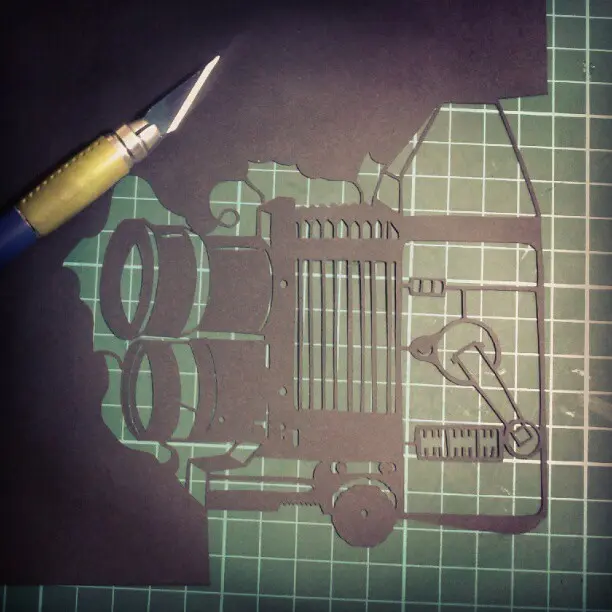
Photo Credit: Internet
The paper itself also affects blade choice and cut quality. If you're deciding what to buy before starting a kirigami project, Origami Paper covers the different weights and finishes available, which matters here since thicker paper needs sharper, fresher blades than standard kami does to cut cleanly.
Comparing Kirigami Cutting Tools
|
Tool |
Best For |
Skill Level Needed |
|
Fine-tip scissors |
Outer curves, symmetrical contours |
Beginner friendly |
|
Craft knife |
Interior cuts, straight lines, sharp corners |
Moderate, improves with practice |
|
Cutting mat |
Surface protection, alignment guide |
None, purely supportive |
|
Metal ruler |
Guiding straight knife cuts |
Beginner friendly |
Pro Tips for Clean Kirigami Cuts
- Replace craft knife blades often. A fresh blade every few sessions keeps cuts clean and actually reduces the risk of slips from forced pressure.
- Practice on scrap paper first when trying a new pattern, especially one with tight interior details you haven't cut before.
- Cut slowly on curves. Rushing a scissor cut around a tight curve is the single most common cause of ragged, uneven edges in kirigami.
- Keep your cutting hand steady and your guiding hand well clear of the blade path, particularly when using a metal ruler for straight interior cuts.
- Store blades and scissors safely between sessions, capped or sheathed, especially if kids or pets have access to your workspace.
Frequently Asked Questions
What cutting tools are needed for kirigami? A craft knife with replaceable blades, sharp fine-tip scissors, and a self-healing cutting mat cover the core needs for most kirigami projects.
Should you use scissors or a craft knife for kirigami? Both, typically. Scissors handle outer curves and contours well, while a craft knife is needed for interior cuts and sharp geometric detail scissors can't reach.
When is a precision knife better than scissors? A knife works better for interior cuts that don't touch an edge, long straight lines guided by a ruler, and detailed geometric or tessellation patterns.
Do you need a cutting mat for kirigami? Yes, a cutting mat protects your work surface, keeps blades sharper longer, and often includes grid lines that help align straight cuts precisely.
How do you choose a blade for detailed paper cuts? A standard, regularly replaced craft knife blade handles most kirigami patterns well. Sharpness matters more than blade shape for clean, controlled cuts.
Final Thoughts
Good kirigami cutting tools come down to a fairly short list, sharp scissors, a reliable craft knife, and a proper cutting mat, but knowing exactly when to switch between them is what separates clean, precise patterns from frustrating, ragged edges. Take your time on each cut, keep your blades fresh, and let the right tool handle the job it's actually suited for.
If you're ready to explore the rest of what belongs in a well-rounded folding and cutting kit, Read the full origami guide for everything from paper choices to techniques across every skill level.







Leave a Reply