Six strands of floss come twisted together in one skein, but stitching with all six at once almost never looks right. This embroidery floss strand guide breaks down exactly how many strands to pull for any stitch, so your finished piece looks clean instead of clumpy.
This article is part of our Embroidery & Cross-Stitch Glossary & Reference, and it works as a quick floss strand chart you can check before starting any new project.
What Does a Strand of Embroidery Floss Mean?
Standard embroidery floss, like DMC or Anchor brand, comes as six thin strands twisted together into one length. Each of those thin threads counts as one strand, and most patterns tell you how many to separate and use together.
I've unpicked more knotted thread than I'd like to admit while learning strand counts, and I've found tension issues almost always trace back to using too many or too few strands for the fabric. The right count keeps stitches sitting smoothly, without gaps or bulky ridges.
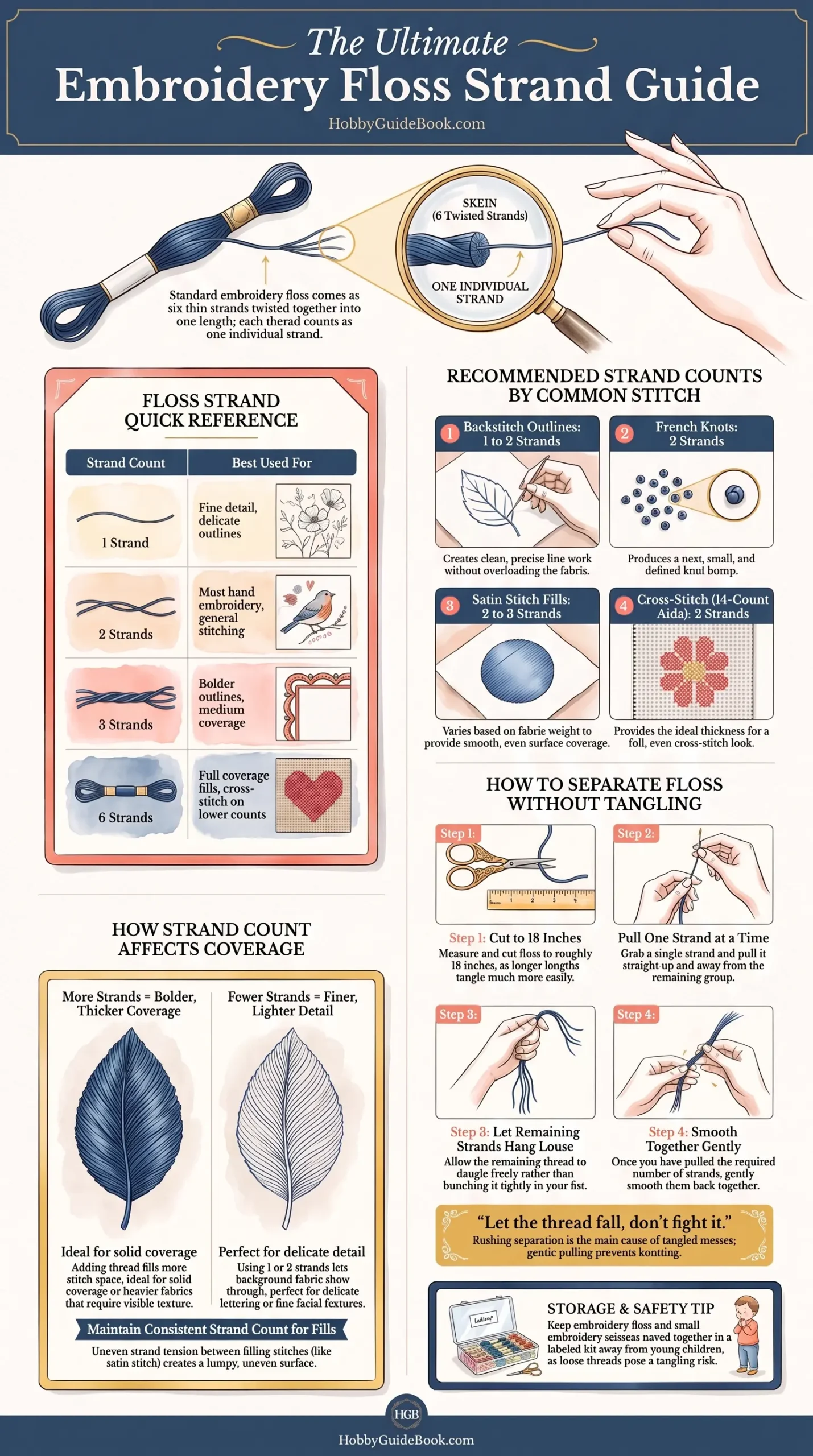
Photo Credit: Hobby Guidebook Editorial
Embroidery Floss Strand Chart
|
Strand Count |
Best Used For |
|
1 strand |
Fine detail, delicate outlines |
|
2 strands |
Most hand embroidery, general stitching |
|
3 strands |
Bolder outlines, medium coverage |
|
6 strands |
Full coverage fills, cross-stitch on lower counts |
Our Embroidery Floss & Thread Types guide covers how different thread brands and materials pair with these strand counts.
How Many Strands Should You Use for Common Embroidery Stitches?
Strand count changes depending on which stitch you're working and how much coverage that stitch needs.
- Backstitch outlines usually look best with 1 or 2 strands.
- French knots typically use 2 strands for a small, defined bump.
- Satin stitch fills often call for 2 to 3 strands, depending on fabric weight.
- Cross-stitch on 14 count Aida almost always uses 2 strands for a full, even look.
Our Satin Stitch Tutorial walks through exactly how strand count changes the finished texture on that particular stitch.
How Do You Separate Embroidery Floss Without Tangling It?
Separating floss cleanly prevents most of the tangling that frustrates beginners early on. Follow these steps for smooth results every time.
- Cut a length of floss around 18 inches, since longer pieces tangle more easily.
- Pull one strand at a time, straight up and away from the rest.
- Let the remaining strands hang loosely rather than bunching them in your fist.
- Smooth strands back together gently once you've pulled the number you need.
"Let the thread fall, don't fight it." Rushing this step is exactly what turns a simple separation into a tangled mess.

Photo Credit: https://kaboompics.com/
How Does Strand Count Affect Stitch Coverage?
More strands mean thicker, bolder coverage, since more thread fills the same stitch space. Fewer strands create a lighter, finer look, which shows more of the fabric underneath.
This matters most on filling stitches like satin stitch, where uneven strand tension between stitches creates a lumpy, uneven surface. Keeping strand count consistent across a shape helps it come out smooth.
When Should You Use One Strand Versus Several Strands?
Use one strand for tiny detail work, delicate lettering, or fine facial features where thick thread would overwhelm the design. Use several strands, typically three or more, when a design calls for bold, visible texture or when working on heavier fabric that needs more coverage per stitch.
A quick safety note, keep floss and small embroidery scissors stored together in a labeled kit, away from young children, since loose thread lengths can pose a tangling risk if left out.

Photo Credit: Katrenur
Frequently Asked Questions
What does a strand of embroidery floss mean? It's one of the six thin threads twisted together to make up a full skein.
How many strands should you use for common embroidery stitches? Most stitches use 1 to 3 strands, depending on the level of detail or coverage needed.
How do you separate embroidery floss without tangling it? Cut shorter lengths and pull one strand at a time slowly and gently.
How does strand count affect stitch coverage? More strands create bolder, thicker coverage, while fewer strands create a finer look.
When should you use one strand versus several strands? Use one strand for fine detail and several for bold texture or heavier fabric.
Final Thoughts
Once strand count clicks, every pattern's instructions make a lot more sense right away. Keep this floss strand chart handy, and your stitches will come out even and smooth every time.
For more, check out the full embroidery & cross-stitch guide.





Leave a Reply