
I still remember trying to learn bullion knots as my second ever stitch, and spending an entire evening fighting thread that just would not cooperate. This embroidery stitch difficulty levels reference exists so you don't make that same mistake, sorting stitches by how forgiving they actually are for a first attempt.
This is part of our broader Embroidery & Cross-Stitch Glossary & Reference guide, which covers other terms and stitches worth knowing.
What Makes a Stitch Beginner, Intermediate, or Advanced?
Difficulty in embroidery usually comes down to three things: how many motions the stitch requires, how much it depends on even tension, and how forgiving it is when something goes wrong. A stitch difficulty chart sorted this way helps you build skills in the right order instead of guessing.
Simple stitches use one repeated motion and forgive small mistakes easily. Advanced stitches often stack multiple motions together, and one uneven pull can throw off the whole shape.
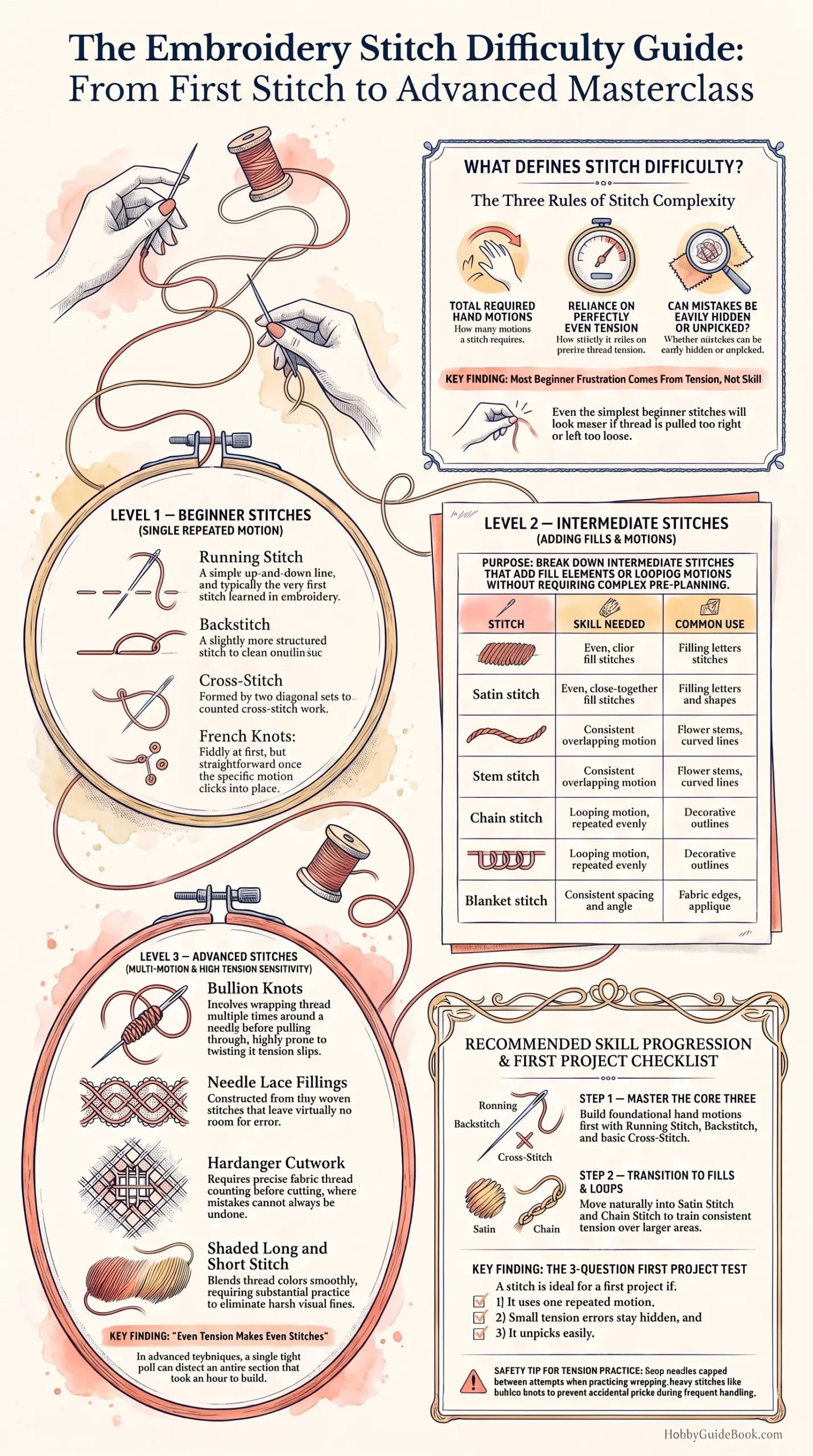
Photo Credit: Hobby Guidebook Editorial
Which Embroidery Stitches Are Easiest for Beginners?
Beginner stitches share one trait: they use a single, repeated hand motion that's easy to keep consistent. That consistency is exactly what builds good tension habits early on.
- Running stitch, a simple up and down line, the very first stitch most people learn.
- Backstitch, slightly more structured, used constantly for outlines.
- Cross-stitch, two diagonal stitches crossing, the foundation of counted cross-stitch work.
- French knots, small and fiddly at first, but genuinely simple once the wrist motion clicks.
I've unpicked more knotted thread than I'd like to admit, and I've learned that most beginner frustration traces back to tension, not skill. Even these simple stitches look messy if pulled too tight or left too loose.
Which Stitches Sit at an Intermediate Level?
Intermediate stitches usually add a fill element or a slightly more complex hand motion, without requiring advanced planning.
|
Stitch |
Skill Needed |
Common Use |
|
Satin stitch |
Even, close together fill stitches |
Filling letters and shapes |
|
Stem stitch |
Consistent overlapping motion |
Flower stems, curved lines |
|
Chain stitch |
Looping motion, repeated evenly |
Decorative outlines |
|
Blanket stitch |
Consistent spacing and angle |
Fabric edges, appliqué |
What Makes an Embroidery Stitch Advanced or Difficult?
Advanced stitches usually combine multiple motions into one stitch, or depend heavily on precise tension throughout. A single inconsistent pull can visibly distort the entire stitch shape, which is why these take more practice to master.
- Bullion knots, wrapping thread multiple times around a needle before pulling through, prone to twisting if tension slips.
- Needle lace fillings, built from tiny woven stitches with almost no room for error.
- Hardanger cutwork, requiring precise counting before cutting fabric threads, where mistakes can't always be undone.
- Shaded long and short stitch, blending thread colors smoothly, which takes real practice to avoid visible harsh lines.
"Even tension makes even stitches." Nowhere is that truer than in advanced work, where a single tight pull can distort an entire section that took an hour to build.
Photo Credit: Ann Hannes
Which Stitches Should You Learn Before Attempting Complex Techniques?
Master running stitch, backstitch, and basic cross-stitch before moving toward anything advanced. These three cover most of the fundamental hand motions that show up again later in more complex stitches.
Once those feel natural, satin stitch and chain stitch are the logical next step, since they build directly on the same even tension skills.
Our Embroidery & Cross-Stitch Abbreviations Reference guide is worth bookmarking too, since chart abbreviations get more common as you move into intermediate patterns.
How Can You Tell if a Stitch Suits a First Project?
Ask yourself three quick questions before starting: does it use one repeated motion, does a small tension mistake stay hidden rather than ruining the shape, and can it be unpicked easily if needed? If the answer is yes to all three, it's a solid choice for a first project.
Our Embroidery Stitch Reference Chart breaks down the full step by step motion for each stitch mentioned here, useful once you're ready to actually try one.

Photo Credit: Muhammad Khawar Nazir
A quick safety note, when practicing tension heavy stitches like bullion knots, keep your needle capped between attempts, since repeated wrapping motions mean more handling time with a sharp point.
Frequently Asked Questions
Which embroidery stitches are easiest for beginners? Running stitch, backstitch, cross-stitch, and French knots are the most beginner friendly, using one simple repeated motion.
What makes an embroidery stitch advanced or difficult? Advanced stitches combine multiple motions or depend heavily on precise tension, making mistakes harder to hide or fix.
Which stitches should you learn before attempting complex techniques? Running stitch, backstitch, and basic cross-stitch build the fundamental motions needed before moving to intermediate or advanced work.
How can you tell whether a stitch is suitable for a first project? It should use one repeated motion, hide small tension mistakes, and unpick easily if you need to redo it.
What are examples of beginner, intermediate, and advanced stitches? Beginner includes running stitch and cross-stitch, intermediate includes satin and chain stitch, advanced includes bullion knots and needle lace.
Final Thoughts
Working through stitches in order, from simple to advanced, saves you the frustration I ran into with bullion knots that one evening. Master the basics first, and the harder stitches come together far more naturally when you get there.
For more, check out the full embroidery & cross-stitch guide.





Leave a Reply