
Look closely at a stitched circle or a rounded animal shape in cross-stitch, and you'll notice the edges aren't made of full Xs at all. This half and quarter stitch tutorial shows you the fractional technique that makes those smooth curves possible.
This article is part of our Cross-Stitch Stitch Types series, and it covers how to work these partial stitches cleanly on your fabric.
What Is Half & Quarter Stitch Used For?
Half and quarter stitch are fractional versions of the standard cross stitch, used for curves, angled edges, and subtle shading in a charted design. Since fabric squares are fixed, these partial stitches let you fake a smoother, rounder line than full Xs could ever manage.
You'll spot them most in detailed portraits, shaded skies, or any pattern chart with rounded shapes, like faces or flower petals.
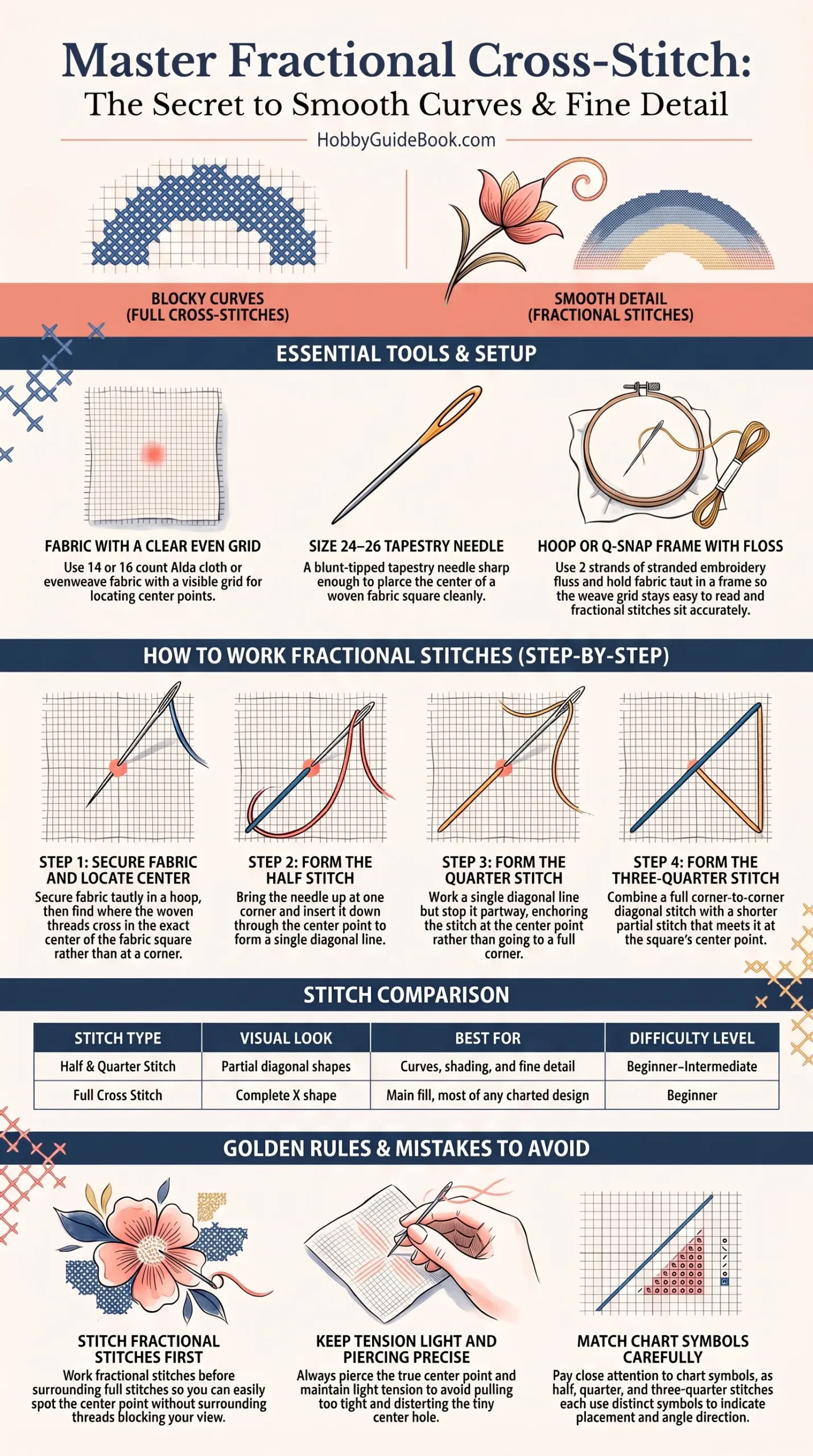
Photo Credit: Hobby Guidebook Editorial
Why Half & Quarter Stitch Trips Up So Many Beginners
I've unpicked more knotted thread than I'd like to admit, and half and quarter stitch is where I really learned that most frustration traces back to tension and fabric handling, not actual skill. These fractional stitches need a tiny hole right in the center of the fabric square, and getting that placement wrong throws the whole shape off.
Learning the three-quarter stitch technique mostly comes down to patience with your needle placement. Once you've located that center point a few times, it stops feeling so fiddly.
What Fabric, Thread, and Needle Work Best?
Fractional cross stitch needs a fabric with a clear, even grid, since you're working with partial squares instead of full ones.
|
Item |
Purpose |
|
Aida cloth (14 or 16 count) |
Evenweave fabric with a visible grid, needed for locating center points |
|
Stranded embroidery floss (2 strands) |
Standard thread, matches most charted patterns |
|
Tapestry needle, size 24-26 |
Blunt tip, sharp enough to pierce the center of a woven square |
|
Embroidery hoop or Q-snap frame |
Keeps fabric taut so fractional stitches sit accurately |
How Do You Work Half & Quarter Stitch Step by Step?
Learning fractional cross stitch comes down to stitching partial diagonals that meet at the center of a fabric square instead of the corner.
- Secure your fabric in a hoop, keeping it taut so the grid stays clear and easy to read.
- Locate the center of the square, where the woven threads cross in the middle rather than at a corner.
- For a half stitch, bring the needle up at one corner and insert it down through that center point, forming a single diagonal.
- For a quarter stitch, work the same single diagonal but stop it partway, anchoring at the center rather than a full corner.
- For a three-quarter stitch, combine a full diagonal with a shorter partial stitch meeting it at the center point.
- Check your chart symbol carefully, since half, quarter, and three-quarter stitches each use a different symbol to show direction and placement.
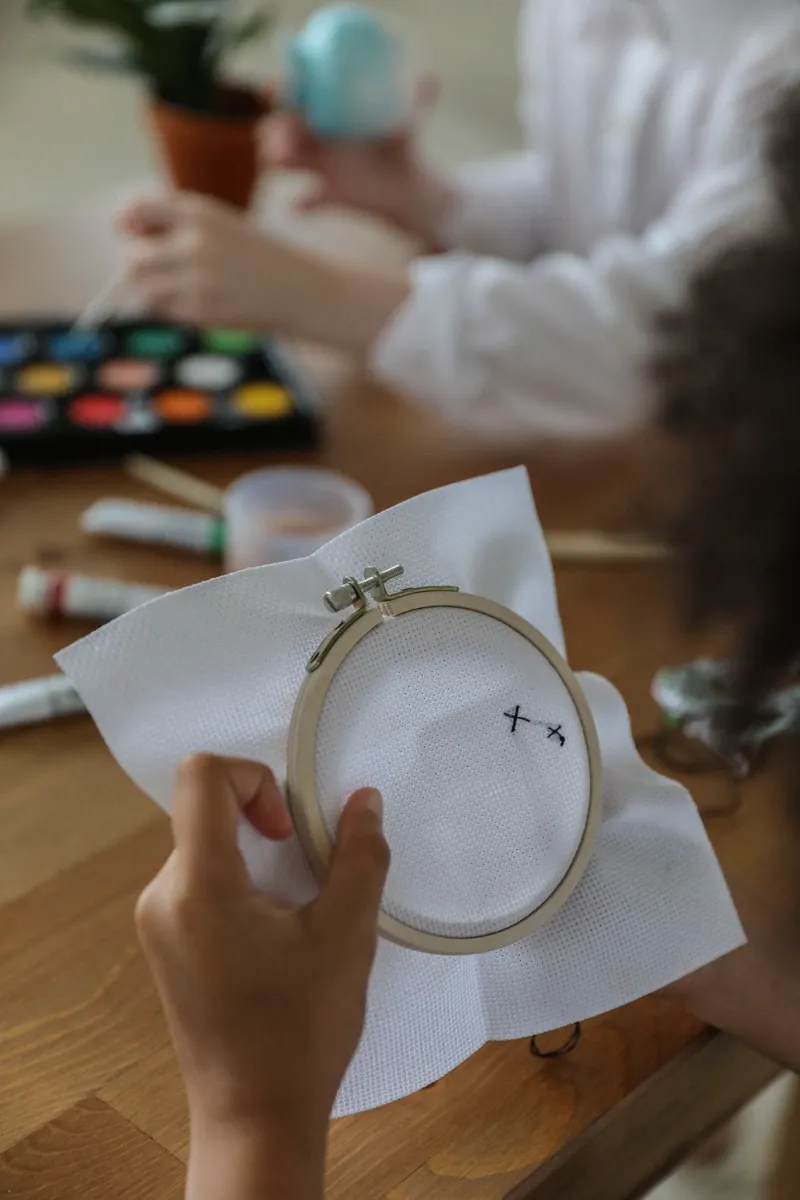
Photo Credit: Monstera Production
How Do You Keep Stitches Even and Consistent?
A few habits keep fractional stitches looking clean instead of messy.
- Always pierce the true center of the square, not just somewhere close to it
- Keep tension light, since pulling too tight can distort the tiny center hole over time
- Match stitch direction to your chart, since fractional stitches can angle either way depending on the design
- Work fractional stitches before surrounding full stitches, so you can find the center point without other threads in the way
"The small stitches are what separate a flat picture from one that looks like it curves." That's a fair way to think about fractional stitch, since these tiny partial Xs are what give a design its soft, rounded edges.
Once you're comfortable with fractional stitches, our full cross stitch tutorial is a good refresher on the standard X stitch these techniques build from.
Comparing Half & Quarter Stitch to Full Cross Stitch
|
Stitch |
Look |
Best For |
Difficulty |
|
Half & Quarter Stitch |
Partial diagonal shapes |
Curves, shading, fine detail |
Beginner-Intermediate |
|
Full Cross Stitch |
Complete X shape |
Main fill, most of any charted design |
Beginner |
For adding fine outline detail alongside these fractional stitches, our guide to backstitch in cross-stitch covers the outlining technique that often finishes off a piece.

Photo Credit: cottonbro studio
What Mistakes Are Most Common?
A few habits trip up most beginners learning half and quarter stitch.
- Missing the true center point, which skews the angle of the fractional stitch
- Confusing chart symbols, mixing up half, quarter, and three-quarter placements
- Pulling too tight, distorting the tiny center hole in the fabric
- Stitching fractional stitches last, making the center point hard to find under surrounding threads
Safety note: keep your tapestry needle stored in a pincushion or needle case between sessions rather than left loose on your worktable, especially if kids or pets are nearby.
Frequently Asked Questions
What is half & quarter stitch used for? Half and quarter stitch are used for curves, angled edges, and shading detail in charted cross-stitch designs.
How do you work half & quarter stitch step by step? Locate the center of the fabric square, then stitch a partial diagonal that meets at that center point instead of a corner.
What fabric, thread, and needle work best? 14 or 16 count Aida cloth, 2 strands of embroidery floss, and a size 24-26 tapestry needle work well for fractional stitches.
How do you keep the stitches even and consistent? Always pierce the true center point, keep tension light, and match stitch direction to your chart symbol.
What mistakes are most common? Missing the center point, confusing chart symbols, pulling too tight, and stitching fractional stitches out of order are the most common mistakes.
Final Thoughts
Half and quarter stitch takes a bit more precision than a full cross, but it's what gives your finished piece those smooth, rounded details. Practice finding the center point on a scrap of Aida first, and the technique will start to feel natural.
For more on getting started, read the full embroidery & cross-stitch guide.






Leave a Reply