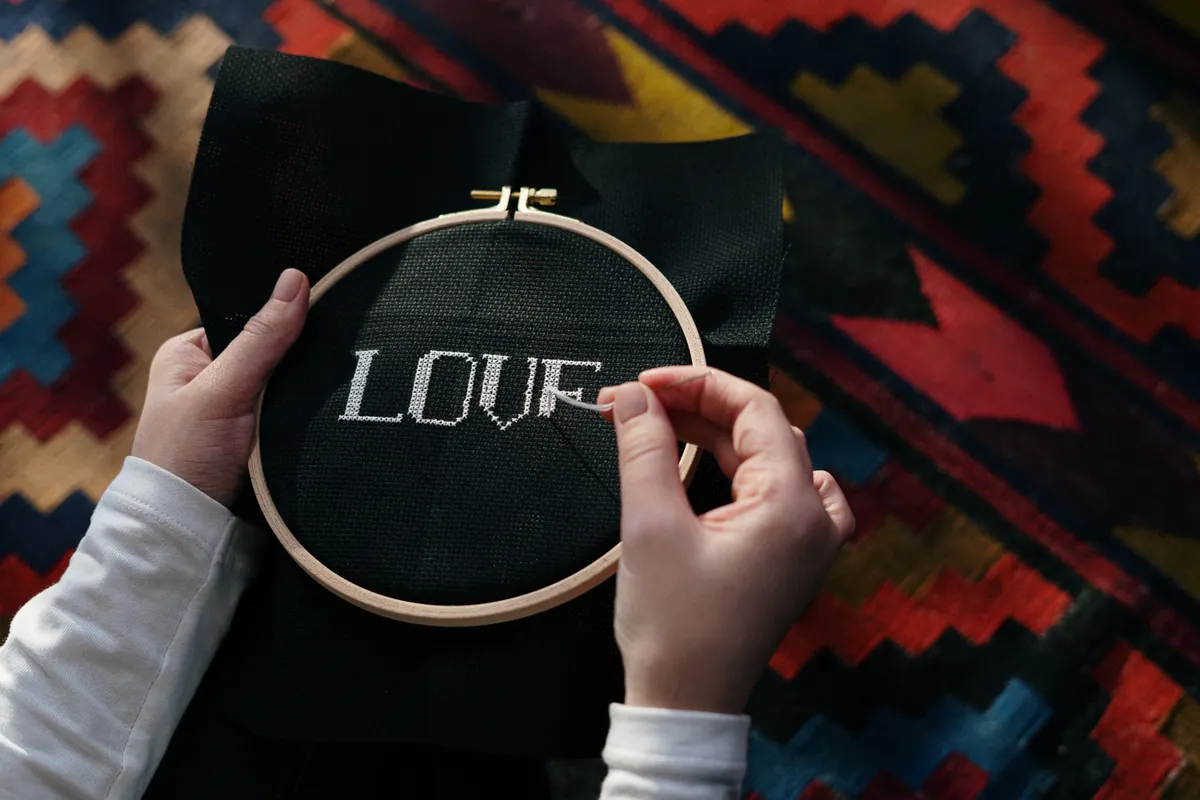
A single spool of black thread and a grid of tiny repeating shapes can somehow look more detailed than a piece stitched in a dozen colors. Blackwork embroidery pulls that off through pattern alone, using nothing but black stitches on white fabric to create real visual depth.
This article is part of our Embroidery & Cross-Stitch Techniques Explained series, and it walks through the core skills for getting started with blackwork.
What Is Blackwork Embroidery Used For?
Blackwork is a form of counted thread geometric embroidery, where repeating patterns are stitched over a counted grid to fill shapes or create standalone designs. It's used for framed geometric art, clothing embellishment, and detailed borders on linens.
Unlike counted needlepoint basics worked on stiff canvas, blackwork is stitched on soft, even-weave fabric, relying on pattern repetition rather than solid coverage to create its distinctive look.
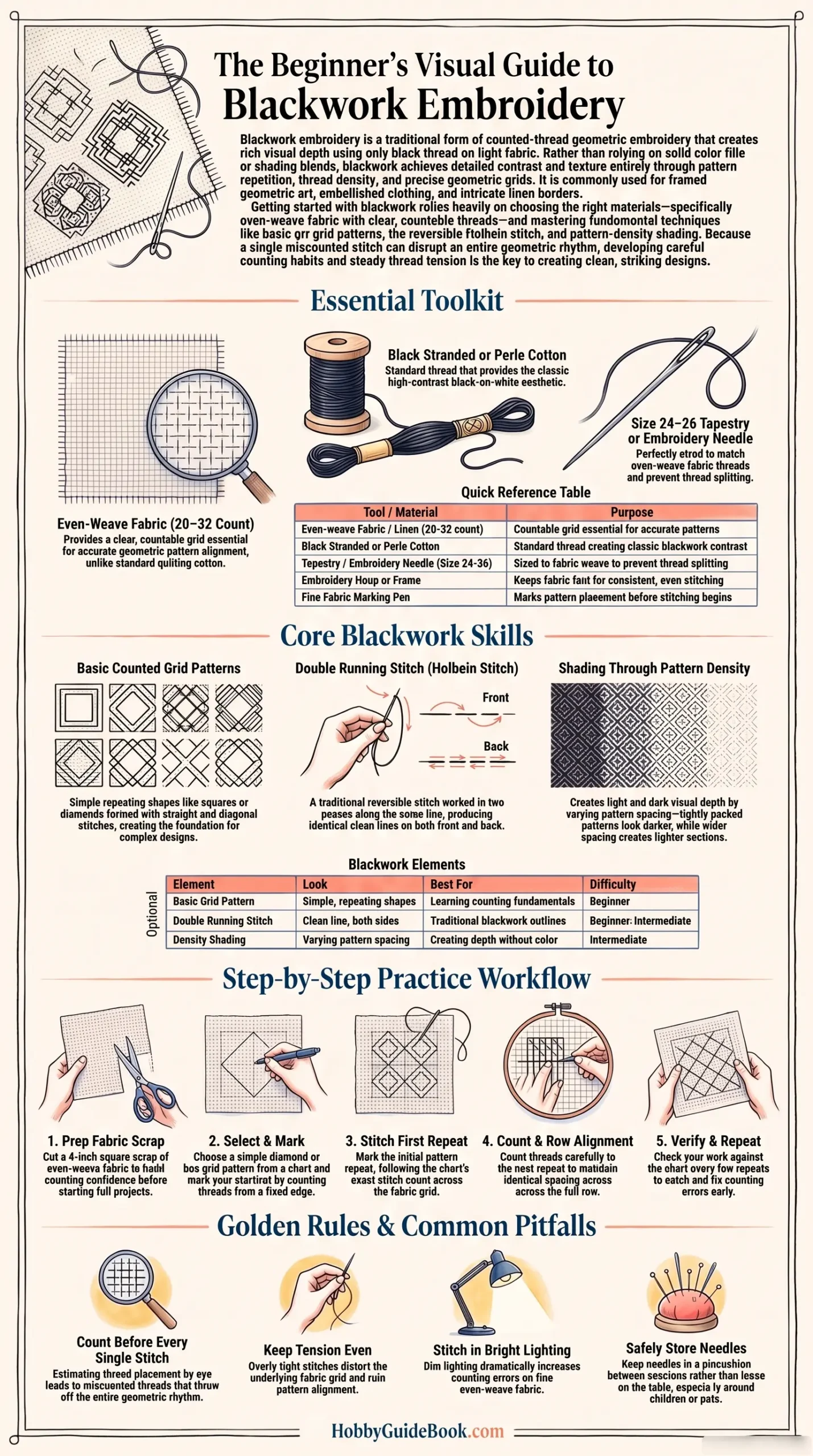
Photo Credit: Hobby Guidebook Editorial
Why Blackwork Rewards Patience
I've unpicked more knotted thread than I'd like to admit, and blackwork taught me that counting mistakes are far easier to spot in a repeating geometric pattern than in a filled shape. One misplaced stitch throws off the whole rhythm, and it shows immediately.
Most beginner frustration with blackwork embroidery traces back to miscounting and inconsistent tension, not a lack of skill. Once you slow down and count carefully, the repeating patterns actually become soothing to work through.
What Fabric, Thread, and Needle Work Best?
Blackwork depends on even-weave fabric with a clear, countable grid.
|
Item |
Purpose |
|
Even-weave fabric or linen (28-32 count) |
Countable grid, essential for accurate patterns |
|
Black stranded cotton or perle cotton |
Standard thread, creates classic blackwork contrast |
|
Embroidery needle or tapestry needle, size 24-26 |
Sized to fabric weave, prevents thread splitting |
|
Embroidery hoop or frame |
Keeps fabric taut for consistent, even stitching |
|
Fine fabric marking pen |
Marks pattern placement before stitching begins |
Even-weave fabric matters more here than in most embroidery styles, since blackwork's geometric patterns rely on precise, evenly spaced counting. Standard quilting cotton lacks the clear grid needed to count accurately.
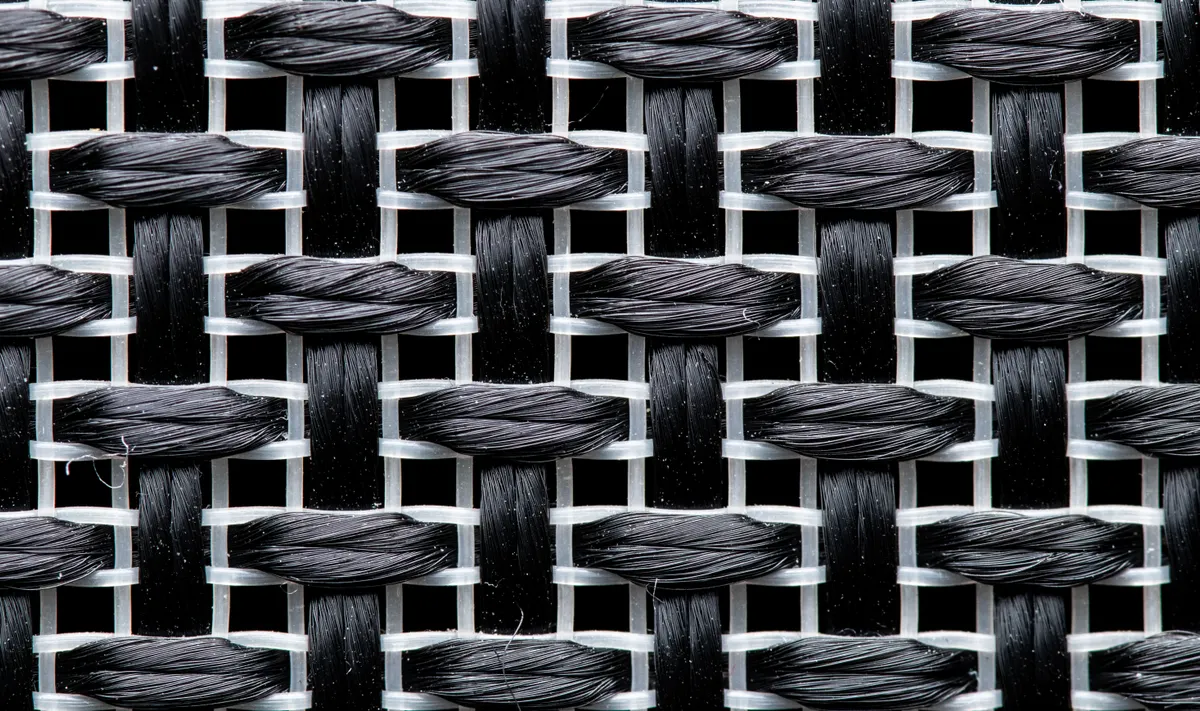
Photo Credit: Jorge Urosa
The Core Blackwork Skills to Learn
A few foundational habits and pattern types cover most beginner blackwork projects.
Basic Counted Grid Patterns
Simple repeating shapes, like small squares or diamonds, worked using straight and diagonal stitches across the even-weave grid. These form the foundation most other blackwork patterns build on.
Double Running Stitch
Also called Holbein stitch, this reversible stitch is worked in two passes along the same line, creating a clean line on both the front and back of the fabric. It's the traditional stitch most associated with blackwork.
Shading Through Pattern Density
Rather than blending colors, blackwork creates shading by varying how tightly patterns repeat. Denser, closer patterns read as darker areas, while looser spacing creates lighter visual sections.
How Do You Work Blackwork Embroidery Step by Step?
Basic counted grid patterns are the best starting point, since they teach the core counting and spacing skills blackwork depends on.
- Choose a simple repeating pattern, like a small diamond or box shape, from a beginner blackwork chart.
- Mark your starting point on the even-weave fabric, counting threads carefully from a fixed edge.
- Work the first pattern repeat, following the chart's stitch count exactly.
- Count threads to the next repeat, keeping spacing identical across the whole row.
- Continue the pattern, checking every few repeats against the chart to catch counting errors early.
- Finish rows steadily, resisting the urge to speed up once the rhythm feels familiar.
Our full blackwork basic patterns guide breaks this down with more chart examples, useful once the core counting motion feels comfortable.
How Do You Keep Stitches Even and Consistent?
Consistency in blackwork depends almost entirely on careful counting and steady tension.
- Count threads before every stitch, rather than estimating placement by eye
- Keep tension even throughout, since tight stitches distort the grid pattern's spacing
- Check pattern repeats often, comparing your work against the chart every few rows
- Work in good lighting, since counting individual fabric threads gets much harder in dim light
"In blackwork, the pattern is the picture, so every stitch has to land exactly right." That's genuinely the mindset shift that helps most, since even one miscounted stitch disrupts the whole geometric rhythm.
Comparing Core Blackwork Elements
|
Element |
Look |
Best For |
Difficulty |
|
Basic Grid Pattern |
Simple, repeating shapes |
Learning counting fundamentals |
Beginner |
|
Double Running Stitch |
Clean line, both sides |
Traditional blackwork outlines |
Beginner-Intermediate |
|
Density Shading |
Varying pattern spacing |
Creating depth without color |
Intermediate |
What Mistakes Are Most Common?
A few habits show up again and again with stitchers new to blackwork.
- Miscounting threads, throwing off an entire pattern repeat partway through
- Inconsistent tension, distorting the geometric grid the pattern relies on
- Choosing complex patterns too early, before basic counting feels comfortable
- Skipping a hoop or frame, making fabric shift and counting harder to control
- Working in poor lighting, missing small counting errors until much later
Safety note: keep your needle stored in a pincushion between sessions rather than loose on your worktable, especially if you're stitching around kids or pets.
A Simple Practice Plan
If blackwork feels intimidating, this short practice sequence builds real counting confidence.
- Cut a small scrap of even-weave fabric, roughly 4 inches square.
- Choose one simple pattern, like a small diamond grid, from a beginner chart.
- Stitch three full rows, counting threads carefully between each repeat.
- Compare your work to the chart, checking for any drifted spacing.
- Try double running stitch along one edge, focusing on the clean, reversible line.
Photo Credit: Olga Kalinina
This kind of focused practice, maybe twenty to thirty minutes, builds real counting accuracy faster than jumping straight into a full geometric design.
Frequently Asked Questions
What is blackwork embroidery used for? Blackwork embroidery is used to create geometric patterns, framed art, and detailed borders using black thread on counted fabric.
How do you work blackwork embroidery step by step? Choose a repeating pattern, count fabric threads carefully, then stitch each repeat consistently across the row, checking against the chart often.
What fabric, thread, and needle work best? Even-weave linen, black stranded or perle cotton, and a size 24-26 needle work well for most blackwork projects.
How do you keep the stitches even and consistent? Count threads before every stitch, keep tension even, and check pattern repeats often against the chart.
What mistakes are most common? Miscounting threads, inconsistent tension, and choosing complex patterns before basic counting feels comfortable are the most common mistakes.
Final Thoughts
Blackwork embroidery takes real patience with counting, but the payoff is a striking design built entirely from repeating pattern and thread. Start with a simple grid pattern on scrap fabric, and the counting rhythm will feel natural before long.
For more on getting started, read the full embroidery & cross-stitch guide.





Leave a Reply