
Open a craft store thread aisle and you'll find dozens of skeins that all look roughly the same at first glance, yet each one behaves completely differently under a needle. Knowing your embroidery floss and thread types before you buy saves you from picking the wrong one and wondering why your stitches look off.
This article is part of our Embroidery & Cross-Stitch Materials & Tools Guide, and it covers the main thread types, strand counts, and which option actually suits a beginner project.
What Are the Main Types of Embroidery Floss and Thread?
Embroidery floss and thread come in several main types, and each one is built for a different look or technique. The most common is stranded cotton, followed by pearl cotton, satin thread, wool thread, and metallic thread, each with its own texture and finished appearance.
Most patterns you'll find, especially beginner ones, are written around stranded cotton, which is why it's worth understanding first before branching into anything specialty.
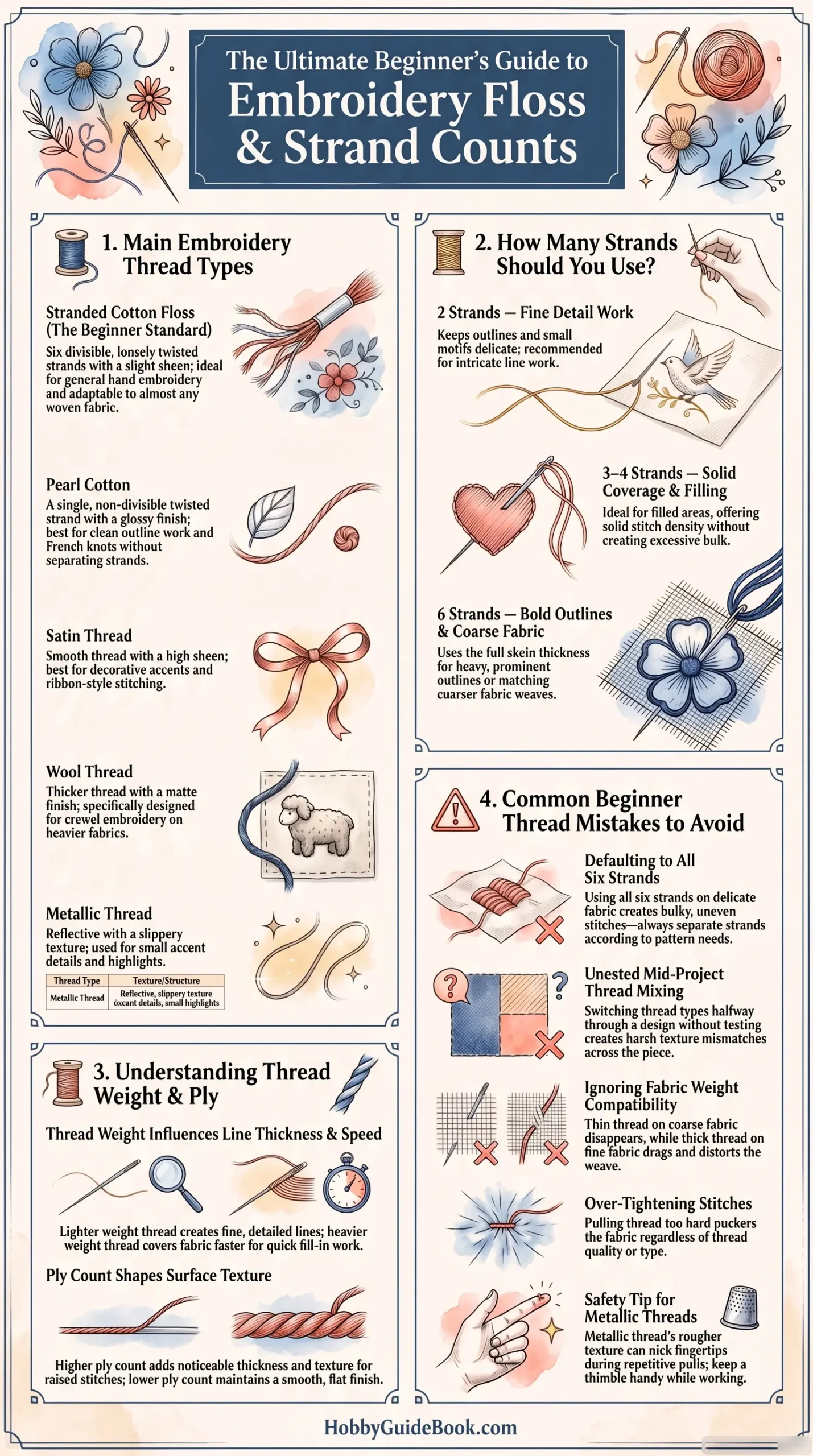
Photo Credit: Hobby Guidebook Editorial
Why Thread Choice Trips Up Beginners
I've unpicked more knotted thread than I'd like to admit, and a good chunk of those knots came from using the wrong thread for the job, not bad technique. Thick pearl cotton forced through a small needle eye tangles constantly, while thin stranded floss used alone on heavy fabric barely shows up at all.
Most beginner frustration traces back to tension, not skill, and thread type plays into that more than people expect, since the wrong thread drags or twists no matter how careful your stitching hand is.
What Fabric, Thread, and Needle Work Best?
Thread choice depends heavily on fabric weight and the stitch technique you're planning to use.
|
Thread Type |
Texture |
Best For |
|
Stranded cotton floss |
Six divisible strands, slight sheen |
General hand embroidery, most beginner patterns |
|
Pearl cotton |
Single twisted strand, glossy |
Outline work, French knots, no separating needed |
|
Satin thread |
Smooth, high sheen |
Decorative accents, ribbon-style stitching |
|
Wool thread |
Thicker, matte finish |
Crewel embroidery on heavier fabric |
|
Metallic thread |
Reflective, slippery texture |
Accent details, small highlight areas |
What Is Stranded Cotton Embroidery Floss?
Stranded cotton floss is the most widely used embroidery thread, made of six thin strands twisted loosely together into one skein. You separate out however many strands your project needs, then thread just that number through your needle.
This is the thread most beginner kits include, since it's affordable, widely available, and flexible enough to work on almost any woven fabric.

Photo Credit: Pao Jaramillo
How Many Strands of Embroidery Floss Should You Use?
Strand count changes the thickness and coverage of your stitch, and getting it right takes a bit of matching to your fabric and design.
- Check your pattern first, since most charted designs specify the exact strand count for each section.
- Use 2 strands for fine detail work, keeping outlines and small motifs delicate.
- Use 3-4 strands for filled areas, giving solid coverage without excessive bulk.
- Use 6 strands for bold outlines or heavier fabric, matching thickness to a coarser weave.
- Test on scrap fabric first, checking how the strand count actually looks before committing to your real project.
For a closer breakdown of strand counts by stitch type, our embroidery floss strand guide walks through exact numbers for common techniques.
How Do Thread Weight and Ply Affect Stitch Coverage?
Thread weight and ply, meaning how many twisted strands make up the thread, directly change how much coverage a single stitch gives.
- Lighter weight thread produces finer, more delicate lines, ideal for detailed outline work
- Heavier weight thread covers more fabric per stitch, useful for bold designs or faster fill-in
- Higher ply count adds thickness and texture, which shows up clearly in raised or textured stitches
- Lower ply count keeps stitches flatter and smoother, better suited to fine detail areas
"Thread should match the story your fabric is telling." That's held true across my own projects, since delicate floral work always calls for finer thread, while bold lettering or geometric fill needs the heavier coverage a thicker thread provides.
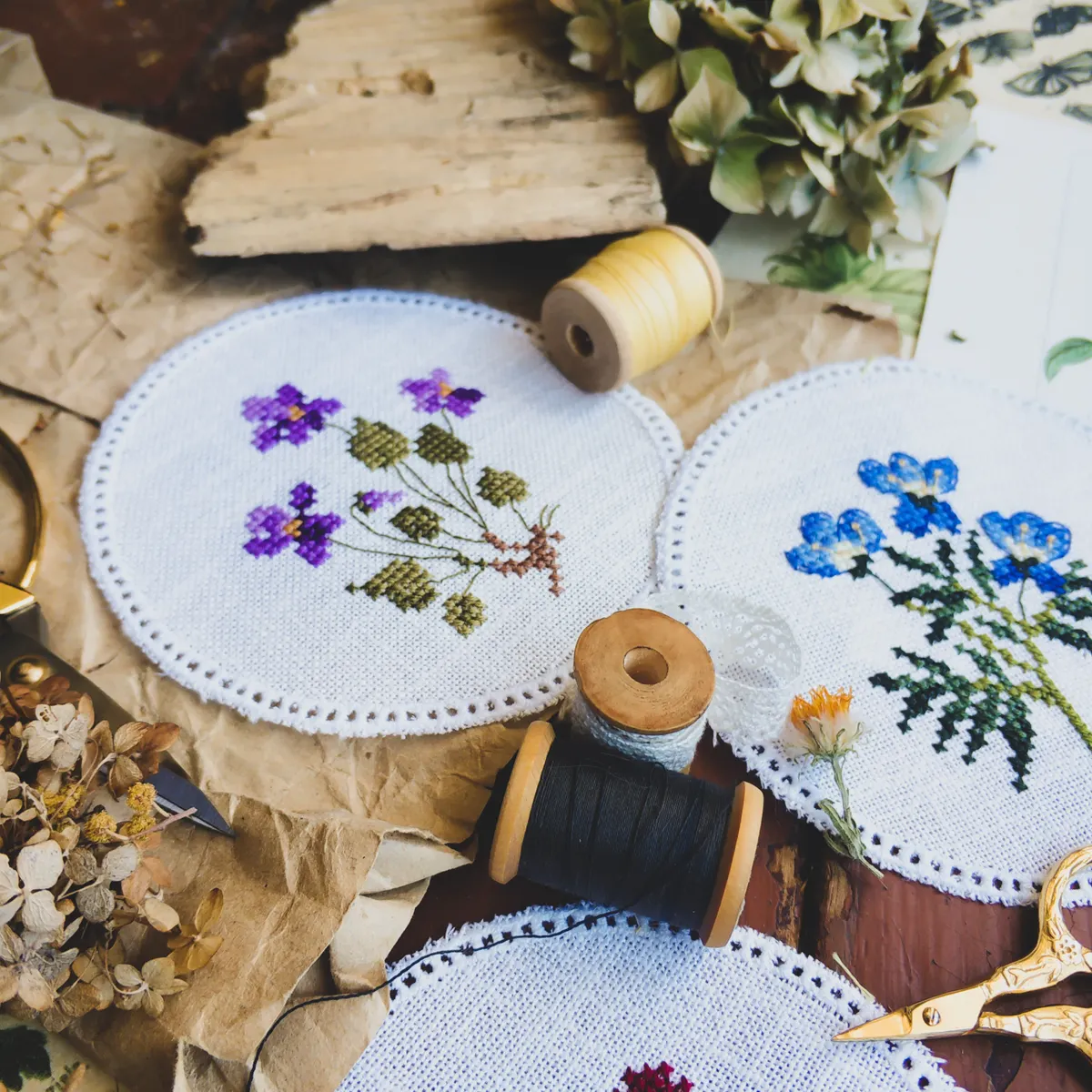
Photo Credit: Olga Kalinina
Which Embroidery Thread Is Easiest for Beginners?
Stranded cotton floss is by far the easiest thread for beginners, since it's forgiving to work with, widely available in craft stores, and flexible enough to adjust strand count as your project changes.
It also pairs well with almost any embroidery fabric, which matters when you're still figuring out how fabric weight and thread thickness work together. Our embroidery fabric guide covers what to look for when choosing fabric to pair with your thread.
What Mistakes Are Most Common?
A few habits trip up most beginners choosing embroidery thread.
- Using all six strands by default, creating bulky, uneven stitches on delicate fabric
- Mixing thread types mid-project without testing, causing inconsistent texture across the design
- Ignoring fabric weight when picking thread, resulting in thread that's either too thin or too thick for the weave
- Pulling thread too tightly through fabric, which puckers material regardless of which thread type you're using
Safety note: when working with metallic thread, keep a thimble handy, since its slightly rougher texture can catch and nick fingertips more easily than smooth cotton floss during repeated pulls.
Frequently Asked Questions
What are the main types of embroidery floss and thread? The main types are stranded cotton, pearl cotton, satin thread, wool thread, and metallic thread, each suited to different textures and techniques.
What is stranded cotton embroidery floss? Stranded cotton floss is a six-strand twisted thread you separate into smaller groups, and it's the most common thread used in embroidery patterns.
How many strands of embroidery floss should you use? Use 2 strands for fine detail, 3-4 for filled areas, and up to 6 for bold outlines or coarser fabric, always checking your pattern first.
How do thread weight and ply affect stitch coverage? Lighter weight thread gives finer lines, heavier weight covers more fabric per stitch, and higher ply adds texture while lower ply keeps stitches flatter.
Which embroidery thread is easiest for beginners? Stranded cotton floss is easiest for beginners, since it's affordable, widely available, and flexible enough to adjust strand count as needed.
Final Thoughts
Embroidery floss and thread types each bring something different to a finished piece, and matching them to your fabric makes every stitch look more intentional. Start with stranded cotton, get comfortable adjusting strand count, and branching into specialty threads will feel like a natural next step.
For more on getting started, read the full embroidery & cross-stitch guide.





Leave a Reply