A tiny disc of wax sitting in the bottom of my sewing box has saved me more frustration than almost any other tool I own, and it costs less than a cup of coffee. This guide to embroidery thread conditioner and wax covers what it actually does, when to use it, and why a quick swipe before stitching can stop a lot of tangling before it starts.
Thread care is one small piece of a well stocked kit, and our Embroidery & Cross-Stitch Materials & Tools Guide covers the rest of what's worth having on hand.
What Does Thread Conditioner Do for Embroidery Floss?
Thread wax for embroidery coats each strand with a thin, smooth layer that reduces friction as the thread passes through fabric. That coating helps floss glide more evenly, resists fraying at the tip, and keeps twisted strands from separating mid stitch.
I've unpicked more knotted thread than I'd like to admit, and looking back, most of that frustration traced to tension and friction, not skill. A conditioned thread simply moves through fabric with less resistance, which means fewer snags pulling your tension out of shape as you work.
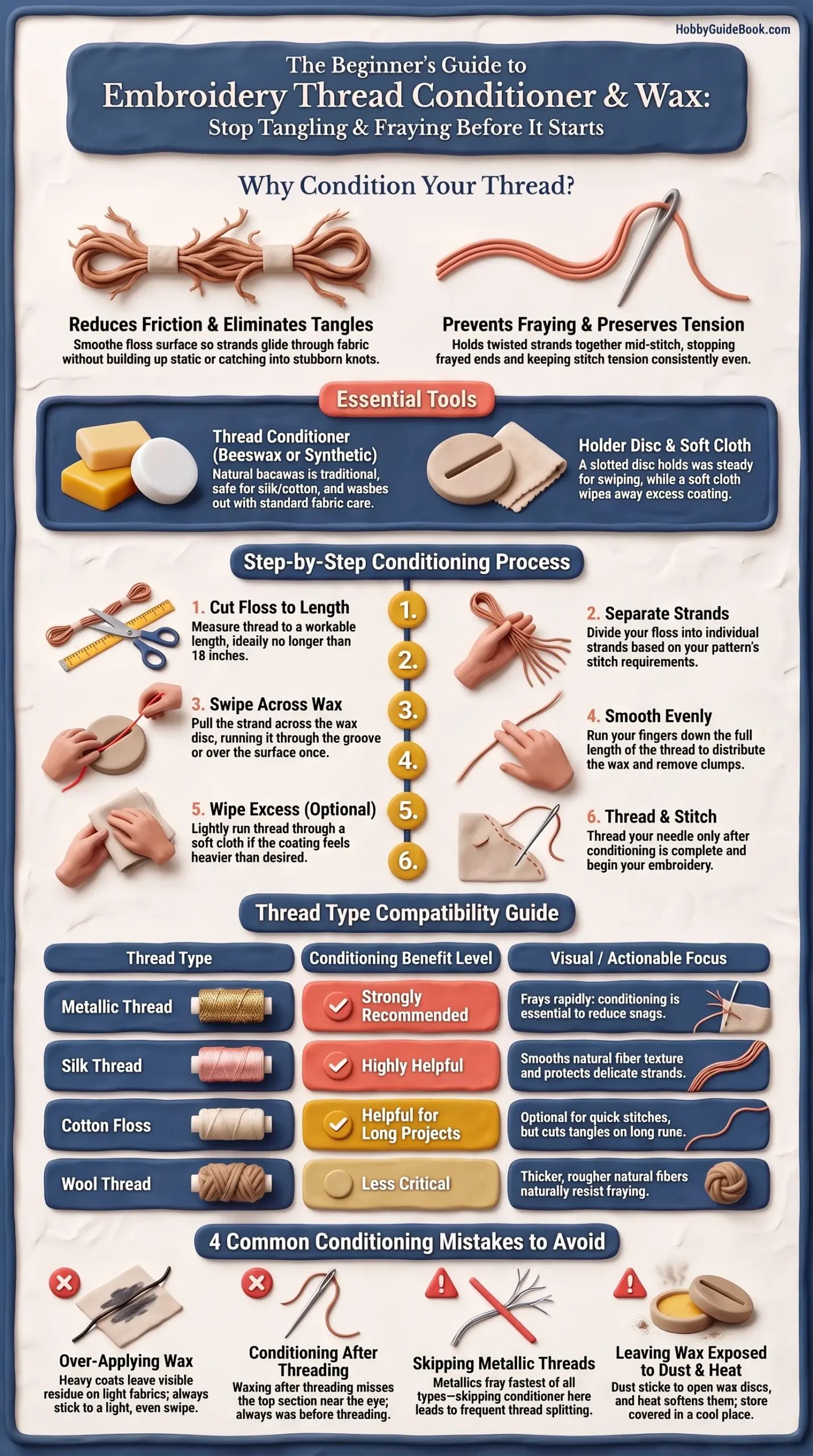
Photo Credit: Hobby Guidebook Editorial
When Should You Use Thread Conditioner Before Stitching?
Apply conditioner right after cutting your thread to length, before threading the needle. Conditioning floss before stitching works best at that exact moment, since the wax needs contact with the full length of thread to coat it evenly.
It's especially useful for longer stitching sessions, projects using metallic or specialty threads, or any piece worked through tightly woven fabric like Aida cloth or linen, where friction builds up fastest.
Materials Needed for Conditioning Thread
|
Material |
Purpose |
|
Beeswax or synthetic thread conditioner |
Coats thread to reduce friction and fraying |
|
Small conditioner disc or case |
Holds wax steady for repeated swiping |
|
Embroidery floss or specialty thread |
The material being conditioned before stitching |
|
Soft cloth |
Wipes away any excess wax residue |
|
Embroidery needle |
Threaded after conditioning is complete |
How Do You Condition Thread Step by Step?
- Cut your thread to a workable length, generally no longer than about eighteen inches.
- Separate strands if needed, since floss is often divided before use depending on the stitch.
- Pull the thread across the wax disc, running it through the groove or over the surface once.
- Run your fingers down the length, smoothing the wax evenly rather than leaving it clumped in spots.
- Wipe off any excess with a soft cloth if the coating feels heavier than you'd like.
- Thread your needle and begin stitching as usual.
Photo Credit: Rumeysa Demir
Is Beeswax Safe to Use on Embroidery Thread?
Yes, beeswax is a traditional and widely used option, safe for most cotton and silk embroidery thread. It's a natural product with a long history in hand sewing, and it washes out along with normal fabric care once a project is finished.
That said, beeswax can leave a very faint residue on lighter fabrics if applied too heavily. A light, even coat avoids that issue, and testing on a scrap piece first is a smart habit if you're unsure how your specific fabric reacts.
Can Thread Conditioner Reduce Tangling and Fraying?
Yes, and this is really the main reason stitchers reach for it. Untreated thread picks up static and friction as it repeatedly passes through fabric, which is exactly what causes those small frayed ends and sudden knots partway through a row.
"Even tension makes even stitches." Conditioner supports that same goal from a different angle, since smoother thread glides through fabric with less resistance, which naturally helps keep your tension steady stitch after stitch.
Do All Types of Embroidery Thread Benefit From Conditioning?
Most thread types benefit, but some more than others. Standard cotton floss holds up fine without conditioner for shorter projects, though longer pieces still see fewer tangles with a light coat applied.
Metallic and specialty threads benefit the most, since their construction tends to fray and catch more easily than plain cotton strands.
|
Thread Type |
Conditioning Benefit |
|
Cotton floss |
Helpful for longer projects, optional for short ones |
|
Metallic thread |
Strongly recommended, reduces fraying significantly |
|
Silk thread |
Helpful, smooths natural fiber texture |
|
Wool thread |
Less critical, thicker fibers resist fraying naturally |
If you're working with a specialty thread and want to understand how it compares to standard floss, our Embroidery Floss & Thread Types guide breaks down the differences in more detail.
What Mistakes Are Most Common?
- Applying too much wax. A heavy coating can leave visible residue on fabric, especially lighter colored pieces.
- Skipping conditioner on metallic thread. This specialty thread frays fastest, and conditioning helps the most here.
- Conditioning after threading the needle. Wax needs to coat the full strand, which is harder to do once it's already through the eye.
- Storing wax uncovered. Dust and lint stick to exposed wax easily, so a covered case keeps it clean between uses.
A quick safety note, keep wax discs away from heat sources like a sunny windowsill, since beeswax softens and can melt out of shape if left somewhere too warm.
Once your thread is conditioned and ready, tracing a fresh pattern is often the next step before stitching begins. Our Embroidery Light Pads & Tracing Tools guide covers how to set up that part of the process.
Photo Credit: Maxi Gagliano
Frequently Asked Questions
What does thread conditioner do for embroidery floss? It coats thread with a thin layer that reduces friction, helping it glide smoothly and resist fraying while you stitch.
When should you use thread conditioner before stitching? Apply it right after cutting thread to length, before threading the needle, so the coating covers the full strand evenly.
Is beeswax safe to use on embroidery thread? Yes, beeswax is a traditional, safe option for most thread types, though a light coat avoids residue on delicate fabric.
Can thread conditioner reduce tangling and fraying? Yes, it smooths the thread's surface, cutting down on the friction and static that usually cause knots and frayed ends.
Do all types of embroidery thread benefit from conditioning? Most do, though metallic and silk threads benefit the most, since they fray more easily than standard cotton floss.
Final Thoughts
Thread conditioner is a small, inexpensive habit that quietly prevents a lot of the tangling stitchers usually blame on bad luck. Keep a disc in your kit, swipe your thread before you start, and you'll likely notice smoother stitching within the very first project.
For more, check out the full embroidery & cross-stitch guide.






Leave a Reply