
I still remember counting the same row of my first cross-stitch chart three times because I kept losing my place on the grid, only to realize afterward I'd stitched an entire section one square off. Beginner cross-stitch projects are exactly where mistakes like that turn into real skill, as long as you start small.
This article is part of our Embroidery & Cross-Stitch Project Ideas for Every Skill Level, and it covers good starter designs, what materials you'll actually need, and how to finish a small piece once the last X is stitched.
What Are Good Beginner Cross-Stitch Projects?
Good beginner cross-stitch projects are small charted designs with a limited color palette, usually under 30 by 30 stitches. Think a tiny heart, a single letter monogram, a small mushroom, or a basic geometric shape from a charted grid pattern.
These bite-sized designs let you focus fully on counting and stitch consistency, without a huge chart overwhelming you before you've even threaded a needle.
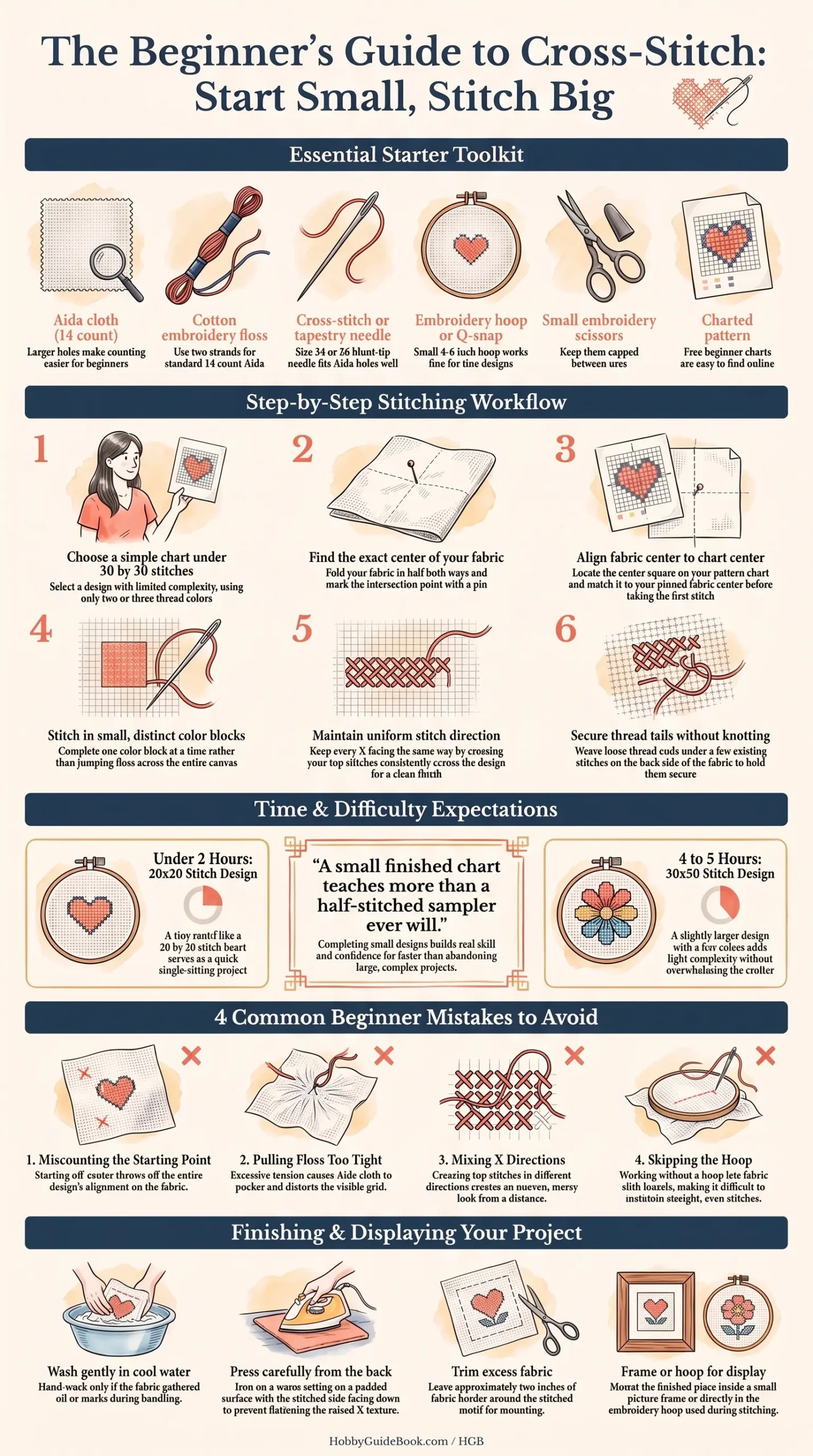
Photo Credit: Hobby Guidebook Editorial
Why Small Charts Teach You the Most
I've unpicked more knotted thread than I'd like to admit, and counted cross-stitch brings its own version of that same lesson, since a small miscount early on throws off everything that follows. A tiny 20 by 20 stitch heart teaches grid counting and even tension far better than a busy sampler ever could, simply because there's less room for a mistake to hide.
Most beginner frustration traces back to tension, not skill, and in cross-stitch that shows up as puckered fabric from pulling floss too tight on every single X. Watching a small charted grid slowly fill in, square by square, gives that same satisfying sense of progress no matter how simple the design is.
What Materials Do You Need for Beginner Cross-Stitch Projects?
Here's what you'll actually need to start stitching, no extras required.
|
Material |
Purpose |
Beginner Tip |
|
Aida cloth (14 count) |
Charted fabric with visible grid |
Larger holes make counting easier for beginners |
|
Cotton embroidery floss |
Main thread for stitching |
Use two strands for standard 14 count Aida |
|
Cross-stitch or tapestry needle |
Carries thread through fabric |
Size 24 or 26 blunt-tip needle fits Aida holes well |
|
Embroidery hoop or Q-snap |
Holds fabric taut while stitching |
Small 4-6 inch hoop works fine for tiny designs |
|
Small embroidery scissors |
Trims thread cleanly |
Keep them capped between uses |
|
Charted pattern |
Grid map showing stitch placement |
Free beginner charts are easy to find online |
How Do You Stitch a Beginner Cross-Stitch Project Step by Step?
Here's a simple process that works for almost any small charted design.
- Choose a simple chart first, picking a design under 30 by 30 stitches with just two or three colors.
- Find the center of your fabric, folding it in half both ways and marking where the folds cross with a pin.
- Locate the chart's center square, matching it to your fabric's center point before your first stitch.
- Stitch in small sections, working one color block at a time rather than jumping across the whole design.
- Keep every X facing the same direction, crossing your top stitch the same way throughout for a neat, even look.
- Secure your thread ends, weaving tails under a few stitches on the back rather than knotting them.
For help actually reading the grid itself, our how to read a cross-stitch pattern guide breaks down symbols and chart keys in more detail.

Photo Credit: Olga Kalinina
How Difficult Are Typical Beginner Cross-Stitch Projects?
Most easy cross-stitch patterns for beginners rank low on the difficulty scale, especially designs using solid Aida fabric and only two or three thread colors. A small heart or single letter is genuinely doable in one sitting, even if you've never picked up a charted pattern before.
Difficulty increases mainly with color count and chart size, not with the cross-stitch itself, which stays the exact same simple X no matter the design. A 50 by 50 stitch design with ten colors will simply take longer and demand more careful counting than a tiny two-color motif.
"A small finished chart teaches more than a half-stitched sampler ever will." That's proven true in my own stitching, since every tiny completed piece taught me something a bigger, abandoned one never got the chance to.
How Long Does a Small Beginner Cross-Stitch Project Take?
Most small beginner cross-stitch projects take somewhere between two and five hours of actual stitching time, depending on chart size and color count. A tiny 20 by 20 stitch design might take under two hours, while a slightly larger 30 by 30 piece with a few colors usually runs closer to four or five hours total.
Expect your first couple of projects to take longer than these estimates, since new stitchers move slower while learning to count accurately and manage tension at the same time. That slows down naturally as your eyes and hands get used to the grid.
What Mistakes Should Beginners Watch Out For?
A handful of habits trip up nearly every new cross-stitcher at some point.
- Miscounting the starting point, throwing off the entire design's placement on the fabric
- Pulling floss too tight, causing Aida cloth to pucker and distort the grid
- Mixing X directions, crossing some stitches one way and others the opposite way, which looks uneven from a distance
- Skipping the hoop, letting fabric shift loosely and making it harder to keep stitches lined up
Safety note: embroidery scissors and needles are sharp by design, so store them in a small case between sessions, especially if you're stitching around young kids or curious pets.
How Do You Finish or Display a Beginner Cross-Stitch Project?
Once your stitching is done, a few simple finishing steps turn a small charted piece into something worth showing off.
- Wash gently if needed, hand-washing in cool water only if the piece picked up any marks while stitching
- Press carefully from the back, using a warm iron on a padded surface with the stitched side facing down to avoid flattening the X texture
- Trim excess fabric, leaving about two inches around the design for framing or hooping
- Frame or hoop the finished piece, using either a small picture frame or the same hoop you stitched it in for an easy display option
If you enjoyed the counting and want to try something with a bit more variety, our cross-stitch sampler projects guide covers slightly bigger designs that combine several small motifs into one piece.

Photo Credit: Olga Kalinina
Frequently Asked Questions
What are good beginner cross-stitch projects? Small charted designs under 30 by 30 stitches, like a tiny heart, letter, or simple shape, work best for starting out.
What materials do you need for beginner cross-stitch projects? Aida cloth, embroidery floss, a cross-stitch needle, a hoop, small scissors, and a charted pattern cover the basics.
How difficult are typical beginner cross-stitch projects? Most simple charts are genuinely easy, with difficulty rising mainly with more colors and larger designs, not stitch difficulty itself.
How long does a small beginner cross-stitch project take? Most small projects take two to five hours, though beginners often move a bit slower while learning to count accurately.
How do you finish or display a beginner cross-stitch project? Wash gently if needed, press carefully from the back, trim excess fabric, and frame or hoop the finished piece.
Final Thoughts
Beginner cross-stitch projects work best when they're small enough to finish without losing count along the way, since a completed piece teaches far more than an abandoned one ever could. Pick one simple chart, gather your basic supplies, and enjoy watching that small grid slowly fill in, one X at a time.
For more on getting started, read the full embroidery & cross-stitch guide.



Leave a Reply