
Nothing derails a counted cross-stitch project faster than losing your place among a handful of scattered, single stitches that don't line up in neat rows. This cross-stitch confetti stitching guide covers exactly how to place those lone stitches accurately, without losing count or second guessing every square on the chart.
Confetti stitching is one of several charted techniques worth knowing well, and our Cross-Stitch Stitch Types guide is a good place to see how it compares to the more structured stitching methods.
What Is Cross-Stitch Confetti Stitching?
Confetti stitching refers to single, isolated cross stitches scattered across a pattern rather than grouped into solid blocks of color. This isolated cross stitch technique shows up constantly in patterns with speckled backgrounds, like night skies, gravel paths, or textured fabric prints.
I've unpicked more knotted thread than I'd like to admit while rushing through confetti sections, mostly from miscounting squares between scattered stitches. Slowing down here made a bigger difference than any tool or trick I've picked up since.
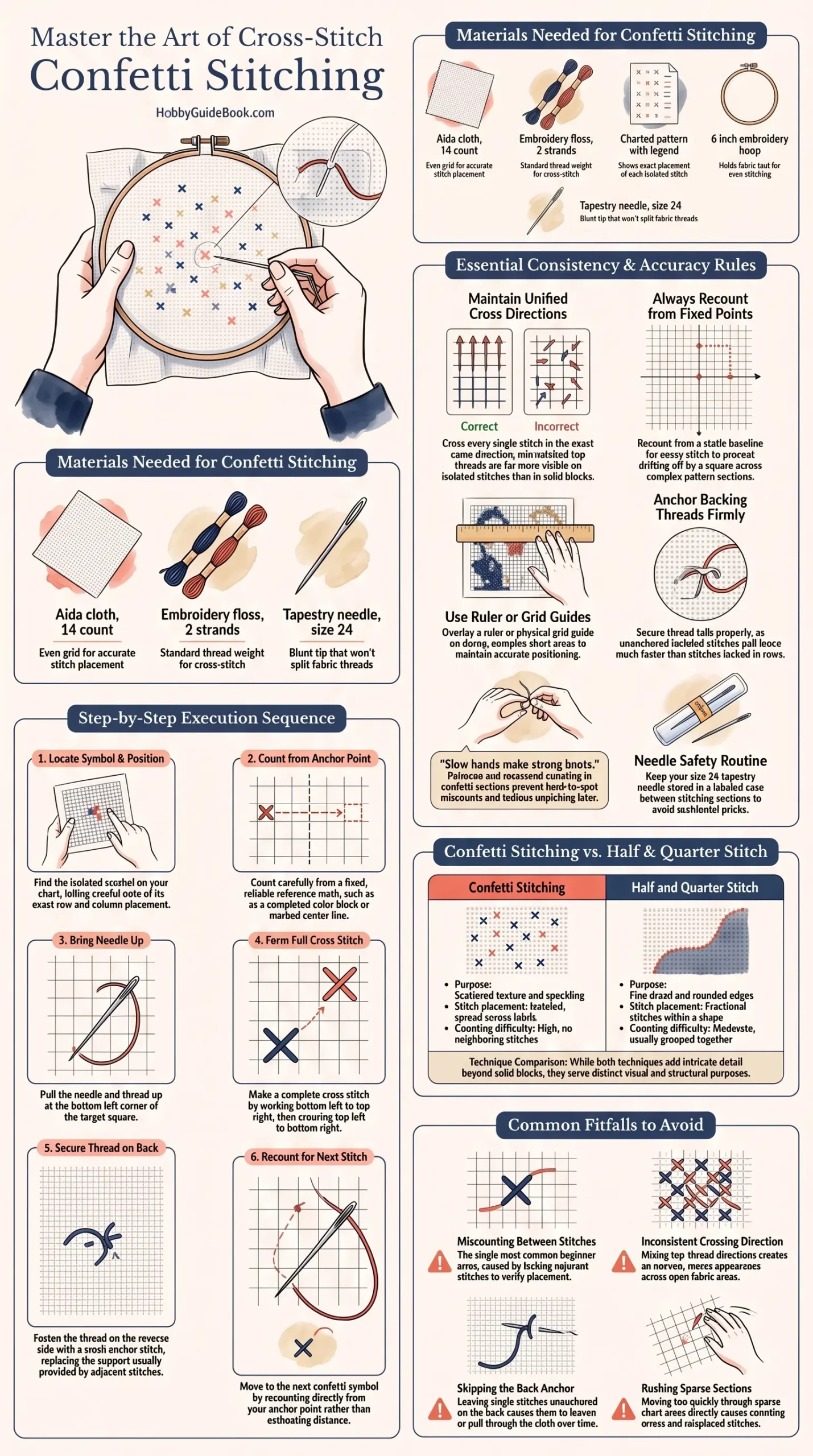
Photo Credit: Hobby Guidebook Editorial
What Is Cross-Stitch Confetti Stitching Used For?
Confetti stitches cross-stitch pattern work is used anywhere a design calls for scattered texture instead of a solid color block, think starry skies, sandy beaches, or the speckled look of stone and bark. It's also common in portrait style patterns, where a few isolated stitches blend colors together for subtle shading.
Because these stitches sit alone rather than in a row, they demand more careful counting than blocked areas do. If your pattern mixes confetti sections with large solid areas, our Basketweave Stitch Tutorial covers a technique better suited to those bigger blocks.
Materials Needed for Confetti Stitching
|
Material |
Purpose |
|
Aida cloth, 14 count |
Even grid for accurate stitch placement |
|
Embroidery floss, 2 strands |
Standard thread weight for cross-stitch |
|
Tapestry needle, size 24 |
Blunt tip that won't split fabric threads |
|
6 inch embroidery hoop |
Keeps fabric taut for precise counting |
|
Charted pattern with legend |
Shows exact placement of each isolated stitch |
How Do You Work Cross-Stitch Confetti Stitching Step by Step?
- Locate the isolated symbol on your chart, noting its exact row and column position.
- Count carefully from a nearby anchor point, like a completed block or a marked center line.
- Bring the needle up at the bottom left corner of that single square.
- Complete one full cross stitch, crossing top left to bottom right, then bottom left to top right.
- Secure the thread on the back with a small anchor stitch, since a single stitch has no neighboring stitches to hold it in place.
- Move to the next confetti symbol, recounting from your anchor point rather than guessing distance.

Photo Credit: Büşra Ş
How Do You Keep the Stitches Even and Consistent?
- Cross every stitch the same direction, since mismatched crosses stand out more on isolated stitches than in blocks.
- Recount from a fixed point for each new stitch, rather than counting from the last one you placed.
- Use a ruler or grid guide on complex sections, since it's easy to drift off by a square without one.
- Anchor thread securely on the back, since isolated stitches can pull loose more easily than stitches worked in a row.
"Slow hands make strong knots." That advice applies well beyond knots. Confetti sections reward patience, since a rushed count here is much harder to spot and fix than a mistake in a solid block.
Confetti Stitching vs Half and Quarter Stitch
Both techniques add detail beyond standard full cross stitches, but they solve different problems.
|
Feature |
Confetti Stitching |
Half and Quarter Stitch |
|
Purpose |
Scattered texture and speckling |
Fine detail and rounded edges |
|
Stitch placement |
Isolated, spread across fabric |
Fractional stitches within a shape |
|
Counting difficulty |
High, no neighboring stitches |
Moderate, usually grouped together |
Our Half & Quarter Stitch Tutorial is worth reading next if your pattern also calls for fractional stitches alongside confetti sections.
What Mistakes Are Most Common?
- Losing count between stitches. This is the most common issue, since there's no adjacent stitch to double check placement against.
- Crossing stitches inconsistently. Mixing top left to bottom right with the opposite direction creates a messy, uneven look across scattered stitches.
- Skipping the anchor stitch on the back. Isolated stitches without a secure anchor tend to loosen or pull through over time.
- Rushing through sparse areas. Confetti sections feel quick since there are fewer stitches, but that speed is exactly what leads to miscounts.
Photo Credit: Ksenia Chernaya
A quick safety note, keep your tapestry needle in a labeled case between sessions, since a stray needle left in a project bag is an easy way to get an unexpected prick.
Frequently Asked Questions
What is cross-stitch confetti stitching used for? It's used to add scattered texture, like speckled skies or stone, using isolated single stitches.
How do you work cross-stitch confetti stitching step by step? Count carefully from a fixed anchor point, place one full cross stitch, then secure the thread on the back.
What fabric, thread, and needle work best? 14 count Aida cloth, two strands of floss, and a size 24 tapestry needle work well together.
How do you keep the stitches even and consistent? Cross every stitch the same direction and recount from a fixed point for each new placement.
What mistakes are most common? Losing count between scattered stitches is the most common problem beginners run into.
Final Thoughts
Confetti stitching rewards patience more than skill, and a steady counting habit will save you far more unpicking than a fast hand ever will. Take it one isolated stitch at a time, and those scattered squares will fill in accurately before you know it.
For more, check out the full embroidery & cross-stitch guide.






Leave a Reply