
Most people starting calligraphy jump straight into Copperplate because it looks impressive, then get frustrated when pressure control feels impossible on day one. Foundational Hand basic strokes take a much gentler route, teaching upright, evenly weighted shapes with a broad-edge nib before pressure ever enters the picture.
This guide is part of Foundational Hand (Roundhand), and it covers the core strokes behind this script, the pen angle it uses, and which drills beginners should practice first.
What Basic Strokes Make Up Foundational Hand
Foundational Hand basic strokes are built from simple, controlled shapes rather than the flourished curves found in pointed pen scripts. Most letters come from four core strokes, including the straight vertical stem, the rounded bowl, the shallow arch, and a small diagonal connector used in a handful of letters.
Unlike Copperplate, Foundational Hand does not rely on hand pressure to create thick and thin lines. Instead, stroke width comes entirely from the flat edge of the nib, which is a big part of what makes this foundational hand pen technique so approachable for beginners.
Background on Why This Script Exists
Foundational Hand, sometimes called Roundhand, was developed in the early 1900s as a teaching script, built specifically to help students learn broad-edge pen control before moving on to more complex historical hands. It draws on older manuscript letterforms but simplifies them into something more consistent and easier to repeat.

Photo Credit: Hobby Guidebook Editorial
If you eventually want to compare it against a script with more slant and contrast, Italic Basic Strokes covers a related broad-edge hand that builds on many of the same pen angle habits.
Tools for Practicing Foundational Hand
|
Tool |
Purpose |
Notes |
|
Broad-edge nib |
Creates consistent stroke width through its flat edge |
A medium width nib is easiest for first practice sessions |
|
Dip pen holder |
Holds the nib steady during repeated strokes |
Choose a grip that feels relaxed, not tight |
|
Ink |
Flows through the nib to form each stroke |
A smooth, well-flowing ink prevents skipping on curves |
|
Practice paper |
Provides a stable surface for repeated drills |
Smooth paper helps the flat nib edge glide evenly |
What Pen Angle Is Used for Foundational Hand
Foundational Hand typically uses a pen angle around 30 degrees from horizontal, which stays consistent across almost every stroke in the alphabet. This is a gentler angle than many historical scripts, which is part of why it feels so manageable for someone holding a broad-edge nib for the first time.
I have found that students who come from ballpoint pen habits tend to hold their nib too steep at first, so checking that 30 degree angle often becomes the very first correction worth making.
"A steady angle matters more than a fast hand." That advice gets repeated often among calligraphy instructors, and it explains why Foundational Hand asks for patience over speed right from the start.
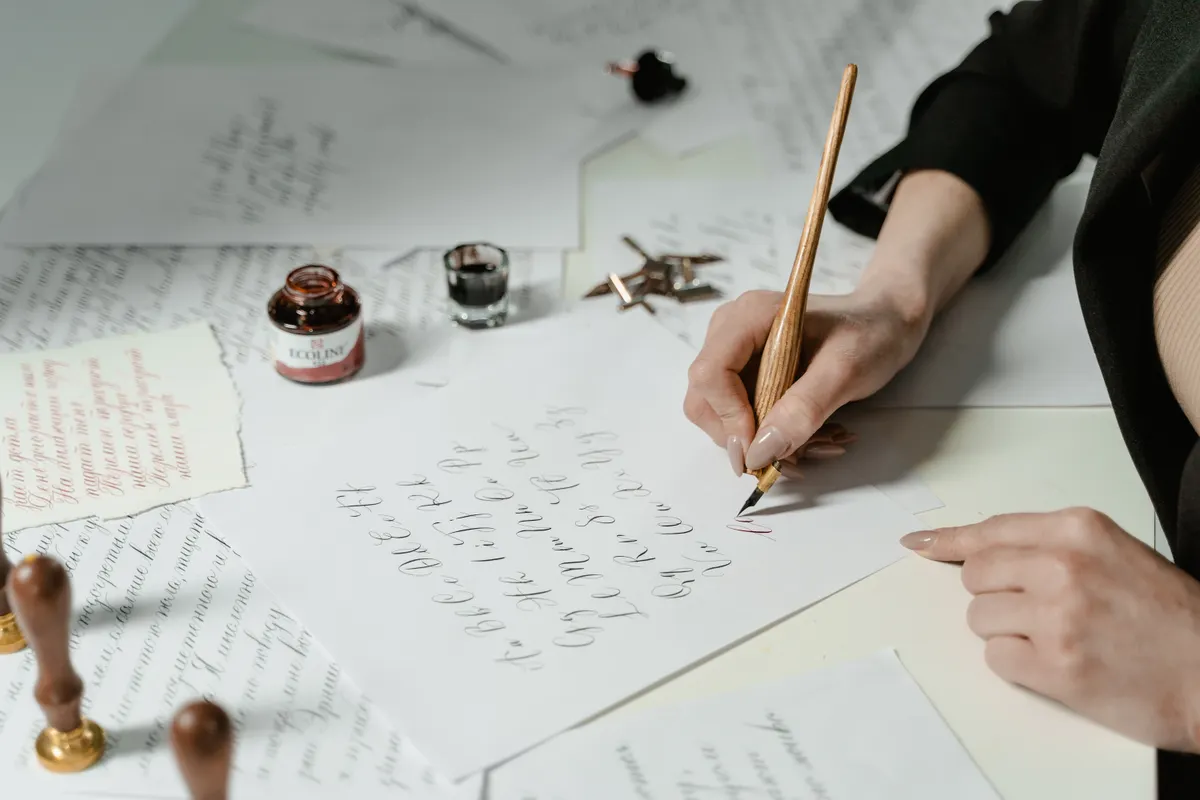
Photo Credit: MART PRODUCTION
Why Is Foundational Hand Useful for Beginners
Foundational Hand is useful for beginners because it removes pressure control from the equation, letting new students focus entirely on nib angle, spacing, and stroke order. Once those basics feel steady, that same control transfers directly into other broad-edge scripts like Italic or Uncial.
Keep your wrist relaxed during practice, since a tense grip is one of the most common reasons beginner strokes come out shaky rather than smooth.
What Drills Should Beginners Practice First
Beginners should start with straight vertical stems, since these build the most basic form of pen control before any curves get involved. From there, simple rounded bowls and shallow arches give practice with the flat nib angle staying steady through a turn.
Step-by-Step Basic Stroke Drills
- Practice straight vertical stems. Pull the pen straight down, keeping the 30 degree angle steady from top to bottom.
- Work on rounded bowl strokes. Practice a smooth curve, checking that thickness stays even through the turn.
- Add shallow arch strokes. These connect two points with a gentle curve, similar to the top of letters like n and h.
- Practice the small diagonal connector. This short stroke appears in a few letters and needs the same steady angle as everything else.
- Combine strokes into simple shapes. Try joining a stem and a bowl together, watching that the pen angle never shifts mid-stroke.
Once these feel steady, Foundational Hand Alphabet Practice walks through building full letters from these same core strokes.

Photo Credit: MART PRODUCTION
Pro Tips and Common Mistakes to Avoid
- Do not steepen your pen angle mid-stroke. This is the most common mistake for beginners moving from ballpoint pens.
- Avoid rushing curved strokes. Rounded bowls need slow, controlled movement to keep stroke width even.
- Do not skip nib cleaning between sessions. Dried ink on a broad edge causes skipping that can look like shaky control instead of an ink flow issue.
- Watch your wrist tension. A relaxed wrist makes it much easier to hold that steady 30 degree angle.
Frequently Asked Questions
What basic strokes make up Foundational Hand? Straight stems, rounded bowls, shallow arches, and a small diagonal connector form most Foundational Hand letters.
What pen angle is used for Foundational Hand? A consistent angle around 30 degrees from horizontal is used across almost every stroke.
Why is Foundational Hand useful for beginners? It removes pressure control from the equation, letting new students focus on nib angle, spacing, and stroke order first.
What drills should beginners practice first? Start with straight vertical stems, then move to rounded bowls and shallow arches once the pen angle feels steady.
A Calm Place to Start
Foundational Hand basic strokes ask for patience with your pen angle rather than pressure control, which is exactly why so many instructors start beginners here. Practice slowly, keep that 30 degree angle steady, and these simple strokes will build the exact control every other broad-edge script depends on.
For everything else this hobby covers, from tools to strokes to full scripts, read the full calligraphy and hand lettering guide.



Leave a Reply