
I framed my first Hardanger piece, a lopsided little bookmark with two uneven kloster blocks, and I still keep it on my desk because it reminds me how far a little patience can take this technique. If you're looking for Hardanger project ideas that match your skill level, this guide walks through beginner pieces, table linens, and ornaments, plus how long each one realistically takes.
This is part of our broader Embroidery & Cross-Stitch Project Ideas for Every Skill Level guide, which covers other techniques worth trying alongside Hardanger.
What Is Hardanger Embroidery?
Hardanger is a counted, whitework style of embroidery that combines satin stitch blocks with cut and drawn thread work, traditionally done in white thread on even weave fabric. The result is a lace-like pattern built from geometric blocks and open, airy cutwork sections.
It's a technique that rewards careful counting more than fast stitching. Our full Hardanger Embroidery guide covers the core stitches in detail if you want a refresher before starting any of these projects.
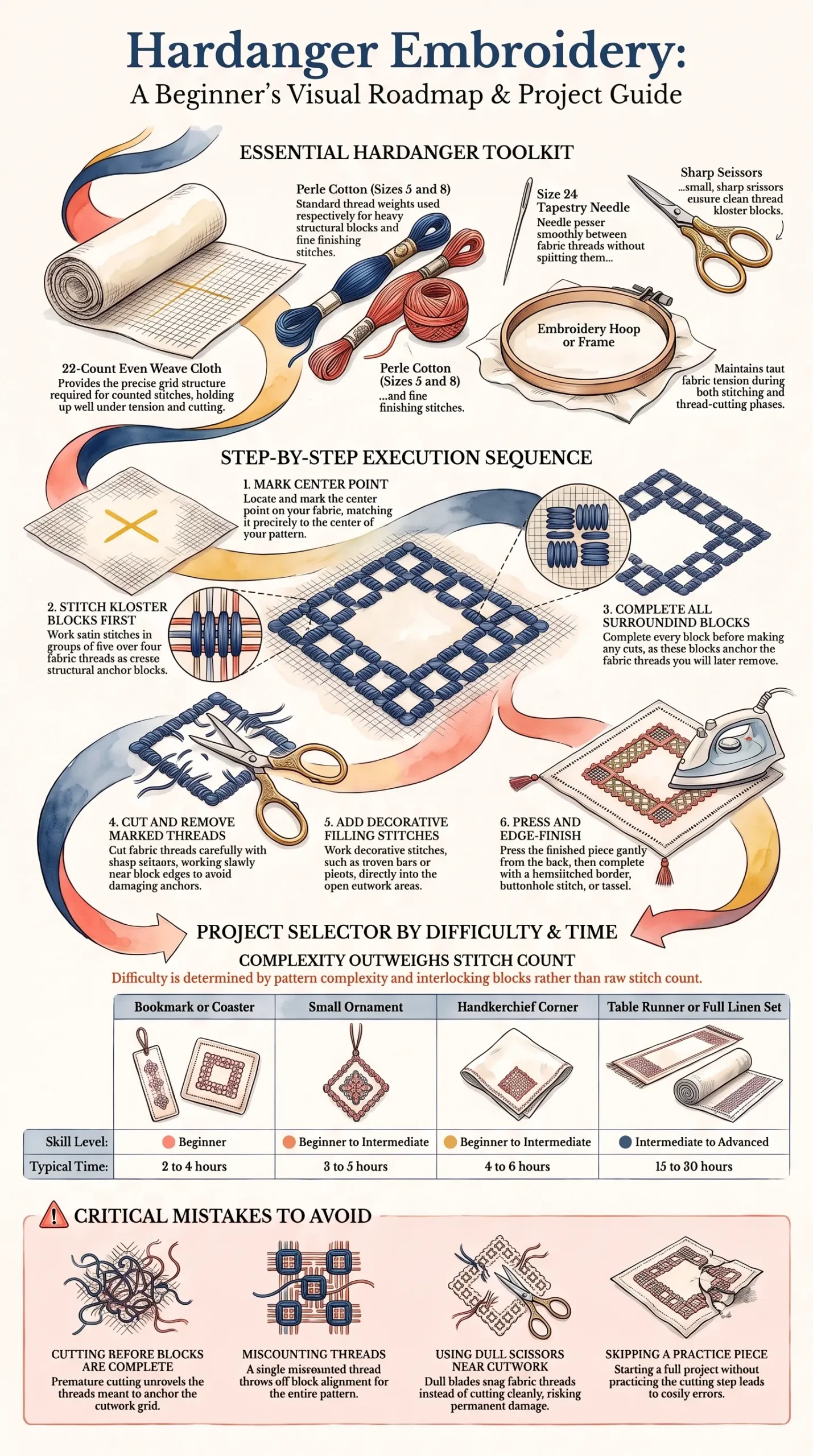
Photo Credit: Hobby Guidebook Editorial
What Are Good Beginner Hardanger Projects?
Start small. A single motif worked on a practice square teaches the core kloster block and cutting technique without the pressure of a full finished piece. From there, most beginners move on to one of these:
- A simple bookmark, using just a few kloster blocks and one small cutwork section.
- A coaster set, small enough to finish quickly but big enough to practice a full repeating pattern.
- A corner motif on a handkerchief, adding just one decorative corner rather than a full border.
- A small ornament, which introduces finishing techniques on a forgiving, low pressure scale.
I've unpicked more knotted thread than I'd like to admit, and Hardanger taught me that most of that frustration traces back to tension and miscounted threads, not lack of skill. Starting small keeps mistakes cheap and easy to fix.
Materials Needed for a Hardanger Project
|
Material |
Purpose |
|
Even weave fabric, 22 count Hardanger cloth |
Provides the grid structure for counted stitches |
|
Perle cotton, size 5 and 8 |
Standard thread weights for blocks and finishing stitches |
|
Tapestry needle, size 24 |
Passes smoothly between fabric threads without splitting them |
|
Small sharp embroidery scissors |
Cuts threads cleanly within kloster blocks |
|
Embroidery hoop or frame |
Keeps fabric taut while stitching and cutting |
How Do You Work a Basic Hardanger Project Step by Step?
- Mark your center point on the fabric, matching it to the center of your chosen pattern.
- Stitch the kloster blocks first, working satin stitches in groups of five over four threads.
- Complete all surrounding blocks before cutting anything, since blocks anchor the threads you'll later remove.
- Cut and remove the marked threads carefully, using sharp scissors and working slowly near block edges.
- Work any decorative filling stitches into the open cutwork area, such as woven bars or picots.
- Press the finished piece gently from the back, then finish according to your chosen project type.
Photo Credit: Olga Kalinina
What Materials Work Best for Table Linens and Ornaments?
Hardanger table linen projects typically use a heavier, more durable even weave fabric since they'll be washed and handled regularly. A tightly woven 22 count cloth holds up well to repeated laundering without the cutwork fraying.
Hardanger ornament ideas allow more flexibility. Smaller scraps of fabric work fine, and since ornaments aren't washed the same way, thinner or more delicate even weave options become fair game too.
How Difficult Are Typical Hardanger Projects?
Difficulty in Hardanger comes down almost entirely to pattern complexity, not raw stitch count. A single motif with two or three kloster blocks is genuinely beginner friendly, while a full table runner with dozens of interlocking blocks and multiple filling stitches sits solidly in intermediate to advanced territory.
"Even tension makes even stitches." That principle matters even more in Hardanger, since uneven satin stitch blocks throw off the whole cutwork grid underneath them.
|
Project Type |
Skill Level |
Typical Time |
|
Bookmark or coaster |
Beginner |
2 to 4 hours |
|
Handkerchief corner |
Beginner to intermediate |
4 to 6 hours |
|
Small ornament |
Beginner to intermediate |
3 to 5 hours |
|
Table runner or full linen set |
Intermediate to advanced |
15 to 30 hours |
How Long Does a Small Hardanger Project Take?
Most small projects, like a bookmark or single ornament, take between two and five hours of actual stitching time, spread over a few sessions. Cutting the threads is usually the slowest step, since rushing that part risks cutting the wrong thread entirely.
Larger table linen pieces take considerably longer, often stretched across several weeks of casual stitching rather than one sitting.
How Do You Finish or Display a Hardanger Project?
Small pieces like bookmarks and ornaments often just need pressing and a simple edge finish, like a hemstitched border or a small tassel. Table linens usually get a hemmed edge, sometimes with a decorative buttonhole stitch worked around the outer border for durability.
For display pieces, a shadow box or small frame works well, especially for single motif squares that won't see regular handling. If you enjoy working single motifs, our Redwork Project Ideas guide offers a similar small scale approach using a completely different, faster technique.
Photo Credit: Ая Тамим
What Mistakes Are Most Common?
- Cutting before all blocks are complete. This is the most common and costly mistake, since it can unravel threads meant to anchor the cutwork.
- Miscounting threads. A single miscounted thread throws off block alignment for the rest of the pattern.
- Using dull scissors near cutwork. Dull blades snag threads instead of cutting cleanly, risking damage to surrounding stitches.
- Skipping a practice piece. Jumping straight into a full project without practicing the cutting step first often leads to costly mistakes.
A quick safety note, always cut away from your body and keep small sharp scissors capped or sheathed when not actively in use, since Hardanger's precise cutting steps involve more blade time than most embroidery techniques.
Frequently Asked Questions
What are good beginner Hardanger projects? Small pieces like bookmarks, coasters, or a single motif square work best, since they limit mistakes while you learn the core technique.
What materials do you need for Hardanger projects? Even weave Hardanger fabric, perle cotton in two weights, a tapestry needle, and sharp small scissors cover the basics.
How difficult are typical Hardanger projects? Small single motif pieces suit beginners, while full table linens with multiple filling stitches require intermediate to advanced skill.
How long does a small Hardanger project take? Most small pieces take two to five hours of stitching time, spread across a few sessions.
How do you finish or display a Hardanger project? Small pieces often need pressing and a simple hem or tassel, while larger linens get a hemstitched or buttonhole border.
Final Thoughts
Hardanger rewards patience more than speed, and a small first project is the best way to build real confidence with the cutting technique. Pick something small, count carefully, and that first finished piece will teach you more than any tutorial could.
For more, check out the full embroidery & cross-stitch guide.






Leave a Reply