
Someone once asked me after watching me fold a modular star in about twenty minutes, "how long did it take you to get that fast?" The honest answer surprised them, since how long to learn origami depends less on raw hours logged and more on which specific skill you're actually trying to measure.
This guide breaks down realistic timelines for each stage of origami, from your very first fold to advanced models that can take an entire evening, so you know what to actually expect along the way.
This article is Part of Common Origami Questions & Comparisons, so if you're comparing other origami learning questions too, that page covers more ground worth exploring.
What Does "Learning Origami" Actually Mean?
Origami isn't really one single skill, it's a stack of related skills that build on each other over time. Asking how long it takes to learn origami is a bit like asking how long it takes to learn cooking, since a beginner making toast and a chef plating a five-course meal are both technically "cooking."
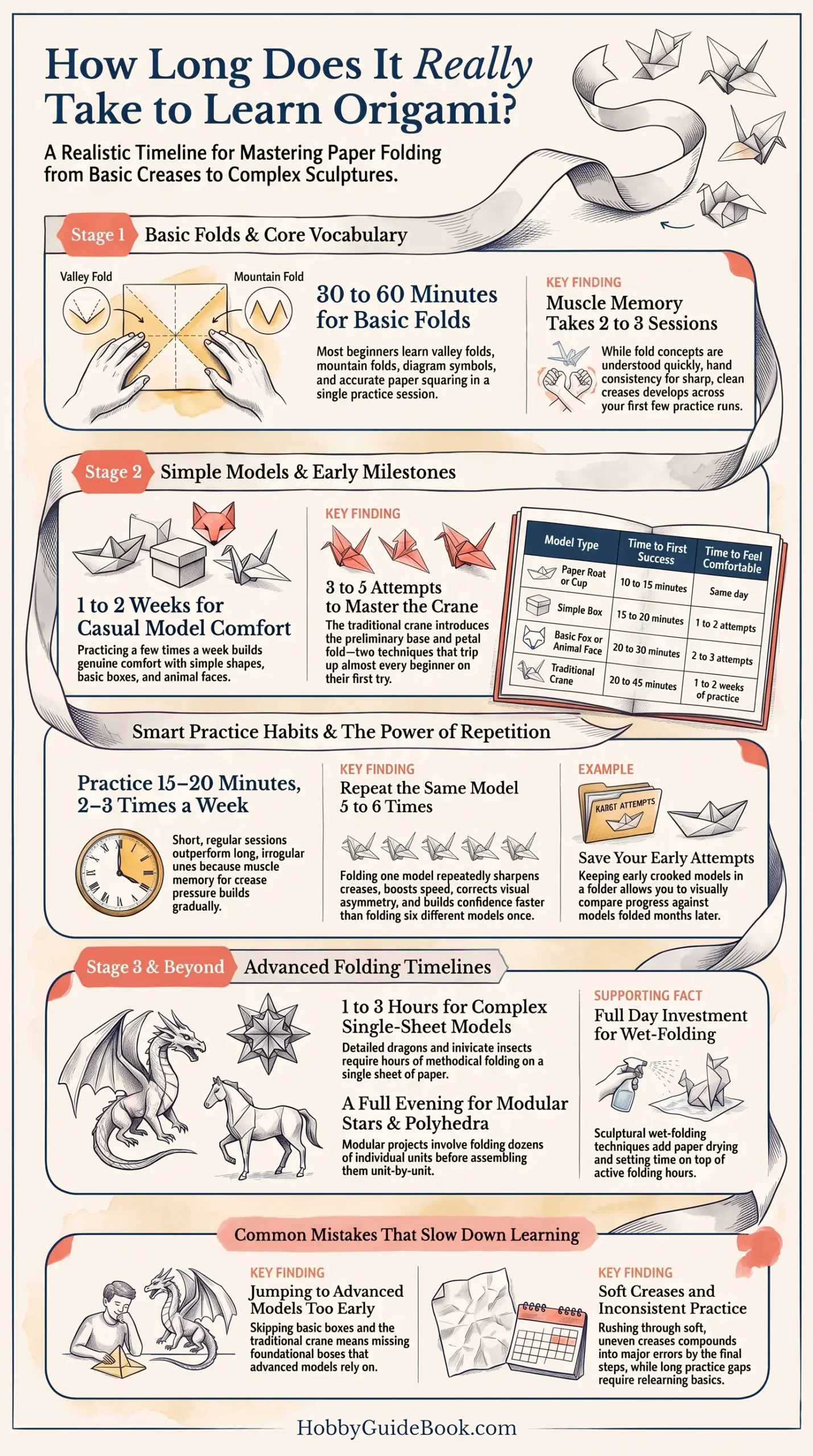
Photo Credit: Hobby Guidebook Editorial
The general skill stages folders move through:
- Basic folds, learning valley folds, mountain folds, and reading simple diagrams
- Simple models, completing beginner shapes like boats, cups, and basic animals
- Intermediate models, tackling cranes, boxes, and models with reverse folds
- Advanced models, working through complex bases, tessellations, and modular builds
- Wet-folding and specialty techniques, adding sculptural, advanced finishing skills
Each stage has its own rough timeline, and I've found that most frustration comes from expecting advanced-stage results during the basic-fold stage. Origami rewards patience more than most crafts, mostly because early mistakes compound visibly rather than hiding themselves.
How Long Does It Take to Learn Basic Origami Folds?
The core folding vocabulary, valley folds, mountain folds, and reading a basic diagram, typically takes just one or two practice sessions to genuinely understand. This is the shortest stage in the entire origami learning timeline, which surprises a lot of beginners who assume the whole craft feels intimidating from the start.
What "basic folds" actually includes:
- Valley folds, folding paper toward yourself into a V shape
- Mountain folds, folding paper away from yourself into an upward point
- Reading fold-line symbols, understanding dashed and dotted diagram markings
- Squaring paper accurately, getting a clean, true square before folding begins
Most people pick up these four basics within thirty to sixty minutes of focused practice. The real learning curve isn't the folds themselves, it's building the muscle memory to press creases sharply and consistently, which usually smooths out within your first two or three practice sessions.
How Long Does It Take to Become Comfortable with Simple Models?
Once basic folds feel natural, most beginners become genuinely comfortable with simple models within one to two weeks of casual practice, folding a few times a week rather than daily.
Realistic timeline for simple models:
|
Model Type |
Typical Time to First Success |
Time to Feel Comfortable |
|
Paper boat or cup |
10 to 15 minutes |
Same day |
|
Simple box |
15 to 20 minutes |
1 to 2 attempts |
|
Basic fox or animal face |
20 to 30 minutes |
2 to 3 attempts |
|
Traditional crane |
30 to 45 minutes first try |
1 to 2 weeks of practice |
The traditional crane deserves special mention here, since it's often the first model where beginners hit real resistance. It introduces the preliminary base and petal fold, two techniques that trip up almost everyone the first time through. For a full step-by-step walkthrough of this exact model, the How to Fold an Origami Crane guide breaks down each stage individually, which helps a lot during that early frustration point.
I've found that most people need three to five attempts at a crane before it clicks. That's completely normal, and honestly closer to the average than folders often admit online.
How Much Practice Does It Take to Improve at Origami?
Improvement in origami tracks pretty closely with consistency rather than raw hours in any single sitting. Short, regular practice sessions genuinely outperform occasional long ones, mostly because muscle memory for crease pressure and fold accuracy builds gradually rather than all at once.
A realistic practice pattern that works well:
- Fifteen to twenty minutes, two or three times a week builds steady, visible progress
- Repeating the same model several times before moving to a new one solidifies technique
- Mixing familiar models with one new challenge keeps practice engaging without overwhelming
- Taking breaks when frustration builds prevents rushed, sloppy creases from becoming a habit

Photo Credit: lil artsy
A quick pro tip: keep a small folder or box of your early attempts, even the crooked ones. Comparing a rough first crane against one folded three months later is genuinely motivating, and it's something most folders never think to do until later.
For more detail on building a sustainable practice habit rather than random, inconsistent folding sessions, the Origami Practice Routine guide covers exactly how often to practice and how to structure sessions for steady improvement.
Does Repeating the Same Model Improve Folding Skill?
Yes, significantly, and this is genuinely one of the most underused learning strategies in origami. Folding the same model five or six times in a row teaches your hands the sequence in a way that folding five different models once each simply doesn't.
What repetition actually improves:
- Crease sharpness, since repeated pressure builds consistent muscle memory
- Speed, as your hands stop pausing to think through each individual step
- Symmetry, since repeated folds naturally correct small early inconsistencies over time
- Confidence, which matters more than people expect when tackling something new afterward
As folders often say, the paper never lies. It only shows you exactly where a fold went wrong.
Repetition is really how you learn to listen to what that honesty is telling you. The third or fourth attempt at the same model often reveals exactly where earlier versions went slightly off, in a way that's much harder to notice on a first try.
How Long Can an Advanced Origami Model Take to Fold?
This is where the timeline stretches dramatically, and it's genuinely one of the more surprising parts of the craft for newer folders to grasp. Advanced models can take anywhere from one to several hours, and some modular projects stretch across multiple sessions entirely.
Realistic time ranges for advanced folding:
- Complex single-sheet models, like detailed dragons or insects, often take one to three hours
- Modular origami stars or polyhedra, involving dozens of individually folded units, can take a full evening once you include assembly
- Tessellation patterns, with repeating geometric folds across a large sheet, may take several hours of careful, methodical folding
- Wet-folded sculptural models, which add drying time on top of folding time, can stretch across a full day when you count setting time
I still remember a modular star that genuinely took a full evening to lock together, unit by unit, well past the point where I expected to be finished. That's not a discouraging fact, it's just the honest reality of advanced origami, where the folding itself is only part of the total time investment.
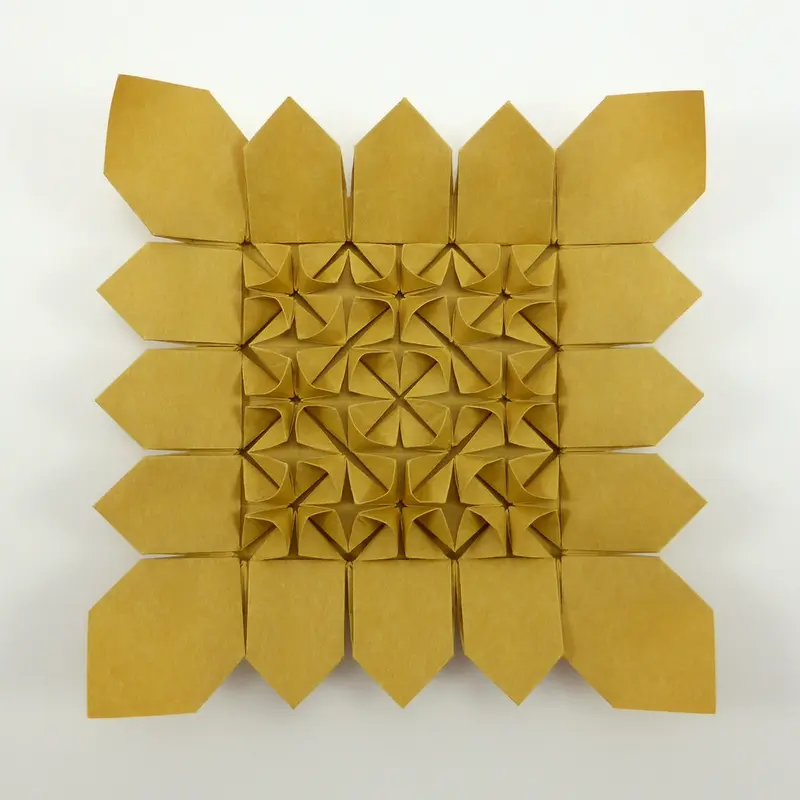
Photo Credit: Internet
Common Mistakes That Slow Down Learning
A few habits show up repeatedly among folders who feel stuck longer than they should.
- Jumping to advanced models too early. Skipping the crane and simple boxes often means missing foundational skills those models quietly teach.
- Practicing inconsistently. Long gaps between sessions mean relearning basics instead of building on them.
- Rushing through creases. Soft, uneven folds early on compound into bigger problems by the final steps.
- Avoiding repetition. Moving to a new model after every single attempt slows down the muscle memory that repetition builds.
Frequently Asked Questions
How long does it take to learn basic origami folds? Most people learn valley folds, mountain folds, and basic diagram reading within thirty to sixty minutes of focused practice.
How long does it take to become comfortable with simple models? Roughly one to two weeks of casual practice, folding a few times weekly, builds genuine comfort with simple models.
How much practice does it take to improve at origami? Short, consistent sessions of fifteen to twenty minutes, two or three times a week, produce steadier progress than occasional long sessions.
How long can an advanced origami model take to fold? Advanced models often take one to three hours, while modular projects or tessellations can stretch across a full evening or longer.
Does repeating the same model improve folding skill? Yes, repetition builds muscle memory, improves crease sharpness and symmetry, and speeds up your folding significantly over time.
Final Thoughts
There's no single answer to how long origami takes to learn, since basic folds click within an hour while advanced modular work can take years to genuinely master. What matters most is consistent, patient practice, and giving yourself permission to fold the same model more than once before moving on.
Ready to keep building your skills from here? Read the full origami guide for more techniques worth exploring next.






Leave a Reply