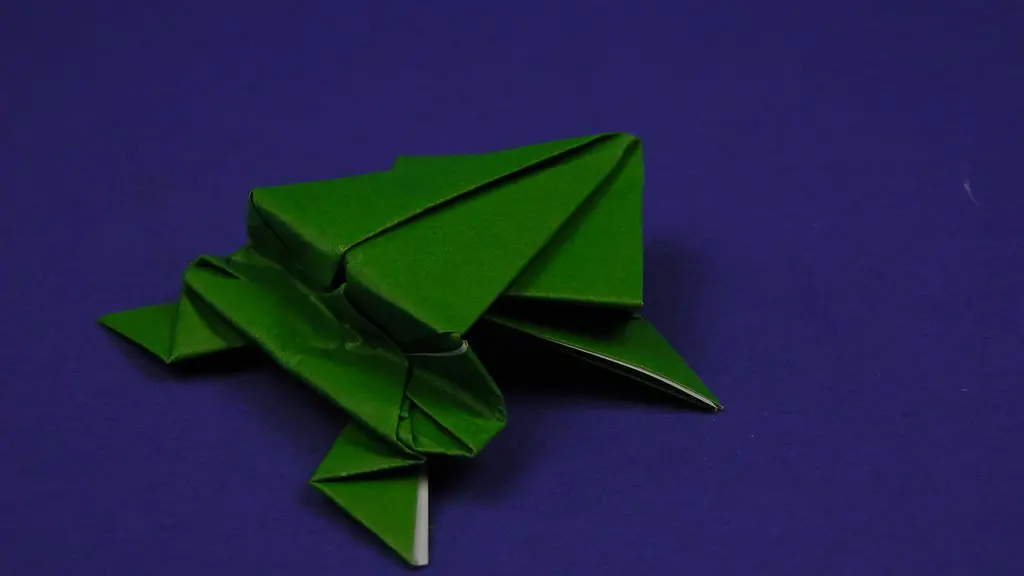
The first time my jumping frog actually launched off the table and landed in a cup three feet away, I laughed out loud, genuinely surprised paper could do that. This origami jumping frog tutorial walks you through the exact folds that build a real spring mechanism into a single sheet, no tape, no cutting, just clever folding.
By the end, you'll know how to fold a frog that actually hops when you press its back, plus which paper works best and how to fix the most common beginner mistakes.
This model is Part of Action Origami: Models That Move, a fun corner of origami where the finished fold does something, flaps, hops, or snaps, instead of just sitting still.
Why the Jumping Frog Is Such a Popular Action Fold
Action origami has been around for decades, and the jumping frog remains one of the most requested models I get asked to teach. Part of the appeal is obvious, it's genuinely fun watching a flat square turn into something that moves on its own.
But there's also a real technical lesson hiding inside this fold. The frog teaches you how folded paper can store energy the same way a spring does, using layered creases and a strategically bent leg section instead of any actual metal or plastic parts.
What makes this model worth learning early on:
- Teaches spring mechanics, a concept that shows up again in other action models
- Builds crease confidence, since sloppy folds here visibly kill the jump
- Uses simple beginner folds, nothing beyond what most new folders already know
- Delivers instant payoff, you see results the moment you press down and release
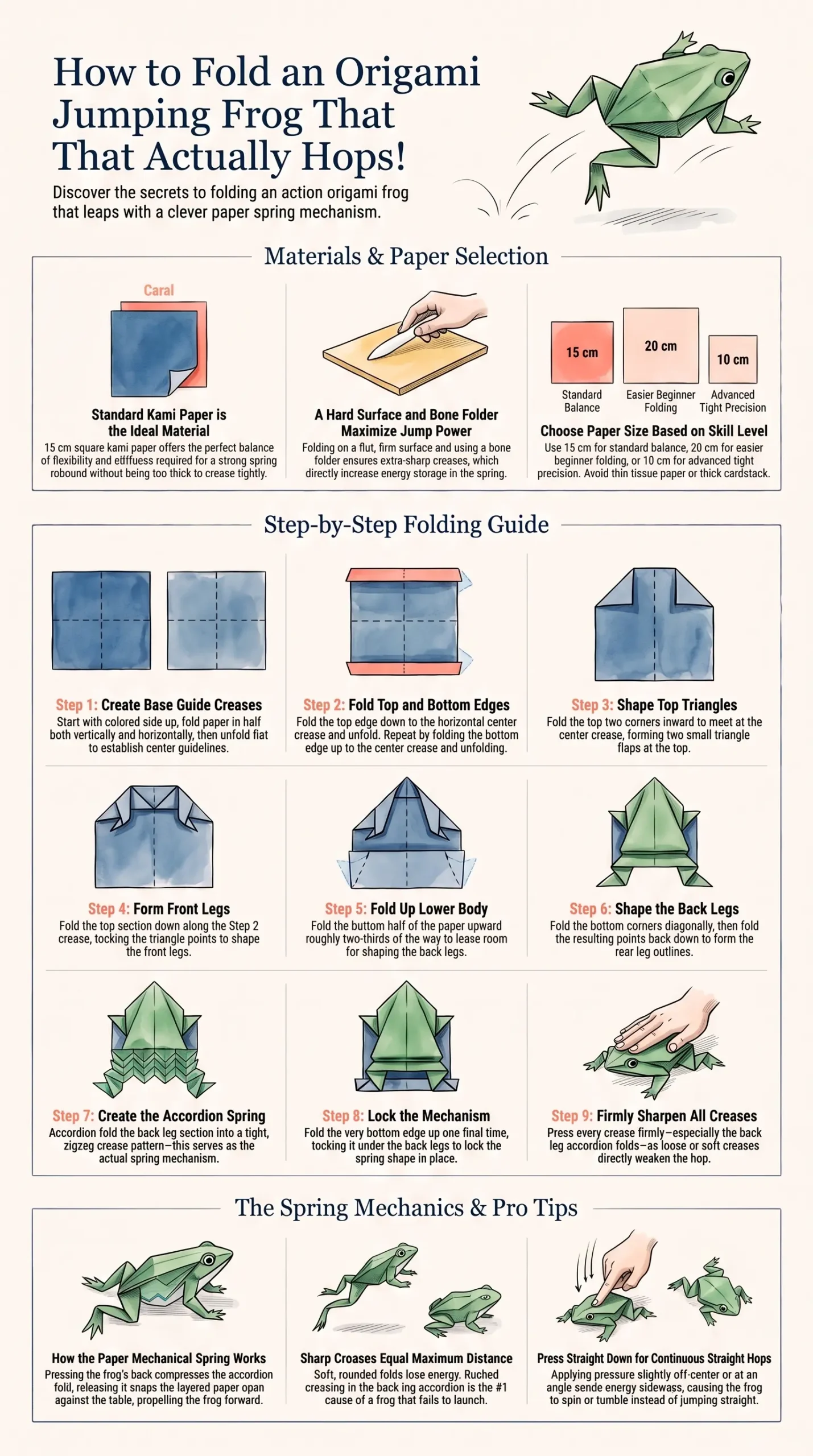
Photo Credit: Hobby Guidebook Editorial
What You'll Need for the Jumping Frog
You really don't need much for this fold, which is part of why it's such a satisfying weekend project.
|
Item |
Why It Matters |
|
Kami paper, 15 cm square |
Crisp folds and enough stiffness for a strong spring action |
|
A flat, hard surface |
Keeps creases sharp, which directly affects jump strength |
|
A bone folder (optional) |
Helps press the leg creases extra firm for maximum spring |
|
Scrap paper for practice |
Useful for practicing the leg fold before your final attempt |
What paper works best for an origami jumping frog? I'd steer beginners toward standard kami paper rather than thin tissue or tracing paper. Thin paper folds easily but often lacks the stiffness needed to actually launch, while paper that's too thick becomes hard to crease sharply in the tighter leg sections.
How to Fold a Jumping Frog Step by Step
This model builds in stages, starting with a base shape before shaping the legs and jump mechanism. Take your time on the early creases, since a weak fold here carries through the entire model.
- Start with your paper colored side up, folded in half both directions to create center guide creases, then unfold flat again.
- Fold the top edge down to meet the horizontal center crease, then unfold. Repeat with the bottom edge folded up to the same crease.
- Fold the top corners inward to the center crease, creating two small triangle flaps at the top of your paper.
- Fold the top section down along the crease made in step two, tucking the triangle points to form the frog's front legs.
- Fold the bottom half up roughly two thirds of the way, leaving room to shape the back legs.
- Fold the bottom corners diagonally, then fold the resulting points back down to form the frog's back leg shape.
- Accordion fold the back legs, creating a small zigzag crease pattern that becomes the actual spring mechanism.
- Fold the very bottom edge up one final time, tucking it under the back legs to lock the spring shape in place.
- Press every crease firmly, especially the accordion folds, since soft creases here directly weaken the jump.
If you enjoy models with genuine moving parts once this one clicks, the Flapping Bird Tutorial is a natural next project, using a similar idea where folded paper creates motion through clever mechanical folds rather than any glued parts.
How Do You Make the Frog's Spring Mechanism Work?
The jump comes entirely from that accordion fold in the back legs. When you press down on the frog's back and release quickly, the folded layers snap back open, pushing against the table and launching the model forward.
A few things that affect jump strength:
- Crease sharpness, since soft, rounded creases store far less spring energy than crisp, firm ones
- Paper stiffness, since thin paper compresses without much rebound
- Even pressure placement, pressing slightly off center often sends the frog sideways instead of forward
- Consistent accordion spacing, uneven zigzag folds create weaker, unpredictable spring action
I've found that most beginner jump problems trace back to one thing, rushed creasing in that back leg section. Slow down there specifically, even if the rest of the fold felt easy.
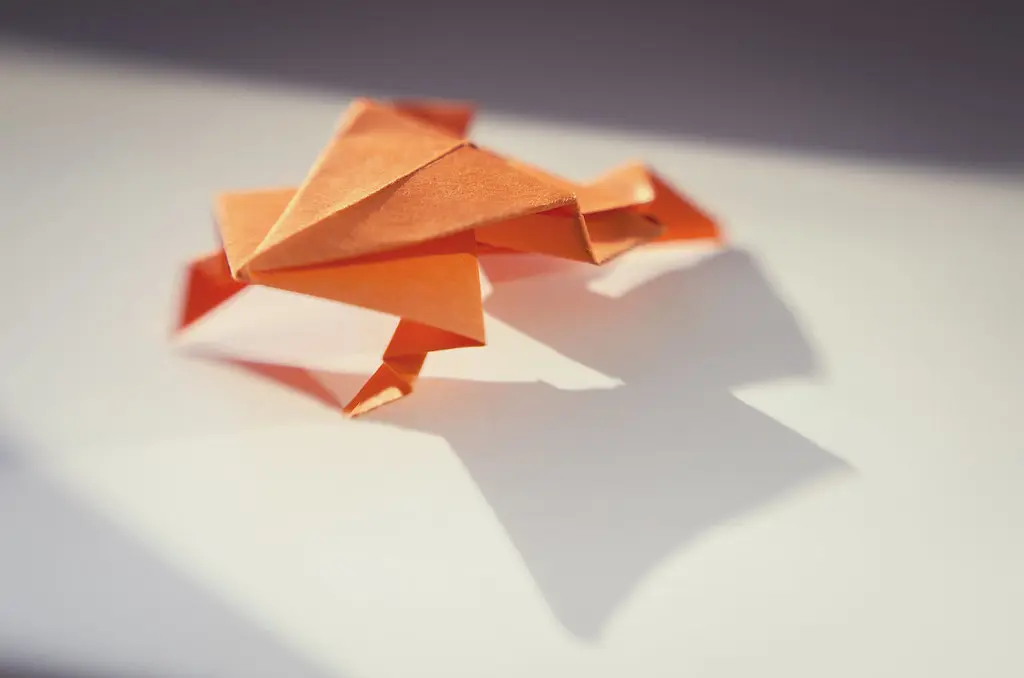
Photo Credit: Internet
Pro Tips and Common Mistakes to Avoid
A handful of small habits separate a frog that barely twitches from one that actually leaps.
- Don't skip firm creasing on the accordion fold. This single section stores almost all the jump energy.
- Avoid paper that's too thin. Tissue paper folds beautifully but rarely holds enough stiffness to launch well.
- Press straight down, not at an angle. Angled pressure sends energy sideways instead of forward.
- Square up your starting paper carefully. A slightly uneven square throws off leg symmetry later.
- Watch small kids around firmer cardstock edges. Thicker paper can carry a slightly sharper edge, so supervise little hands during folding and jumping play.
As folders often say, the paper never lies. It only shows you exactly where a fold went wrong.
With the jumping frog, that's especially true. A weak or crooked jump almost always points straight back to one specific crease worth refolding.
For a broader look at foundational techniques like accordion pleating and reverse folds that show up across many action models, Origami Techniques Explained breaks each core method down individually, which is worth bookmarking as you branch into other moving folds.
Can Beginners Fold an Origami Jumping Frog?
Yes, genuinely, this is one of the more beginner-friendly action models out there. The individual folds themselves are fairly simple, mostly valley and mountain folds without anything as tricky as a sink fold or complex reverse fold.
What makes it approachable for newer folders:
|
Skill Needed |
Difficulty Level |
|
Basic valley and mountain folds |
Easy |
|
Corner and edge alignment |
Easy to moderate |
|
Accordion pleating for legs |
Moderate |
|
Overall model complexity |
Beginner to low-intermediate |
Where beginners sometimes stumble is the accordion leg section, since it requires several tight, evenly spaced folds in a row. I'd genuinely recommend practicing that specific section alone on scrap paper before attempting the full model, since it's the one part of this fold that actually determines whether your frog jumps at all.

Photo Credit: Internet
What Size Paper Is Good for a Jumping Frog?
Standard 15 cm squares work well for most folders, giving enough surface area for clean leg creases without becoming difficult to handle. Larger paper, around 20 cm, can actually make the leg folds easier for beginners still building crease confidence.
Quick size guidance:
- 15 cm square, the standard choice, balances jump distance with manageable folding
- 20 cm square, easier for beginners, though the finished frog jumps slightly less far
- 10 cm square or smaller, better suited for experienced folders comfortable with tight, precise creases
Frequently Asked Questions
What makes an origami jumping frog jump? An accordion fold in the back legs stores spring energy, which releases suddenly when you press and let go, launching the frog forward.
What paper works best for an origami jumping frog? Standard kami paper works best, offering enough stiffness for a strong spring without becoming too thick to crease sharply.
How do you make the frog's spring mechanism work? Fold the back legs into tight, even accordion pleats and press each crease firmly, since sharp creases store more jump energy.
What size paper is good for a jumping frog? A 15 cm square is the standard choice, though 20 cm squares can be easier for beginners still building folding confidence.
Can beginners fold an origami jumping frog? Yes, it uses mostly simple valley and mountain folds, making it approachable even for folders fairly new to the hobby.
Final Thoughts
The jumping frog is proof that a few sharp creases can genuinely turn flat paper into something that moves. Take your time on the accordion fold, press your creases firm, and don't be surprised if you end up folding a dozen frogs in one sitting just to watch them jump.
Ready to explore more models that move? Read the full origami guide for other techniques and projects worth trying next.




Leave a Reply