
The first time I locked the final unit into a modular star, my hands were shaking a little. Not from difficulty exactly, but from the strange feeling that thirty identical little folds had somehow become one solid, self-supporting shape with nothing holding it together but the paper itself. That moment is exactly why modular origami hooks people the way it does, and this guide breaks down precisely how it works, from the first unit to the final tuck.
This piece is Part of Origami Techniques Explained, and it's meant for anyone who's folded a single-sheet crane or two and is wondering what modular folding actually involves before jumping in.
What Is Modular Origami, Really?
Modular origami is a style where you fold several identical, or nearly identical, pieces of paper separately, then interlock them into one larger three-dimensional shape. No glue, no tape, no thread. The paper's own tension and folded pockets hold everything in place.
Each individual piece is called a unit, and depending on the model, you might need anywhere from three units to over thirty. I've folded modular stars that used just six units, and I've also spent a full evening locking together a sixty-unit sphere that tested my patience more than my folding skill.
This is different from traditional origami, where one sheet becomes one finished object, like a crane or a box. In modular work, the finished object doesn't exist in any single sheet. It only appears once every unit is folded and connected in the right order.
How Modular Origami Is Different From Single-Sheet Origami
If you've only folded traditional single-sheet models, modular origami requires a small shift in thinking. You're not folding toward a finished shape from the very first crease. You're folding a small, repeatable building block that will only make sense once several copies sit together.
There's also a different kind of precision involved. A single-sheet crane can survive one slightly uneven fold and still look fine. A modular origami units set can't. If even one unit is folded a few millimeters off, the whole final shape can end up lopsided, loose, or refusing to close properly at the last connection point.
I've learned to fold the very first unit slowly and carefully, then use it as a physical template, lining every following unit against it edge to edge before creasing. It's a small habit that saves a lot of frustration two hours into a project.

Photo Credit: Ann H
Materials and Tools for Modular Folding
You don't need anything exotic to start modular folding, but a few specific items make the process noticeably smoother, especially once you're working with many small pieces at once.
|
Item |
Purpose |
Notes |
|
Kami paper (multiple colors) |
Standard modular unit paper |
Thin enough to fold crisp pockets |
|
Square sheets, same size |
Ensures all units match |
Mixing sizes ruins the final fit |
|
Bone folder |
Sharpens creases on every unit |
Speeds up repetitive folding |
|
Tweezers |
Tucks small flaps into tight pockets |
Very useful on the final few units |
|
Small tray or bowl |
Holds finished units before assembly |
Prevents loose pieces from scattering |
|
Rubber bands (a few, optional) |
Holds early assembly steady while working |
Remove once enough units lock in |
If you're curious where modular folding eventually leads, Modular Origami Projects has a full list of models organized from simple to genuinely challenging.
How Modular Origami Units Are Connected
This is the part that confuses most beginners, and it's worth explaining clearly. Modular units aren't glued or taped together. Instead, each folded unit has small flaps or pockets built into its shape during the folding process itself.
You slide the flap of one unit into the pocket of the next, and the paper's natural tension, plus the friction between layers, holds the connection in place. As more units get added, the whole structure tightens and becomes more stable, almost like a puzzle locking itself shut piece by piece.
Here's the general order most modular projects follow.
- Fold every unit first. Don't assemble as you go. Fold all pieces to the same stage before connecting anything.
- Check that units match. Lay a few side by side and confirm the creases and size line up exactly.
- Connect three units first to form a small base shape, usually a simple point or corner.
- Add units gradually, working outward or around, checking tension as you go.
- Tighten as you close the shape. The final few units are often the trickiest, since there's less room to maneuver flaps into place.
- Adjust, don't force. If a unit won't tuck in cleanly, recheck its fold lines rather than pushing it into a pocket it doesn't quite fit.
Does Modular Origami Require Glue?
Traditionally, no. Genuine modular origami relies entirely on the interlocking structure of the folded units, with the paper's tension doing all the holding. This is actually one of the things that makes the style so impressive once you understand it.
That said, some folders add a small dab of glue to units that will be handled often, like a kusudama ball given as a gift, simply to keep it from loosening over months of handling. This isn't required, and most traditional models are designed to stay locked without any adhesive at all if folded accurately.
If you do choose to use glue for durability, apply it sparingly and only after the piece is fully assembled and checked. Adding glue mid-build can trap a poorly fitted unit in place permanently, which is harder to fix than an unglued mistake.
What Is Kusudama Origami?
Kusudama origami is a specific and very popular branch of modular folding, usually built into a rounded, flower-covered ball shape. Traditionally, kusudama models were sometimes stitched together with thread rather than interlocked purely through folds, though many modern versions use fully lockable units instead.
These models are often used decoratively, hung from ceilings, given as gifts, or displayed as centerpieces. If you've ever seen a paper ball covered in small flower shapes at a craft fair, there's a good chance it was kusudama.

Photo Credit: Mike Norris
What Is a Sonobe Unit?
The Sonobe unit is one of the most well known building blocks in modular origami, and it's a great one to learn early. It's a simple parallelogram-based unit with built-in flaps and pockets, and it can be combined in surprisingly different ways to create cubes, stars, and even more complex geometric shapes.
Once you understand the Sonobe unit specifically, a huge number of other modular models start to make sense, since many designs borrow the same basic pocket and flap logic with small variations. It's often the first "real" modular unit beginners learn, right after simpler triangular units.
How Many Sheets Do Modular Origami Models Usually Use?
This varies a lot depending on the design. Simple modular stars or small geometric shapes might use just 3 to 6 units. Mid-sized kusudama balls commonly use 12 or 30 units, since those numbers divide evenly into the symmetrical shapes many designs are built around.
Larger, more complex models, especially ones inspired by origami sekkei style architectural forms, can use 60 units or more. If you're interested in that structural side of folding, Origami Sekkei (Architectural Origami) covers how folders build large-scale geometric and building-inspired designs using these same modular principles.
Pro Tips for Folding Modular Origami
- Fold in batches, not one at a time. Complete every unit before you start connecting, so you're not mixing folding and assembly steps.
- Use paper the same weight throughout. Mixing thick and thin paper in one model makes some units bulkier than others, and the fit suffers.
- Count your units before assembly. Running short partway through a 30-unit model is a frustrating reason to stop mid-project.
- Keep loose units contained. A small tray keeps finished pieces from sliding off the table while you fold the next one.
- Work on a flat, stable surface, since modular assembly often requires two hands applying gentle pressure at once, and a wobbly surface makes that harder than it should be.
- Be patient with the final connections. The last few units are always tighter to fit than the first ones, and rushing here is the most common reason models come apart later.
A fellow modular folder once told me that a modular model is never really finished at the last unit. It's finished the moment every earlier unit was folded exactly the same way. I think about that every time I start a new batch.
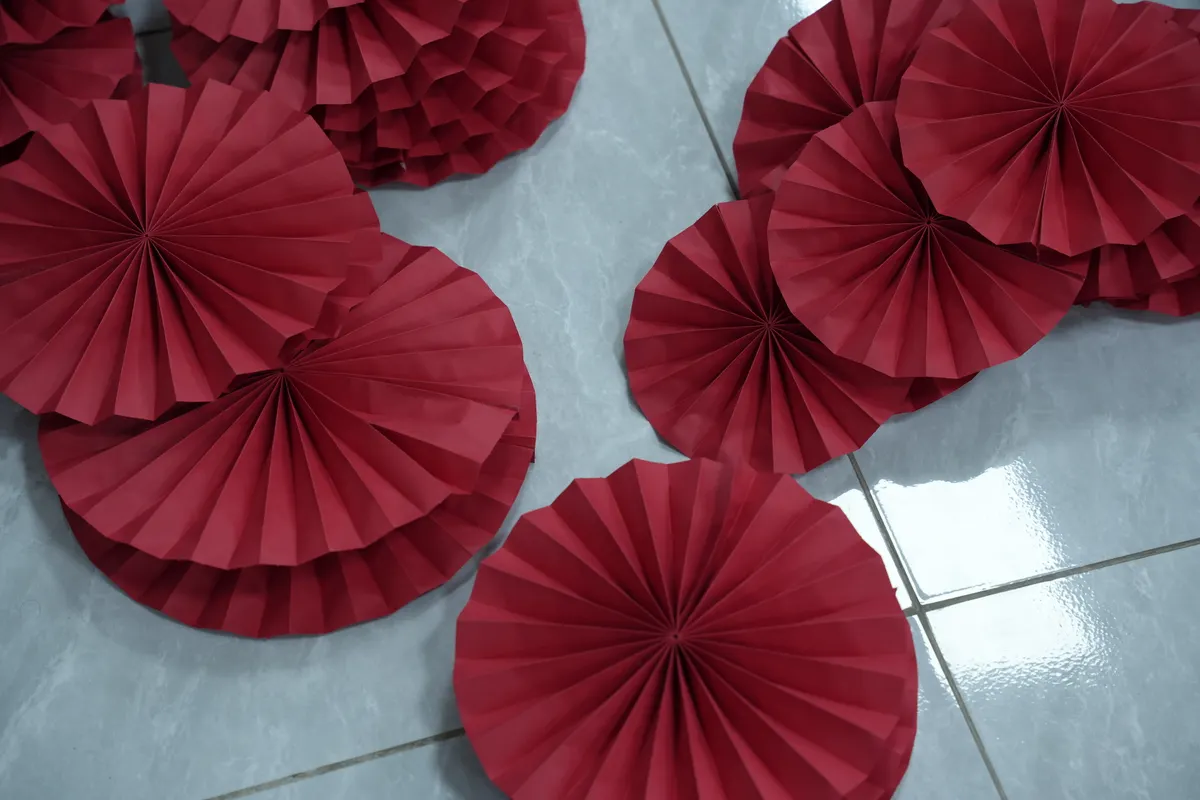
Photo Credit: NGUYỄN THÀNH NHƠN
Comparing Modular Origami to Single-Sheet Origami
|
Feature |
Modular Origami |
Single-Sheet Origami |
|
Number of sheets |
Multiple, often 3 to 60+ |
One |
|
Glue required |
No, typically |
No |
|
Precision needed |
Very high, units must match |
Moderate |
|
Assembly step |
Yes, units are connected |
No, folding is the finished piece |
|
Common examples |
Kusudama, geometric stars, Sonobe cubes |
Cranes, boxes, flowers |
|
Typical time investment |
30 minutes to several hours |
Minutes to an hour |
Frequently Asked Questions
What is modular origami? Modular origami is a folding style where several identical folded units are connected together, without glue, to form one larger three-dimensional shape.
How is modular origami different from single-sheet origami? Single-sheet origami turns one piece of paper into a finished object, while modular origami combines multiple separately folded units into a single interlocked shape.
How are modular units connected? Units connect through built-in flaps and pockets folded into each piece. Sliding a flap from one unit into another unit's pocket holds them together through tension and friction.
Does modular origami require glue? No, traditional modular origami doesn't require glue. The folded structure holds itself together, though some folders add a small amount for extra durability on frequently handled pieces.
How many sheets do modular origami models usually use? It depends on the design. Simple models use as few as 3 to 6 sheets, mid-sized kusudama balls often use 12 or 30, and larger models can use 60 or more.
What is a Sonobe unit? A Sonobe unit is a common modular origami building block shaped like a parallelogram with built-in flaps and pockets, often used to create cubes, stars, and other geometric shapes.
Final Thoughts
Modular origami takes the basic rules of paper folding and adds a puzzle-like layer on top, where patience with repetition matters just as much as the folding itself. Once you fold your first handful of matching units and watch them lock into a real shape, it's hard not to want to try a bigger model next.
If you're ready to see where this style can go, Read the full origami guide for everything from your first single-sheet fold to advanced modular and architectural work.





Leave a Reply