
I spent one entire evening years ago folding thirty identical paper units, only to realize at midnight I'd folded three of them backwards and had to unfold half a finished sphere to fix it. That's the honest reality of modular origami projects, patient repetition rewarded by a shape no single sheet of paper could ever create alone.
This piece is Part of Origami Project Ideas for Every Skill Level, and it covers exactly what modular origami involves, which projects suit which skill level, and the specific details, unit counts, paper choices, glue questions, that trip up folders moving into this side of the hobby for the first time.
What Makes Modular Origami Different
Modular origami builds one larger shape from many separate, identical paper units, each folded individually and then locked together through tension alone, without gluing the pieces in place. It's a real shift from traditional single-sheet folding, where the entire model comes from one piece of paper start to finish.
I've found that modular work rewards a completely different kind of patience than traditional folding. A single crane might take five minutes once you know the sequence, but a modular sphere with thirty units easily eats an entire evening, and that repetition is actually where a lot of folders find the meditative appeal of this side of the hobby.
For a fuller breakdown of how modular origami works as its own category within the craft, Modular Origami covers the underlying principles in more depth, including how locking tabs and pockets hold everything together without adhesive.
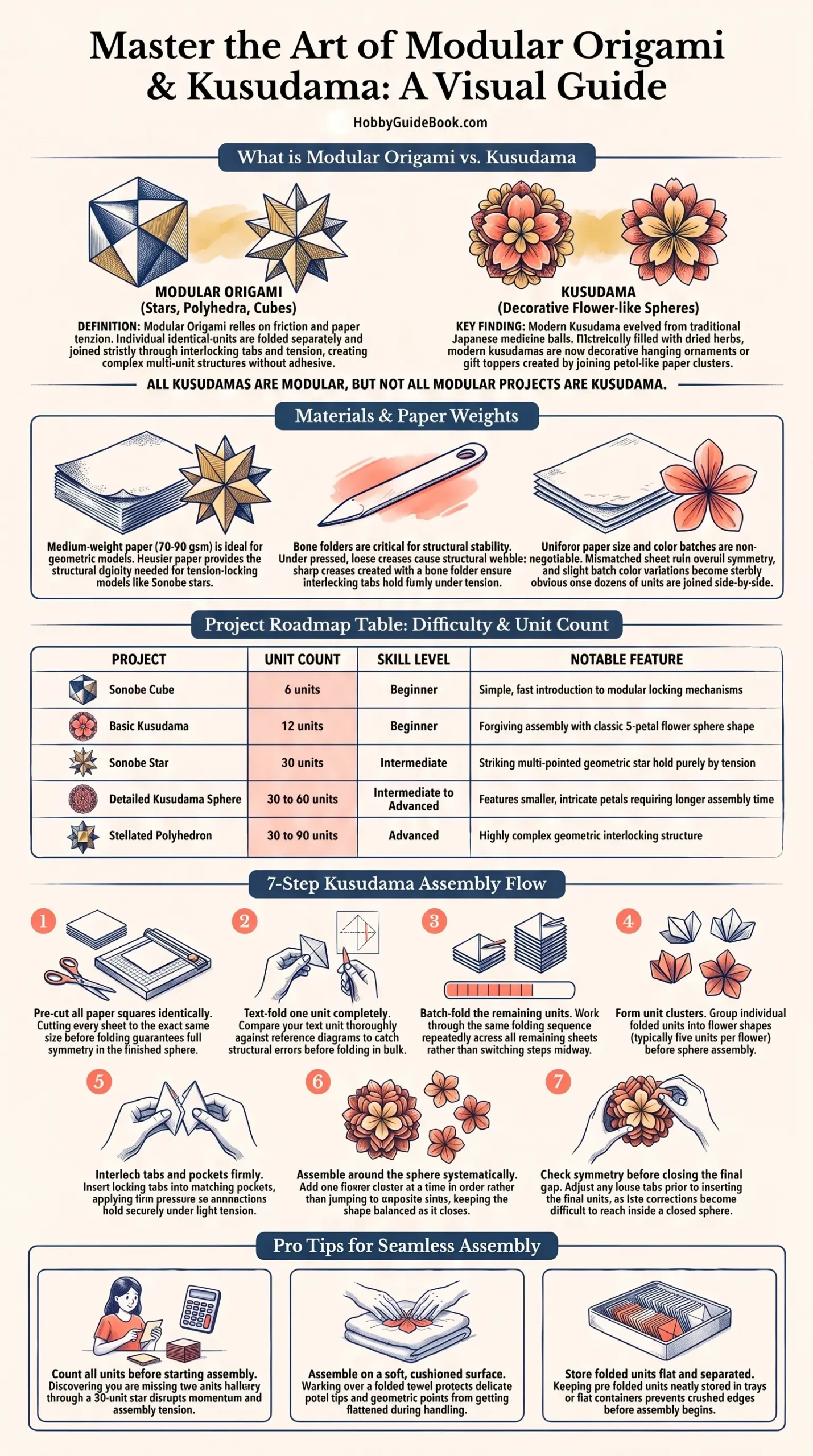
Photo Credit: Hobby Guidebook Editorial
What Is a Kusudama in Origami?
A kusudama is a decorative paper ball traditionally made from multiple folded units joined together into a spherical shape, often with flower-like petals forming the outer surface. The name comes from Japanese, roughly translating to medicine ball, tracing back to an older tradition of filling paper balls with dried herbs.
Modern kusudama has shifted almost entirely into a decorative and ceremonial craft rather than a medicinal one. You'll see them used as hanging ornaments, gift toppers, or centerpiece decorations, often strung with ribbon through a small hole at the top of the finished sphere.
Most kusudama designs use identical folded units, frequently based on a simple flower or petal shape, repeated and assembled into a full sphere. A basic kusudama origami tutorial typically starts with a single unit pattern folded many times over before assembly even begins, so getting comfortable with that one repeated fold matters more than anything else early on.
How Many Units Are Needed for a Kusudama Ball?
This varies quite a bit depending on the specific design, but most traditional kusudama balls use somewhere between 12 and 30 units total. Simpler designs, often built from five-petal flower clusters, commonly land around 12 units, since each cluster covers a larger portion of the sphere's surface.
More elaborate designs with smaller, more detailed petals can climb toward 30 or even 60 units for larger, more complex spheres. I'd recommend starting with a 12-unit design for your first kusudama, since it's genuinely forgiving if one or two units come out slightly uneven, and the assembly process itself is much less overwhelming than jumping straight into a 60-unit design.
What Is the Difference Between a Kusudama and Modular Origami?
This distinction confuses a lot of beginners, and honestly, it's a reasonable point of confusion since kusudama technically falls under the broader modular origami umbrella. Modular origami is the general category, any model built from multiple separate folded units joined together, while kusudama specifically refers to the decorative spherical designs within that category.
Think of it like the relationship between a square and a rectangle. Every kusudama is modular origami, but not every modular origami project is a kusudama. Modular stars, geometric polyhedra, and interlocking cube designs are all modular origami too, but none of them are kusudama specifically, since they don't form that characteristic rounded, flower-covered sphere shape.
Knowing this distinction actually helps when searching for patterns, since a search for modular origami will pull up geometric shapes and stars alongside kusudama designs, while searching specifically for kusudama narrows results down to just the spherical, decorative style.
Materials and Tools for Modular Origami Projects
A few specific items make modular work smoother, especially once you're folding dozens of identical units for a single project.
|
Item |
Purpose |
Notes |
|
Kami paper, uniform color set |
Base material for individual units |
Consistent size across all sheets matters |
|
Small bowl or tray |
Holds folded units before assembly |
Prevents units from scattering or bending |
|
Bone folder |
Sharpens creases on every unit |
Consistency across units improves final shape |
|
Reference diagram or app |
Guides the repeated unit fold |
Same pattern folded many times over |
|
Acid-free glue, optional |
Reinforces locking points if needed |
Only needed for display pieces, not structural |
Step-by-Step: Building a Basic Modular Kusudama
This walks through the general process most simple kusudama designs follow, using a basic five-petal unit as an example.
- Choose your unit pattern and cut all your squares first. Cutting every sheet to the same size before folding anything keeps the final sphere symmetrical.
- Fold one complete unit fully, checking it against your reference diagram closely before repeating the pattern, since a mistake caught early saves redoing dozens of units later.
- Fold the remaining units in batches, working through the same sequence repeatedly rather than switching between different steps across multiple units at once.
- Group your units into the cluster size your design calls for, often five units forming one flower shape before joining multiple flowers into the full sphere.
- Insert locking tabs into their matching pockets, pressing firmly so each connection holds under light tension without needing glue.
- Work around the sphere systematically, adding one cluster at a time rather than jumping between opposite sides, which helps the shape stay balanced as it comes together.
- Check the sphere's symmetry as you close the final gap, adjusting slightly loose tabs before the last few units make later corrections difficult to reach.
How Many Units Does a Typical Sonobe Model Use?
The Sonobe unit is one of the most widely used modular origami building blocks, known for its simple, triangular locking shape that combines into cubes, stars, and more complex geometric forms. A basic Sonobe cube uses just 6 units, making it one of the more approachable modular projects for someone trying this style for the first time.
A modular origami star built from Sonobe units, sometimes called a Sonobe star or stellated form, typically uses 12, 30, or occasionally more units depending on how many points the final star has. The 30-unit version is especially popular, creating a striking, multi-pointed geometric shape that holds together entirely through the Sonobe unit's built-in locking tabs.
A modular folder I met at a paper crafting meetup once described Sonobe units as origami's version of building blocks, simple on their own, genuinely impressive once you see how many shapes the same basic unit can create. That description stuck with me, since it captures exactly why Sonobe remains such a popular entry point into modular work.

Photo Credit: Internet
Do Modular Stars Need Glue?
Generally, no. Well-folded Sonobe units and similar modular star designs are built specifically to lock together through tension and interlocking tabs, without needing adhesive to hold their shape. A properly assembled 30-unit star should hold together on its own, even with some handling.
That said, plenty of folders add a small dot of glue at key stress points anyway, particularly for stars meant as long-term display pieces or gifts that will be handled repeatedly over time. This isn't cutting a corner so much as reinforcing a model that's already structurally sound, protecting it against gradual loosening from repeated touching rather than compensating for a fold that never locked properly in the first place.
If your units feel loose without glue, the more likely fix is sharper creases rather than adhesive. A soft, under-pressed fold on a Sonobe unit often struggles to hold its locking tab firmly, and revisiting those creases with a bone folder solves the looseness far more reliably than reaching for glue as a first response.
What Paper Is Best for Modular Origami Projects?
Paper choice genuinely affects how well modular units lock together. Medium weight paper, somewhere around 70 to 90 gsm, tends to work better than thin standard kami for modular projects, since it holds a firmer shape once locked and resists the units gradually loosening from repeated handling.
Thinner kami paper can still work fine for kusudama designs with lots of small petal folds, where flexibility matters more than rigidity. But for geometric modular shapes like Sonobe stars and cubes, where locking tension does all the structural work, slightly heavier paper genuinely holds its shape better over time.

Photo Credit: Internet
Uniform color and size across your entire set of sheets matters more in modular work than almost any other origami style, since even a slightly mismatched sheet size throws off symmetry once dozens of units come together into one final shape. Buying a dedicated multicolor pack sized specifically for modular projects saves a lot of frustration compared to cutting mismatched paper from scattered sources.
Comparing Common Modular Origami Projects
|
Project |
Unit Count |
Skill Level |
Notable Feature |
|
Sonobe cube |
6 units |
Beginner |
Simple, fast introduction to modular locking |
|
Basic 12-unit kusudama |
12 units |
Beginner |
Forgiving assembly, classic sphere shape |
|
Sonobe star |
30 units |
Intermediate |
Multi-pointed geometric star shape |
|
Detailed kusudama sphere |
30 to 60 units |
Intermediate to advanced |
Smaller petals, longer assembly time |
|
Stellated polyhedron |
30 to 90 units |
Advanced |
Complex geometric interlocking structure |
Once basic modular projects feel manageable, Advanced Origami Projects covers where to go next, including more complex geometric modular builds alongside other challenging techniques like wet-folding and tessellations.
Pro Tips for Better Modular Origami Projects
- Fold every unit from the exact same paper batch. Slight color or size mismatches between different paper packs become obvious once dozens of units sit side by side.
- Press every crease firmly with a bone folder. Loose units are the single most common reason modular models feel wobbly or come apart during assembly.
- Count your units before starting assembly. Discovering you're two units short halfway through a 30-unit star wastes far more time than checking beforehand.
- Keep folded units stored flat and separated. Loose units tossed in a bag together often get crushed or bent before assembly even begins.
- Assemble on a soft, flat surface. A slightly cushioned surface, like a folded towel underneath your work area, protects delicate petal shapes from getting flattened during handling.
Frequently Asked Questions
What is a kusudama in origami? A kusudama is a decorative paper ball made from multiple folded units joined together, traditionally used as ornaments or ceremonial decorations rather than single-sheet models.
How many units are needed for a kusudama ball? Most kusudama designs use between 12 and 30 units, with simpler five-petal cluster designs often landing around 12 units for a first project.
What is the difference between a kusudama and modular origami? Modular origami is the broader category covering any multi-unit model, while kusudama specifically refers to the decorative spherical designs within that category.
How many units does a typical Sonobe model use? A basic Sonobe cube uses 6 units, while larger Sonobe stars commonly use 12 or 30 units depending on the number of points.
Do modular stars need glue? Generally no, since well-folded units lock together through tension alone. Some folders add a small dot of glue for display pieces meant for repeated handling.
What paper is best for modular origami projects? Medium weight paper around 70 to 90 gsm generally holds locking shapes better than thin kami, especially for geometric stars and cubes.
Final Thoughts
Modular origami projects reward patience in a way traditional single-sheet folding never quite does, one repeated unit at a time building toward a shape that genuinely surprises you once the last piece locks into place. Start with a simple 12-unit kusudama or a Sonobe cube, get comfortable with the repetition, and the more ambitious stars and spheres will feel far less intimidating.
If you're ready to explore the rest of what this hobby has to offer, Read the full origami guide for everything from paper choices to techniques across every skill level.





Leave a Reply