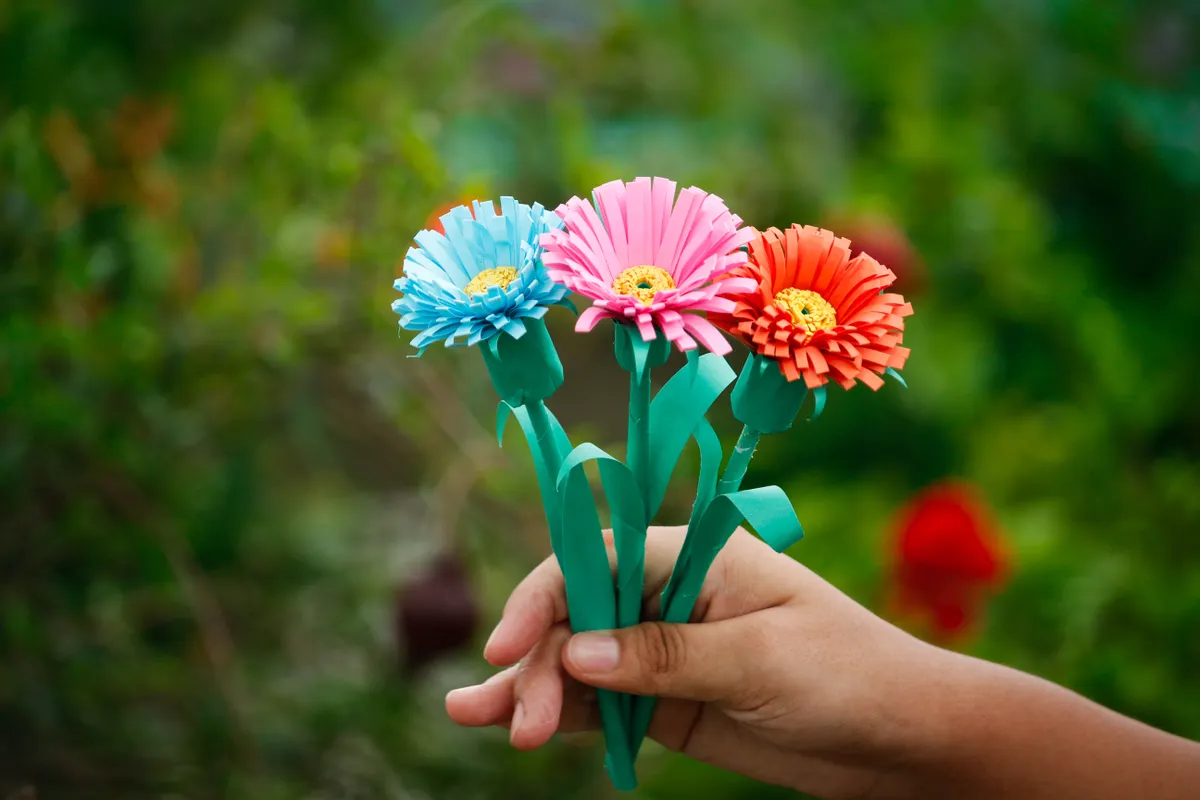
I once folded forty tulips in a single evening for a friend's wedding centerpiece because real flowers were out of the budget, and not one guest realized they were paper until they reached out to touch one. That's the quiet magic of origami flowers, they hold their shape for years, cost almost nothing beyond a stack of paper, and still fool people up close.
This guide walks through the most popular flower models worth folding, which ones suit true beginners, and what paper actually works best once you start experimenting.
This article is Part of Origami Project Ideas for Every Skill Level, so if you're building out a broader folding practice, flowers fit naturally alongside animals and boxes.
Why Origami Flowers Are Worth Learning
Flowers hold a strange middle position in origami. Some models are genuinely beginner-friendly, using nothing but basic folds, while others rank among the most complex traditional designs out there, involving dozens of precise creases before the shape even starts taking form.
That range is actually a strength. You can start with something simple and stay engaged for years as you work toward more advanced flower models, rather than outgrowing the category after a few weeks.
I've folded thousands of sheets over the years, and flowers remain one of the few categories where a slightly imperfect fold still often looks intentional, since real petals aren't perfectly symmetrical either. That forgiveness makes flowers a genuinely encouraging place to build skill.
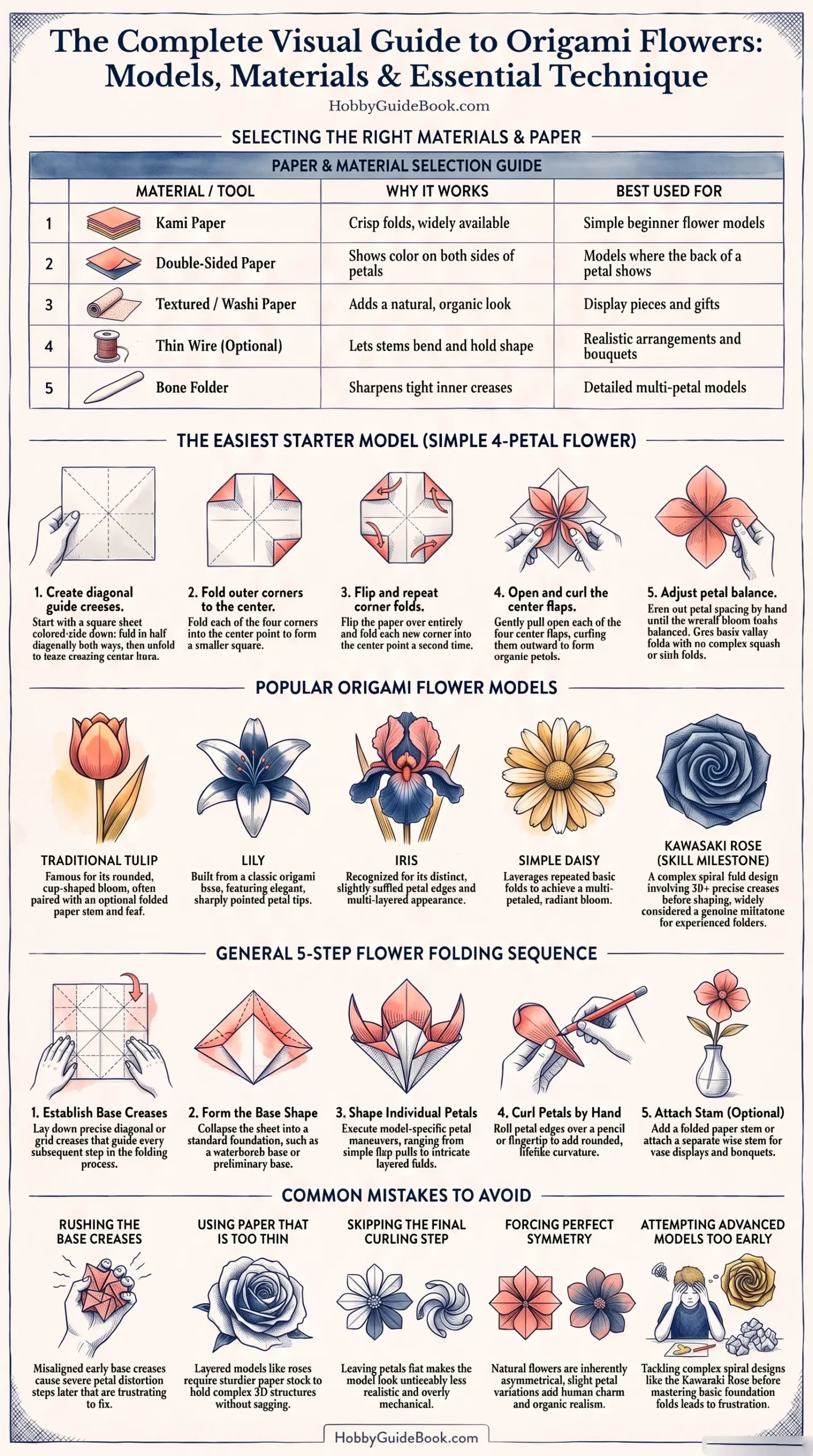
Photo Credit: Hobby Guidebook Editorial
What Materials Work Best for Flower Folding?
Flowers benefit from slightly different paper choices than boxes or animals, mostly because petal shaping often relies on paper holding a gentle curve rather than just a sharp crease.
|
Material |
Why It Works |
Best For |
|
Kami paper |
Crisp folds, widely available |
Simple beginner flower models |
|
Double-sided paper |
Shows color on both sides of petals |
Models where the back of a petal shows |
|
Textured or washi paper |
Adds a natural, organic look |
Display pieces, gifts |
|
Wire (optional) |
Lets stems bend and hold shape |
Realistic arrangements, bouquets |
|
Bone folder |
Sharpens tight inner creases |
Detailed multi-petal models |
Notice wire isn't strictly origami paper, but many flower folders add a thin wire stem afterward for a more realistic finished look, without it changing the folded flower itself.
What Paper Works Best for Origami Flowers?
This question comes up constantly, and the honest answer depends on which flower model you're folding.
For simple flowers, standard kami paper works fine. It folds crisply, holds creases well, and comes in enough colors to cover most flower designs without any special sourcing.
For flowers with visible undersides, like many tulips and lilies, double-sided paper prevents an awkward moment where white paper backing shows through on a petal that's supposed to be fully colored.
For flowers meant as keepsakes or gifts, slightly heavier paper, around 70 to 90 gsm, holds its shape longer than very thin sheets and resists sagging if displayed for weeks rather than days.
What Is the Easiest Origami Flower to Fold?
For genuine beginners, the simple four-petal flower stands out as the easiest starting point, even ahead of the classic tulip most people picture first.
Steps for folding a basic four-petal flower:
- Start with a square sheet, colored side down. Fold it in half diagonally both ways, then unfold, leaving two crossing creases.
- Fold each corner into the center point, creating a smaller square shape.
- Flip the paper over and repeat, folding each new corner into the center again.
- Gently pull open each of the four flaps from the center, curling them slightly outward to form petals.
- Adjust petal spacing evenly by hand until the shape looks balanced.
This model takes most beginners under ten minutes and relies entirely on basic valley folds, no tricky squash or sink folds required. It's a genuinely forgiving first flower.
What Are the Most Popular Origami Flower Models?
Beyond that simple starter flower, a handful of specific origami flower models show up constantly across tutorials and craft communities, each for good reason.
Widely folded flower designs:
- Traditional tulip, known for its rounded, cup-shaped bloom and optional folded stem and leaf
- Kawasaki rose, a more advanced spiral-fold design prized for its realistic layered petals
- Lily, built from a classic base with elegant, pointed petal tips
- Iris, featuring distinct, slightly ruffled petal edges
- Simple daisy, using repeated basic folds for a many-petaled look
The Kawasaki rose deserves a specific mention here, since it's often what experienced folders point to as a genuine skill milestone. It's not a beginner model by any stretch, involving twenty or more precise creases before shaping even begins, but it's widely considered one of the most rewarding flowers to finally complete.

Photo Credit: JESMINA A S
How Do You Fold Origami Flowers Step by Step?
While every flower model differs in its specific folds, most follow a similar general structure worth understanding before you start.
The general flower-folding process:
- Establish base creases first. Most flowers start from diagonal or grid creases that guide every later fold.
- Form the base shape. This is often a waterbomb base or preliminary base, standard starting points shared across many origami models.
- Shape individual petals. This step varies the most between models, ranging from simple flap pulls to detailed petal folds.
- Curl or shape petals by hand. Gently rolling petal edges over a pencil or your fingertip adds a more natural, rounded look.
- Add a stem if desired. Some models include a folded paper stem, while others work better with a separate wire stem attached after.
A pro tip worth remembering: work slowly through the base creases especially, since a soft or misaligned base crease causes petal shaping problems several steps later that are frustrating to fix retroactively.
Can You Make Origami Flowers From One Sheet of Paper?
Yes, and most traditional flower models are specifically designed this way. A classic tulip, simple daisy, and the basic four-petal flower covered earlier all use just one square sheet from start to finish, following true origami's no-cutting, no-gluing approach.
That said, some flower arrangements use multiple single-sheet flowers combined together afterward, like a Kawasaki rose paired with separately folded leaves, or several simple flowers arranged into a bouquet. Each individual piece still comes from one sheet, they're just assembled as a group rather than being one continuous fold.
Can Origami Flowers Be Folded Without Glue?
Yes, genuinely. Traditional origami relies entirely on folds, no cutting and no gluing involved, and the vast majority of popular flower models honor that fully.
Where glue sometimes sneaks in:
- Attaching a separate stem to a flower head for display purposes
- Securing loose petals on very advanced, layered rose designs
- Assembling multi-piece arrangements, like attaching folded leaves to a separate flower
None of this is required for a proper folded flower to hold together. If you're following traditional technique strictly, skipping glue entirely is absolutely achievable, and most experienced folders take pride in flowers that hold their shape through folding alone.
As folders often say, the paper never lies. It only shows you exactly where a fold went wrong.
With flowers specifically, that usually shows up as uneven petals rather than a structural failure, a flaw that often just adds character rather than ruining the piece.
Can Origami Flowers Be Used as Decorations or Gifts?
Absolutely, and this is genuinely one of the most rewarding parts of learning flower models. Unlike real flowers, folded paper versions last indefinitely without wilting, watering, or fading in the same way fresh blooms do.
Popular ways folded flowers get used:
- Gift toppers, replacing a bow on a wrapped present
- Table centerpieces, arranged in a small vase or bowl
- Bookmarks, using a flattened flower design tucked into pages
- Greeting card decorations, attached flat to the front of a handmade card
- Small bouquets, combining several single flowers with folded or wire stems
If you're specifically interested in gift-focused folding, the Origami Gift & Wrapping Ideas guide covers more ways to incorporate flowers and other models into presents and packaging.

Photo Credit: Internet
Common Mistakes When Folding Origami Flowers
A few habits trip up folders working through flower models for the first time.
- Rushing the base folds. Petal shaping depends heavily on a clean, accurate base, so slow down early rather than rushing to the visually exciting petal stage.
- Using paper that's too thin for the model. Some flowers, especially roses, need slightly sturdier paper to hold layered shaping.
- Skipping the curling step. Flat, uncurled petals look noticeably less realistic than ones gently shaped by hand afterward.
- Forcing symmetry. Slightly uneven petals often look more natural, real flowers aren't perfectly symmetrical either.
- Attempting advanced roses too early. The Kawasaki rose specifically trips up folders who skip simpler flower models first, since it assumes real comfort with base folds already.
If flowers are your first real origami category, the Beginner Origami Projects guide offers a solid foundation of basic folds worth practicing before tackling more advanced blooms.
Frequently Asked Questions
What is the easiest origami flower to fold? A simple four-petal flower is the easiest, using only basic valley folds without any tricky squash or sink folds involved.
What are the most popular origami flower models? The traditional tulip, Kawasaki rose, lily, iris, and simple daisy are among the most widely folded flower designs.
Can you make origami flowers from one sheet of paper? Yes, most traditional flower models use just one square sheet, following origami's standard no-cutting, no-gluing approach.
Can origami flowers be folded without glue? Yes, the vast majority of flower models hold together entirely through folding, with glue only sometimes used for separate stems.
What paper works best for origami flowers? Standard kami works for simple flowers, while double-sided or slightly heavier paper suits models with visible undersides or display use.
Can origami flowers be used as decorations or gifts? Yes, they work well as gift toppers, centerpieces, bookmarks, card decorations, and small bouquets that never wilt or fade.
Final Thoughts
Origami flowers offer something genuinely rare in this hobby, a category with real range from true beginner models to some of the most advanced folds out there. Start with something simple, let your petals be a little imperfect, and work toward the more advanced designs once the basics feel comfortable.
Ready to explore more folding ideas beyond flowers? Read the full origami guide to see the rest of what this craft has to offer.




Leave a Reply