
I folded the same paper crane nearly forty times over one month before my creases finally started landing exactly where I meant them to, and that repetition taught me more than any single tutorial ever could. If you're wondering how often to practice origami to actually get better instead of just staying stuck at "wobbly beginner," this origami practice routine breaks down exactly how much time, how many repeats, and what kind of sessions genuinely move your skill forward.
This guide covers realistic session lengths, how often to fold each week, and how long it typically takes before common folds start feeling automatic instead of effortful.
This article is Part of Getting Started with Origami, so if you're still working out the basics before building a full routine, that page covers the foundational steps worth starting with.
Why a Practice Routine Actually Matters in Origami
Origami rewards consistency far more than long, occasional sessions. I've found that folding for fifteen minutes several times a week builds real skill much faster than a single two-hour session once a month, simply because your fingers need repeated exposure to the same fold types before the motion feels natural.
A practice routine also protects you from a specific frustration every folder eventually hits, the mid-fold moment where paper suddenly stops cooperating. That moment almost always traces back to a rushed or unfamiliar fold, and regular practice is really the only thing that fixes it long term.
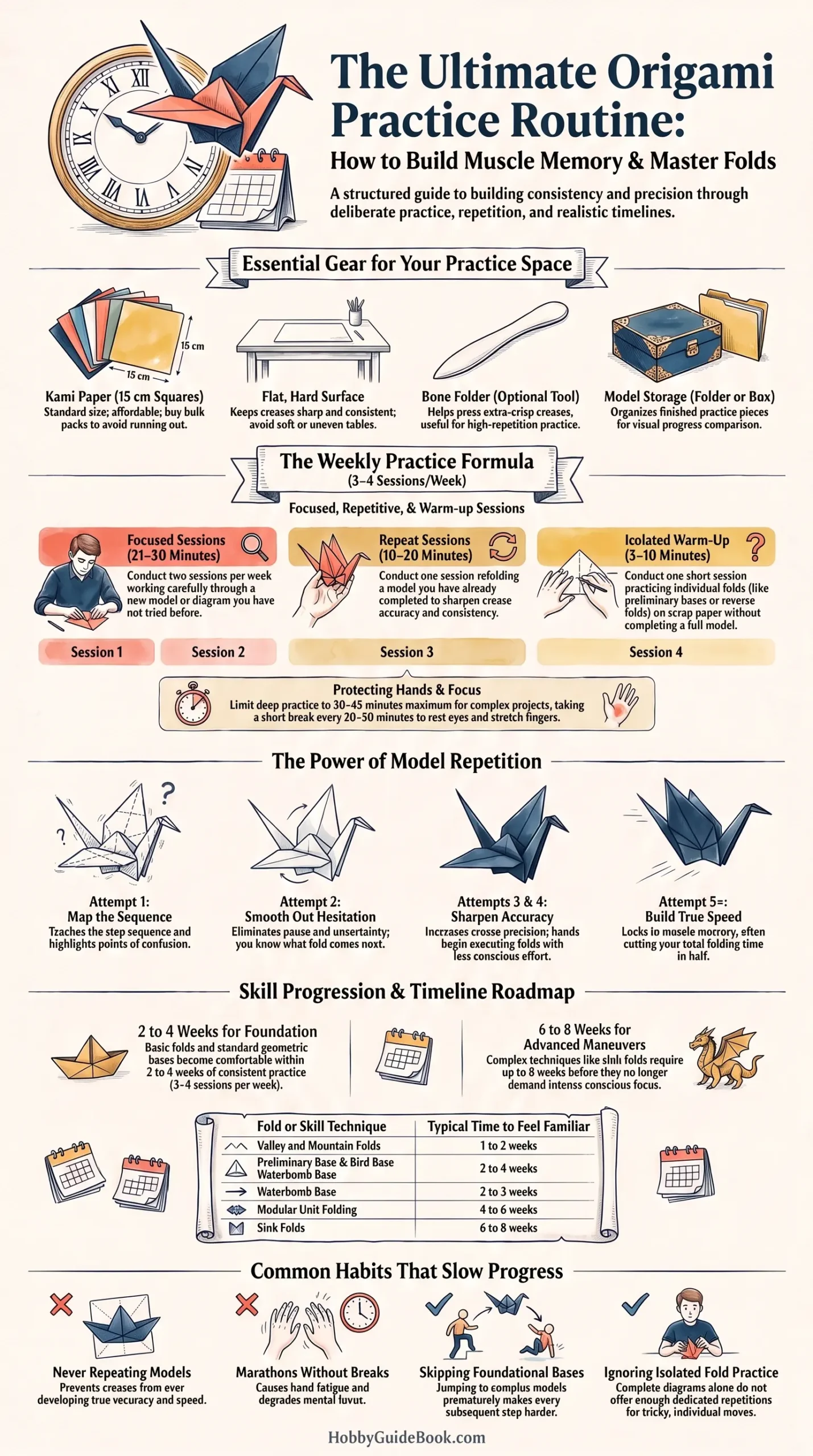
Photo Credit: Hobby Guidebook Editorial
What a good routine actually builds over time:
- Muscle memory, so your fingers know how to press a sharp crease without conscious thought
- Pattern recognition, so new diagrams start looking familiar instead of overwhelming
- Patience with mistakes, since repeated folding naturally teaches you to notice and correct errors calmly
- Faster diagram reading, since practiced folders recognize common sequences almost instantly
What You'll Need for a Practice Routine
You don't need much to build a solid habit, which is honestly part of why origami makes such a good regular practice. Here's what I'd actually recommend keeping on hand.
|
Item |
Why It Matters |
|
Kami paper, 15 cm squares |
Standard size, affordable enough to fold through in real quantity |
|
A flat, hard surface |
Keeps creases sharp and consistent, unlike soft or uneven tables |
|
A bone folder (optional) |
Helps press extra-crisp creases, especially useful for repeated practice folds |
|
A simple diagram book or app |
Gives you a steady supply of models to rotate through as skill grows |
|
A folder or box for finished models |
Keeps practice pieces organized so you can compare progress over time |
I'd suggest buying kami paper in bulk packs rather than single sheets once you commit to regular practice. Nothing kills momentum faster than running out of paper mid-session.
How Often Should Beginners Practice Origami?
For beginners, three to four sessions a week is genuinely the sweet spot, enough repetition to build real muscle memory without burning out on a hobby that's supposed to feel relaxing. Daily practice works too if you enjoy it, but it's not required to see steady improvement.
A realistic weekly breakdown for beginners:
- Two focused sessions, working through a new model or diagram you haven't tried before
- One repeat session, refolding a model you've already completed to sharpen consistency
- One short warm-up session, practicing individual folds without finishing a full model
This kind of rhythm mirrors how most physical skills get built, a mix of new challenge and repeated reinforcement. Skipping the repeat sessions is honestly one of the more common mistakes I see beginners make, since they're eager to move on to the next model before the current one has actually settled into memory.
How Long Should an Origami Practice Session Be?
Fifteen to thirty minutes is plenty for most practice sessions, especially early on. Origami demands close, sustained attention, and pushing much past thirty minutes without a break tends to hurt focus more than it helps.
Session length guidance by goal:
- Warm-up sessions, five to ten minutes, just enough to practice a handful of individual folds
- New model sessions, twenty to thirty minutes, giving enough time to work through a full diagram carefully
- Repeat sessions, ten to twenty minutes, since familiar models fold faster with each repetition
- Deep practice sessions, thirty to forty-five minutes, reserved for more complex or modular projects
A quick pro tip: set a rough time limit before you start folding a new model, especially if you tend to get absorbed and lose track of time. It's not about rushing, it's about protecting your hands and eyes from strain during long, close-focus sessions.
A quick safety note worth mentioning: if you're folding for extended stretches, take a short break every twenty to thirty minutes to stretch your fingers and rest your eyes. Repetitive fine motor work and close focus can quietly build tension if a session runs too long without pausing.
Should Beginners Repeat the Same Model Several Times?
Yes, genuinely, and this might be the single most underused technique in early origami practice. Repeating a model isn't boring busywork, it's how a shaky first attempt turns into a clean, confident fold by the fourth or fifth try.
Why repetition works so well:
- First attempt teaches you the sequence and where you tend to get confused
- Second attempt smooths out hesitation, since you already know roughly what's coming next
- Third and fourth attempts sharpen crease accuracy, since your hands start moving with less conscious effort
- Fifth attempt onward builds real speed, often cutting folding time in half compared to your first try
As folders often say, the paper never lies. It only shows you exactly where a fold went wrong.
Repetition is really how you learn to listen to that honesty. The same mistake showing up across several attempts tells you exactly which fold needs closer attention, something a single attempt could never reveal.
For a deeper look at how base folds specifically benefit from repeated practice, the Basic Origami Folds Every Beginner Should Know guide breaks down the core folds worth mastering through repetition first.
Photo Credit: Miro Vrlik
How Can You Practice Folds Without Making a Complete Model?
Isolated fold practice is a genuinely useful habit, especially for warm-up sessions or moments when you don't have time for a full model. Instead of following a complete diagram, you simply practice one fold type repeatedly on scrap paper.
A few ways to practice folds in isolation:
- Repeat a single valley or mountain fold across a full sheet, focusing purely on crease sharpness
- Practice a preliminary base from scratch several times in a row, since it appears in countless models
- Work on reverse folds using scrap paper, since this technique trips up beginners more than almost any other
- Fold a waterbomb base repeatedly, building comfort with a shape used across many intermediate models
This kind of practice feels less satisfying than finishing a full model, admittedly, but it's incredibly efficient. You're isolating exactly the skill that needs work instead of folding through an entire diagram just to practice one tricky section near the end.
How Long Does It Take for Common Folds to Become Familiar?
Most beginners start feeling real comfort with basic folds, valley folds, mountain folds, and simple bases, somewhere between two and four weeks of regular practice. More complex techniques, like reverse folds or sink folds, often take six to eight weeks before they stop requiring conscious thought.
A rough timeline based on consistent practice:
|
Fold or Skill |
Typical Time to Feel Familiar |
|
Valley and mountain folds |
1 to 2 weeks |
|
Preliminary and bird base |
2 to 4 weeks |
|
Waterbomb base |
2 to 3 weeks |
|
Reverse folds |
4 to 6 weeks |
|
Sink folds |
6 to 8 weeks |
|
Modular unit folding |
4 to 6 weeks |
These timelines assume three to four practice sessions a week, not daily folding. Progress naturally moves faster with more frequent practice, but there's genuinely no rush here, origami rewards patience far more than speed.

Photo Credit: Internet
For a broader look at how these individual fold timelines add up into overall skill progression, the How Long Does It Take to Learn Origami? guide covers realistic expectations across beginner, intermediate, and advanced stages.
Common Mistakes That Slow Down Practice Progress
A few habits quietly undercut progress even among folders practicing regularly.
- Only folding new models, never repeating old ones. Repetition is where real crease accuracy actually develops.
- Practicing for too long without breaks. Long, uninterrupted sessions hurt focus and physical comfort over time.
- Jumping to complex models too early. Skipping foundational folds makes every later model harder than it needs to be.
- Skipping isolated fold practice. Full models alone don't always give tricky individual folds enough dedicated repetition.
Frequently Asked Questions
How often should beginners practice origami? Three to four sessions a week is ideal, balancing new models with repeat practice to build steady, lasting skill.
How long should an origami practice session be? Fifteen to thirty minutes works well for most sessions, with warm-ups shorter and complex models running slightly longer.
Should beginners repeat the same model several times? Yes, repeating a model several times sharpens crease accuracy and builds genuine speed and confidence with that sequence.
How can you practice folds without making a complete model? Practice individual fold types, like reverse folds or bases, repeatedly on scrap paper without following a full diagram.
How long does it take for common folds to become familiar? Basic folds usually feel familiar within two to four weeks, while advanced folds like sink folds often take six to eight weeks.
Final Thoughts
Building a steady origami practice schedule matters far more than trying to master everything in one long session. Fold a little several times a week, repeat models you've already learned, and give yourself real time before expecting advanced folds to feel effortless.
Ready to put a routine into practice? Read the full origami guide for more techniques and models worth folding next.





Leave a Reply