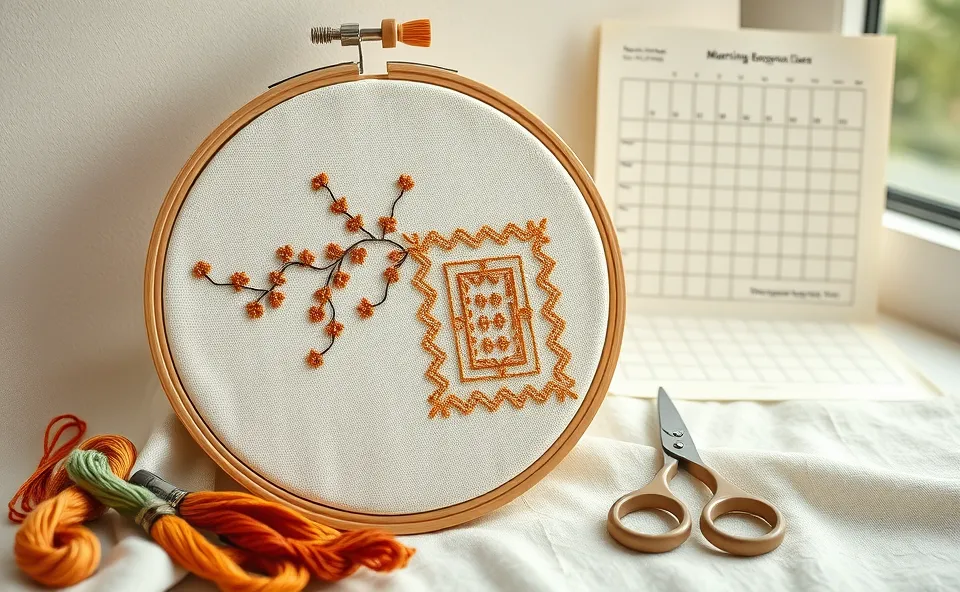
Pick up any embroidery magazine or cross-stitch chart and you'll run into words like "evenweave," "crewel," or "counted thread" within the first page. If you're new to needlework, that alone can feel like a wall. This guide covers the embroidery and cross-stitch basics you need to make sense of it all: a quick look at history, the main types you'll come across, and the terms that show up again and again.
Think of this as your starting map. Once you know where things sit, the rest of this site gets a lot easier to navigate. For the full picture of both crafts, you can always go back to the complete embroidery & cross-stitch guide.
What Is Embroidery?
Embroidery is the broad craft of decorating fabric with a needle and thread. It covers a huge range of stitches, styles, and traditions, from simple outlines to dense, textured pictures.
There's no single "correct" way to do it. Some embroiderers work freehand from a traced design. Others follow a printed chart. Both count as embroidery.
For a full breakdown of what the craft actually involves, including the tools and stitches that define it, see What Is Embroidery?
What Is Cross-Stitch?
Cross-stitch is one specific technique inside the embroidery family. It uses a small X-shaped stitch, repeated across a counted grid, to build up a picture square by square.
Unlike freehand embroidery, cross-stitch is worked from a chart. You're following a set pattern rather than deciding stitch placement yourself, which is part of why many people find it a comfortable place to start.
For a closer look at how cross-stitch works and what makes it different from other counted techniques, see What Is Cross-Stitch?
History
Nobody can point to one person or one moment and say "that's where embroidery started." Needlework with thread and a needle developed independently in many parts of the world, often thousands of years apart, as people found practical and decorative uses for the same basic idea: stitching thread through fabric.
Different regions and time periods developed their own stitches, tools, and motifs. What counted as fine embroidery in one culture might look completely different from another, and both would be equally valid. That variety is part of what makes embroidery history so hard to summarize in a single timeline, and honestly, a little suspicious when a source tries to.
Cross-stitch has its own thread running through this history, closely tied to sampler-making. A sampler was a piece of fabric where a stitcher, often a young learner, worked rows of stitches and letters to practice technique and keep a personal record of patterns. Sampler styles shifted over time and varied by region, so again, there's no single fixed version of "the" cross-stitch sampler.
What's clear is that both crafts have stuck around because they're useful, portable, and satisfying to do. That's still true today.
Types
Embroidery isn't one thing. It's a family of related techniques, and knowing the main branches helps you understand where cross-stitch and other styles fit.
Here are the main types you'll run into:
- Freestyle (surface) embroidery. Stitches are placed by hand, following a traced or printed design rather than a grid. This is the most flexible type.
- Counted-thread embroidery. Stitches are placed by counting fabric threads or grid squares. Cross-stitch is the best-known example.
- Canvas work (needlepoint). Stitches are worked on a stiff, open-weave canvas, usually covering the entire background.
- Crewel embroidery. A style that uses wool thread, often on linen, known for textured, raised stitching.
- Machine embroidery. Designs are stitched using an embroidery machine rather than by hand, often from a digitized pattern file.
- Appliqué and mixed-media embroidery. Fabric pieces are attached to a base fabric and combined with stitching for texture and detail.
Here's a quick side-by-side of the three most common starting points.
|
Type |
Worked By |
Follows a Chart? |
|
Freestyle embroidery |
Hand |
No, usually a traced design |
|
Cross-stitch |
Hand |
Yes, a counted chart |
|
Machine embroidery |
Machine |
Follows a digitized file |
If you're brand new, freestyle embroidery and cross-stitch are the two most beginner-friendly starting points, and most people naturally gravitate toward one or the other first.
Terminology
A handful of terms come up constantly once you start reading patterns, tutorials, or supply lists. Here's a quick reference.
Freestyle (surface) embroideryEmbroidery worked freehand rather than from a counted grid.
Counted-thread embroideryAny technique, including cross-stitch, worked by counting fabric threads or grid squares.
Chart (pattern)A grid-based guide showing where stitches go and which thread colors to use.
Embroidery hoopA frame that holds fabric taut while you stitch.
Embroidery floss (stranded cotton)Thread made of six thin strands twisted together, often separated for different thicknesses.
EvenweaveFabric woven so the threads per inch are equal in both directions, giving a consistent countable grid.
Fabric countThe number of stitches per inch a piece of even-weave fabric supports.
SamplerA stitched piece, historically used to practice technique or record patterns.
Learning the names before the stitches makes everything after this so much easier. Once "evenweave" and "fabric count" click, reading any pattern gets a lot less intimidating.
A Few Common Mix-Ups
New stitchers often trip over the same handful of terminology mix-ups. Knowing these ahead of time will save you some confusion later.
- Assuming cross-stitch and embroidery are separate crafts. Cross-stitch is a type of embroidery, not something separate from it.
- Confusing needlepoint with cross-stitch. Both use counted grids, but needlepoint is worked on stiff canvas and usually covers the entire background, while cross-stitch is worked on softer even-weave fabric like Aida cloth.
- Mixing up "hoop" and "frame." A hoop is round or oval and adjustable. A frame is usually rectangular and often fixed in size. Both hold fabric taut, but they're not interchangeable terms.
I've spent enough time untangling knotted floss to say this with confidence: most early frustration in this hobby comes from not knowing the vocabulary, not from lacking skill. Once the terms make sense, the actual stitching gets a lot less stressful.
Embroidery and Cross-Stitch Basics: Quick Recap
Here's the short version of everything above. Embroidery is the broad craft. Cross-stitch is one counted technique within it. Both have long, varied histories with no single origin point. And a small set of terms, like chart, hoop, evenweave, and fabric count, will carry you through almost any beginner pattern or tutorial.
Common Questions
Who invented embroidery?
There's no single known inventor. Embroidery developed independently across many cultures and regions over a very long span of time, as people found their own ways to stitch decoration and pattern into fabric.
What are the main types of embroidery?
The main types are freestyle (surface) embroidery, counted-thread embroidery (which includes cross-stitch), canvas work or needlepoint, crewel embroidery, machine embroidery, and appliqué or mixed-media embroidery. Each uses a different approach to placing stitches on fabric.
Where to Go Next
Once the basics feel solid, the rest of this site builds on exactly what you've learned here. If you want the full overview of both crafts, including materials, tools, and getting started, read the full embroidery & cross-stitch guide. That's the best next stop from here.
Leave a Reply