
I still remember staring at my first diagram, completely lost, because nobody had explained what a "preliminary base" actually was before asking me to fold one. This origami glossary A-Z fixes that exact problem, giving you plain definitions for every term you'll run into, from basic folds to modular vocabulary, so diagrams finally make sense the first time through.
This page is Part of Origami Glossary & Reference, built specifically for folders who keep hitting unfamiliar words mid-diagram and need a fast, reliable answer without digging through a dozen tutorials.
Why an Origami Glossary Actually Matters
Origami has its own working vocabulary, and most diagrams assume you already know it. Terms like valley fold, crease pattern, and module show up constantly, but rarely get explained inside the diagram itself.
I've found that folders who learn this vocabulary early progress noticeably faster than those who just guess their way through symbols. Once you know what a term means, you stop second guessing every diagram and start actually reading it with confidence.
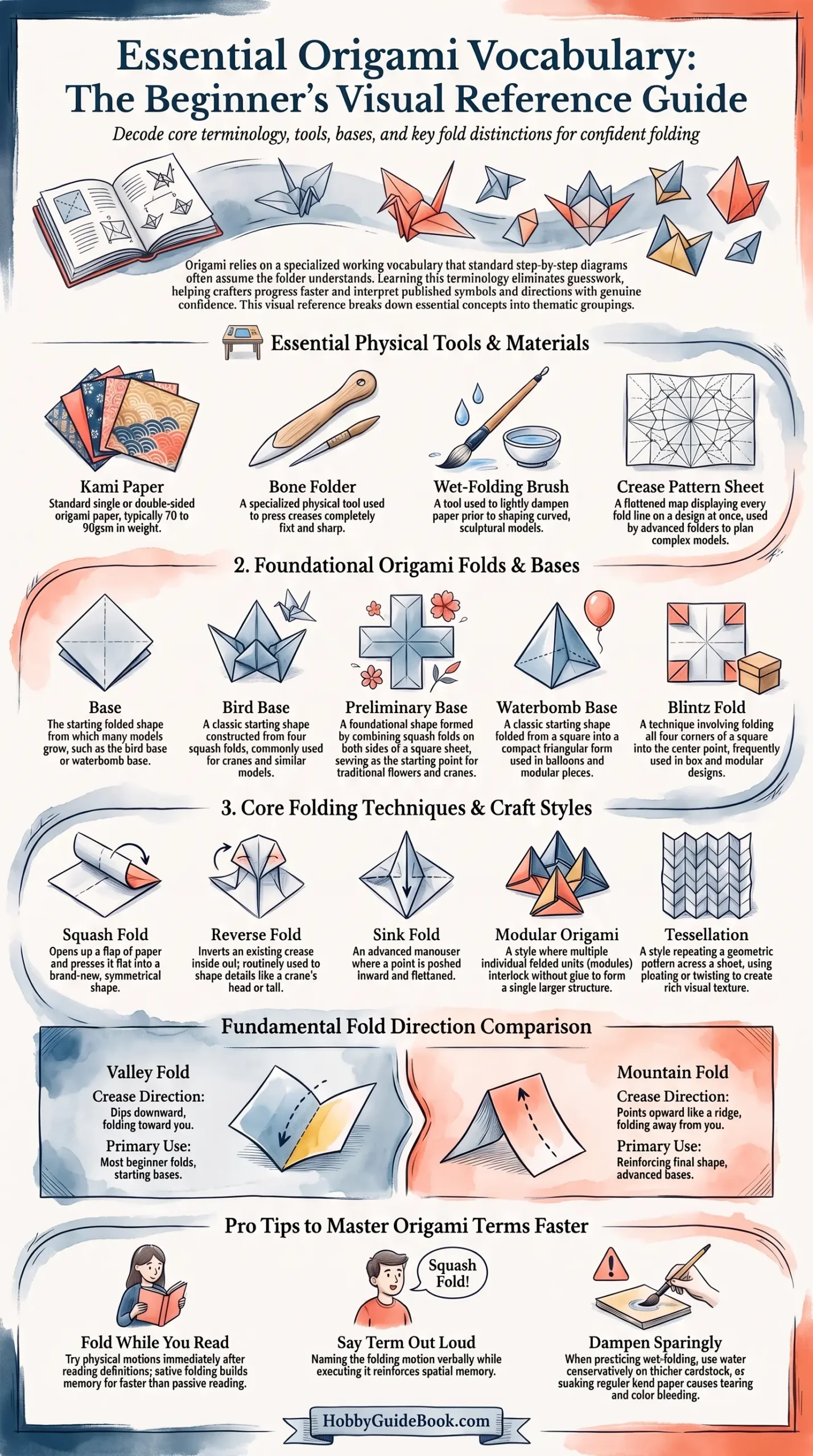
Photo Credit: Hobby Guidebook Editorial
Common Items You'll See Referenced in This Glossary
A few physical tools and materials come up repeatedly across these definitions, so it helps to know them upfront.
|
Item |
What It's Used For |
|
Kami paper |
Standard single or double sided origami paper, usually 70 to 90gsm |
|
Bone folder |
Tool used to press creases flat and sharp |
|
Crease pattern sheet |
A printed map showing every fold line on a flattened design |
|
Diagram book |
Step-by-step visual instructions using standard fold symbols |
|
Wet-folding brush |
Used to lightly dampen paper before shaping curved models |
How to Use This Glossary
Getting the most out of an origami dictionary style reference is easier with a simple approach.
- Scan the letter group that matches the term you're stuck on.
- Read the definition slowly, then look back at your diagram to see the term in context.
- Try the fold immediately after reading, since seeing the motion cements the definition far better than reading alone.
- Bookmark terms you forget often, since a handful of words tend to repeat across nearly every model type.
Origami Terms A to F
These first few terms cover foundational vocabulary you'll see in almost every beginner diagram.
- Base – the starting folded shape many models grow from, such as the bird base or waterbomb base.
- Bird Base – a classic starting shape used for cranes and similar models, built from four squash folds.
- Blintz Fold – folding all four corners of a square into the center point, often the first step in box and modular designs.
- Crease Pattern – a flattened map showing every fold line in a design at once, commonly used by advanced folders to plan complex models before making a single fold.
- Diagram – the picture-based instructions showing exact fold lines and directions using standard arrows and symbols.
- Fold – a single crease made by pressing paper along one line, the most basic building block in the craft.
Crease patterns and diagrams work hand in hand, and understanding the difference between them genuinely changes how you approach a new model. If diagram symbols specifically still feel confusing, Origami Symbols & Diagram Legend breaks down every standard arrow and line used across published instructions.
Origami Terms G to M
This middle stretch covers paper types and the vocabulary specific to modular work.
- Kami – standard origami paper, typically colored on one side and white on the other, usually 70 to 90gsm in weight.
- Kirigami – a related paper craft that allows cutting, unlike traditional origami which avoids cuts entirely.
- Mountain Fold – a fold where the crease points upward like a ridge, with the paper folding away from you.
- Module – one single folded unit used inside a modular design, several of which lock together without any glue.
- Modular Origami – the style where multiple identical or paired units interlock into one larger finished shape.
Modular vocabulary trips up a lot of beginners because it borrows terms from traditional folding but applies them slightly differently. A single module is not the same as a full model, since a model might require dozens of modules locked together before it's finished.
A folding instructor I once heard speak at a paper arts workshop described modular vocabulary as its own smaller language inside origami, since terms like unit, lock, and pocket rarely apply outside that specific style. That framing helped me stop confusing modular terms with traditional single-sheet vocabulary early on.
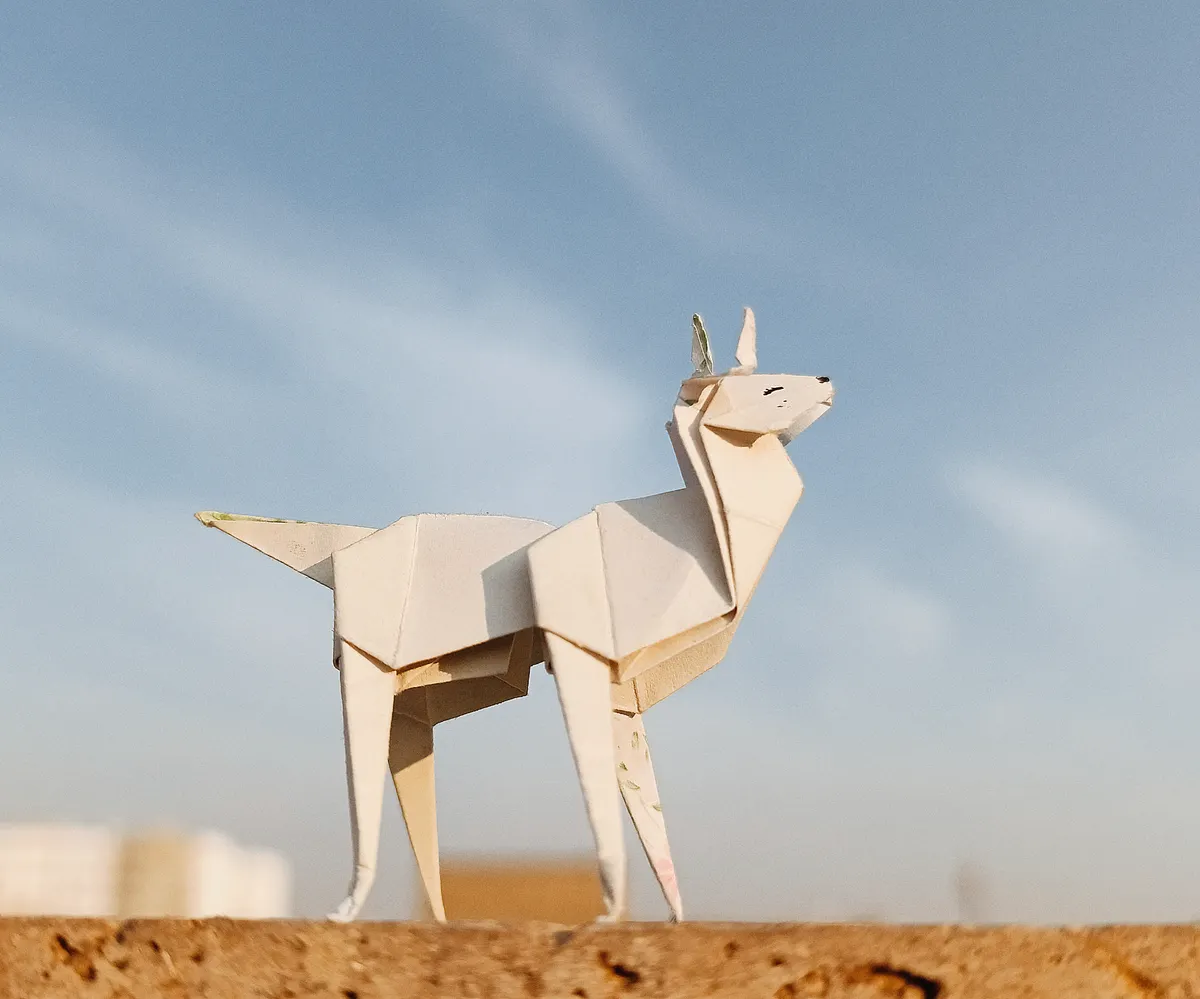
Photo Credit: bahar 𓆰
Origami Terms N to S
These terms cover the core folding techniques that show up across nearly every skill level.
- Origami – the general term for the craft of folding paper into shapes using only hand folds, without cutting or gluing.
- Preliminary Base – a foundational shape formed by combining squash folds on both sides of a square, used as the starting point for many traditional models including cranes and flowers.
- Reverse Fold – a technique where an existing crease gets folded inside out, commonly used to shape a crane's head or tail.
- Sink Fold – a more advanced technique where a point is pushed inward and flattened, common in intermediate and advanced models.
- Squash Fold – a fold that opens a flap and presses it flat into a new, symmetrical shape.
Learning these techniques by name makes intermediate diagrams far easier to follow, since instructions often name the fold rather than fully re-explaining it each time. For a deeper breakdown of how these terms connect to actual hand motions step by step, Origami Terminology covers the physical technique behind each name in more detail.
Origami Terms T to Z
The final group covers the vocabulary tied to more advanced and sculptural styles.
- Tessellation – an origami style that repeats one geometric pattern across the full sheet, often pleated or twisted to build texture.
- Valley Fold – a fold where the crease dips downward like a valley, with the paper folding toward you.
- Waterbomb Base – another classic starting shape, folded from a square into a compact triangular form used in balloons and select modular pieces.
- Wet-folding – an advanced technique using lightly dampened paper to create smooth curves instead of sharp creases, often used for sculptural animal models.
Pro Tips for Learning Origami Vocabulary Faster
A few habits make new terms stick far quicker than passive reading alone.
- Fold while you read, rather than reading the whole glossary in one sitting without practicing.
- Say the term out loud as you fold it, since naming the motion while doing it builds memory faster.
- Keep a small paper handy while wet-folding practice models, and only use water sparingly on thicker cardstock, since soaking regular kami paper too much can tear it or cause colors to bleed.
- Revisit confusing terms after a week, since spaced repetition works better than trying to memorize everything at once.

Photo Credit: Raymond Petrik
Comparing Valley and Mountain Folds
|
Fold Type |
Crease Direction |
Common Use |
|
Valley Fold |
Dips downward, toward you |
Most beginner folds, bases |
|
Mountain Fold |
Points upward, away from you |
Reinforcing shape, advanced bases |
Frequently Asked Questions
Where can you find a full list of origami terms? This glossary covers the core vocabulary alphabetically, and pairing it with a diagram symbol guide gives you a fairly complete reference for most models.
What does preliminary base mean? It's a foundational folded shape made by combining squash folds on both sides of a square, used to start many traditional models like cranes and flowers.
What is a crease pattern in origami? It's a flattened map showing every fold line in a design at once, often used by advanced folders to plan a model before folding it.
What is the difference between a module and a model? A module is one single folded unit, while a model is the completed shape, which in modular origami often requires many modules locked together.
What do valley and mountain folds mean? A valley fold creases toward you, while a mountain fold creases away from you, and diagrams use different dashed lines to show each one.
What are common origami bases called? The most common starting shapes are the bird base, waterbomb base, and preliminary base, each used as the foundation for different model families.
Final Thoughts
Knowing these terms turns confusing diagrams into something you can actually follow with confidence. Keep this origami terms list handy, and revisit it whenever a new word slows you down mid-fold.
If you're ready to put this vocabulary into practice, Read the full origami guide for techniques, paper choices, and projects across every skill level.




Leave a Reply